


Buy DFI.Money (YFII) with USD, EUR and Other Fiat Currencies
The decentralized finance (DeFi) landscape continues to evolve in 2026, offering sophisticated tools for yield optimization and asset management. Among the enduring projects from the first DeFi summer is DFI.Money (YFII), a community-driven fork of Yearn.Finance that maintains a fixed supply and automated yield strategies. For investors looking to gain exposure to this historical DeFi asset, the process begins with a fundamental step: purchasing YFII securely with traditional currency.
This guide provides a comprehensive walkthrough for buying DFI.Money using USD, EUR, and other fiat currencies, highlighting the best tools and practices for a seamless experience.
What is DFI.Money (YFII)?
DFI.Money, known by its ticker YFII, is a decentralized finance protocol and yield aggregator that emerged from a pivotal moment in crypto history. In July 2020, a proposal called YIP-8, which aimed to extend the distribution of YFI tokens through a weekly “halving” model, was rejected by the Yearn.Finance community. In response, a group of community members hard-forked the codebase to create DFI.Money, implementing the rejected proposal and emphasizing community ownership. This makes YFII one of the earliest examples of a community-led fork in DeFi.
The core functionality of DFI.Money revolves around The Vault, an automated yield aggregator. Users deposit funds into these vaults, and the protocol automatically rotates those assets across various DeFi protocols like Curve and Balancer to seek the highest annual percentage returns (APR) . YFII is the native governance token used for voting on protocol upgrades and future strategies.
From a tokenomics perspective, YFII has a strictly fixed maximum supply of approximately 40,000 tokens, all of which were distributed to liquidity providers through mining, with the minting keys subsequently burned. As of early 2026, the circulating supply hovers around 39,700 tokens, with a market capitalization of approximately $1.7 million . The token’s price history reflects the volatility of the DeFi sector. After reaching an all-time high near $9,251 in September 2020, YFII has since stabilized in a lower range. Data from early 2026 shows the token trading between $38 and $48, with a brief spike to $145 in January 2026. Notably, a significant portion of the supply is distributed among holders, with the top five addresses controlling around 33% and the remaining 66% spread across a broader community, indicating a relatively decentralized ownership structure. As analysts at INDODAX noted in mid-2025, YFII operates within a “critical support zone,” highlighting its status as a niche but historically significant DeFi asset.
Where Can I Buy DFI.money (YFII) With Cash: 10 Best Crypto Wallets
To acquire YFII with fiat currency, you need a secure and versatile crypto wallet that bridges the gap between traditional payment methods and the blockchain. Given that YFII is an ERC-20 token, compatibility with the Ethereum network is essential. Here are 10 of the best wallets to consider for buying, storing, and managing your DFI.Money tokens.
1. Walletverse
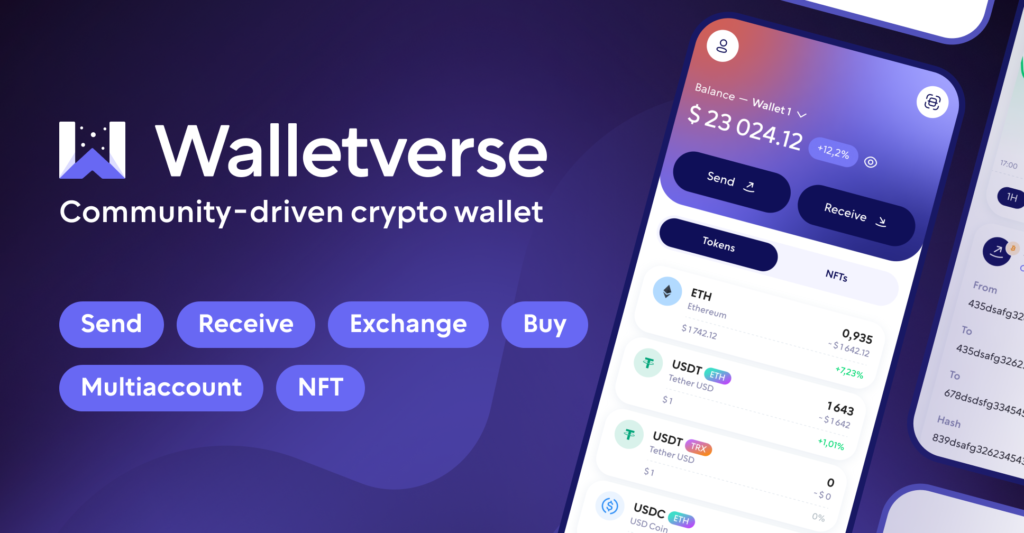
Walletverse is the ultimate mobile crypto wallet designed to simplify DeFi and Web3 access for both beginners and advanced users. As a multi-currency, non-custodial wallet, it supports over 700 cryptocurrencies, including ERC-20 tokens like YFII. You can buy YFII directly using familiar payment methods like Apple Pay, Google Pay, or credit/debit cards, with support for a wide range of fiat currencies including USD, EUR, GBP, CAD, AUD, JPY, INR, and KZT. The app features passcode and biometric authentication for top-tier security and is community-driven with a 4.8 rating on Google Play and a perfect 5.0 on the App Store. A standout feature is its proprietary GasFree USDT Transaction System, which allows users to transfer USDT on the TRON blockchain without needing TRX for fees—lowering the barrier for new users. It also supports staking for assets like Solana, ETH, and TRX.
- Pros: GasFree USDT transfers, support for 700+ coins including all ERC-20 tokens, excellent mobile ratings, multiple fiat on-ramps, AML/KYC compliant with a non-custodial structure.
- Cons: Currently available as a mobile-only application.



2. MetaMask

MetaMask is the leading Ethereum Virtual Machine (EVM) wallet, available as a browser extension and mobile app. It is the standard for interacting with DeFi protocols like DFI.Money and its vaults.
- Pros: Unmatched compatibility with DeFi dApps and Ethereum-based tokens, full user control over private keys.
- Cons: Primarily focused on EVM chains; integrated fiat purchases require using third-party services within the “Buy” feature.
3. Trust Wallet

Acquired by Binance, Trust Wallet is a popular mobile option that supports a massive range of assets, including all ERC-20 tokens like YFII. It includes a built-in Web3 browser for dApp interaction.
- Pros: Supports multiple blockchains, user-friendly interface, supports buying crypto with fiat via third-party partners.
- Cons: As a hot wallet, security relies entirely on the user’s device safety.
4. Ledger Nano X

For long-term holders of DeFi assets, the Ledger Nano X hardware wallet provides bank-grade security by keeping private keys offline. It connects via Bluetooth to the Ledger Live app, which now supports some fiat purchase options.
- Pros: Highest level of security for cold storage, supports a vast number of cryptocurrencies including all ERC-20 tokens.
- Cons: Requires a physical device purchase; less convenient for frequent, small transactions.
5. Rainbow Wallet

Rainbow is a mobile-first wallet designed specifically for Ethereum and Layer 2 networks. Its intuitive and visually appealing interface makes it a favorite for managing ERC-20 tokens like YFII.
- Pros: Beautiful and easy-to-use interface, optimized for Ethereum and L2s, supports buying crypto with card or Apple Pay.
- Cons: Primarily focused on the Ethereum ecosystem.
6. Crypto.com DeFi Wallet

This non-custodial wallet integrates seamlessly with the Crypto.com exchange ecosystem. It gives users full control over their private keys while providing easy access to fiat on-ramps and DeFi protocols.
- Pros: Strong integration with the Crypto.com platform, supports 30+ blockchains, allows direct fiat purchases.
- Cons: The app interface can feel feature-dense for absolute beginners.
7. Exodus Wallet

Exodus is a multi-platform desktop and mobile wallet known for its elegant design and ease of use. It supports a wide array of assets and includes a built-in exchange feature for swapping between cryptos.
- Pros: Intuitive user interface, built-in exchange, supports Trezor hardware wallet integration.
- Cons: Not fully open-source; built-in exchange fees can be slightly higher than some alternatives.
8. Guarda Wallet

Guarda is a versatile, non-custodial wallet available on web, desktop, and mobile. It supports over 50 blockchains and offers multiple built-in fiat gateways for buying crypto directly with a card or bank transfer.
- Pros: Multi-platform availability, no registration required for basic functions, strong support for staking and exchanges.
- Cons: The web version requires entering a seed phrase, which poses a risk if used on a shared or compromised computer.
9. SafePal

Backed by Binance, SafePal offers both software and hardware wallet solutions. The mobile app is particularly strong, featuring a built-in exchange and direct fiat purchase options, making it easy to acquire YFII.
- Pros: Affordable hardware wallet option, feature-rich software app, supports a wide range of blockchains.
- Cons: The ecosystem is newer compared to more established brands like Ledger.
10. TokenPocket

A leading multi-chain wallet, especially popular in Asian markets, TokenPocket supports a vast number of public chains. It has robust dApp connectivity, making it easy to interact with the DeFi protocols where YFII operates.
- Pros: Excellent multi-chain support, integrated dApp browser, supports fiat purchases.
- Cons: The interface is feature-rich and can be less intuitive for users accustomed to minimalist designs.
Buy YFII with Apple Pay
Apple Pay provides a seamless and secure way to purchase digital assets by combining convenience with biometric authentication. Using Apple Pay to buy YFII eliminates the need to manually enter card details for every transaction, as the payment is authenticated with Face ID or Touch ID. In a modern wallet like Walletverse, you simply select YFII, choose Apple Pay as your funding source, and the equivalent value in your chosen fiat currency (like USD or EUR) is instantly converted into YFII tokens. This method is favored for its speed and the added layer of security it provides for your financial data.
Buy YFII with Google Pay
Google Pay offers Android users a streamlined and secure contactless payment solution, acting as a bridge between your bank account and the crypto world. When you opt to buy DFI.Money using Google Pay within apps like Walletverse or other integrated platforms, you are leveraging Google’s tokenized payment system. This means your actual card numbers are not shared with the merchant, reducing the risk of fraud. The process is straightforward: select Google Pay, confirm the transaction on your device, and the YFII tokens will be credited directly to your self-custody wallet, ready for interaction with DeFi vaults or long-term storage.
How to Buy DFI.money(YFII) with fiat?
Buying YFII with regular money is simple through Walletverse. Just follow these steps.
- Download Walletverse from Google Play Store or Apple App Store.
- Create a new wallet and securely store your recovery phrase offline. Enable passcode and biometric login.
- Tap “Buy Crypto” on the main screen.
- Search for “YFII” and select YFII.
- Choose your currency like USD or EUR and enter the amount you want to spend.
- Pick Apple Pay, Google Pay, or your credit card as the payment method.
- Review the details including fees and the exchange rate.
- Confirm with your fingerprint or face scan. Your YFII appears in your wallet instantly.
DFI.Money (YFII) holds a unique place in DeFi history as a community-driven fork with a fixed supply and automated yield strategies. While it operates as a smaller-cap asset today, its role in the evolution of yield aggregators makes it a point of interest for dedicated DeFi participants. The path to owning YFII is clear and secure with modern self-custody wallets. By using a solution like Walletverse, you can seamlessly convert your fiat currency into YFII while maintaining absolute control over your private keys and benefiting from innovative features like GasFree USDT transactions.
Data current as of March 2026.
FAQ
Most frequent questions and answers
As a niche DeFi governance token with a fixed supply, YFII’s value is tied to the adoption of its vaults and the overall health of the DeFi sector. It carries higher volatility and lower liquidity compared to major cryptocurrencies.
You can buy YFII with USD using a secure mobile wallet like Walletverse. Simply download the app, complete KYC verification, select “Buy,” choose YFII, and pay with Apple Pay, Google Pay, or a credit/debit card.
You need a wallet that supports the Ethereum network for ERC-20 tokens. Walletverse is an excellent choice as it is non-custodial, supports 700+ cryptocurrencies, and offers built-in fiat purchasing for YFII.
YFII tokens can be purchased on decentralized exchanges or through fiat on-ramps in multi-currency wallets. For a direct, all-in-one experience, you can use a wallet like Walletverse to buy YFII instantly with your bank card.
The cheapest method involves comparing fees. Using a wallet like Walletverse with bank transfer options often incurs lower fees than credit cards. Additionally, features like Walletverse’s GasFree system can save on future network transfer costs.


