


Buy Ethernity Chain (ERN) with USD, EUR and Other Fiat Currencies
Ethernity Chain (ERN) is a crypto asset connected to digital collectibles, entertainment-focused Web3 products, authenticated NFTs, and tokenized fan experiences. The project started as an NFT marketplace and later evolved toward broader blockchain infrastructure for entertainment, real-world assets, and consumer-facing Web3 use cases.
For users who want to buy Ethernity Chain with USD, EUR, or other fiat currencies, the process usually starts with a crypto wallet, fiat on-ramp, or exchange that supports card payments, Apple Pay, Google Pay, and token swaps. This guide explains what ERN is, how the Ethernity ecosystem developed, and which wallets can help users buy, store, send, and manage ERN.
This article was prepared by ilink, a FinTech and Web3 software developer with 14 years of experience and completed projects worldwide.
What is Ethernity Chain (ERN)?
Ethernity Chain is a blockchain project originally created around authenticated NFTs, digital collectibles, and entertainment IP. CoinMarketCap Academy describes Ethernity Chain as a digital art marketplace designed to produce authenticated NFTs, including digital artwork and trading-card-style collectibles connected to sports, music, film, and well-known public figures.
The ERN token was created as the native asset of the Ethernity ecosystem. It has been used for buying digital collectibles, interacting with marketplace features, participating in DeFi-style products, and supporting governance or community-driven activity around the project. Ethernity’s earlier documentation describes ERN as an ERC-20 token on Ethereum with Layer 2 integration on Polygon and utility across collectibles, staking products, and DAO voting.
Ethernity became known for combining NFTs with recognizable entertainment and sports brands. Its early positioning focused on authenticated digital collectibles, where blockchain helps verify ownership, scarcity, and provenance. This made the project part of the broader NFT movement, but with a stronger focus on verified IP, celebrity drops, collectibles, and charity-linked digital assets.
The ecosystem later expanded beyond its original marketplace model. In July 2024, Ethernity announced a Layer 2 testnet on Optimism’s Superchain, positioning the project as an entertainment-focused Layer 2 solution for brands, games, NFTs, real-world asset collectibles, and interactive media. The announcement also stated that Ethernity used Optimism’s OP Stack and joined a Superchain ecosystem with more than 20 chains, 800+ apps, and $16 billion in TVL at that time.
Optimism’s Urv Goel, VP and Head of Global Business Development at Optimism Unlimited, said: “By joining the Superchain, Ethernity becomes part of a community of builders dedicated to scaling Ethereum and giving back to the ecosystem.” This quote reflects how Ethernity’s later roadmap moved from NFT marketplace infrastructure toward wider Ethereum scaling and entertainment blockchain use cases.
An important update for buyers is that Ethernity Chain has rebranded to Epic Chain. The official Ethernity website states that, following a community DAO vote, Ethernity Chain officially evolved into Epic Chain.
This means users should check whether a platform lists the asset as ERN, EPIC, or supports migration-related activity. Binance notes that EPIC retains the same total supply structure as ERN, with a total supply of 30 million tokens, while the transition affects circulating supply as migration continues.
For buyers, ERN should be viewed as a token from an evolving entertainment and Web3 infrastructure ecosystem. It is not a stablecoin, and its value can move sharply depending on liquidity, token migration, exchange support, ecosystem activity, and broader crypto market conditions.
Where Can I Buy Ethernity Chain (ERN) with Cash? 10 Best Crypto Wallets
1. Walletverse
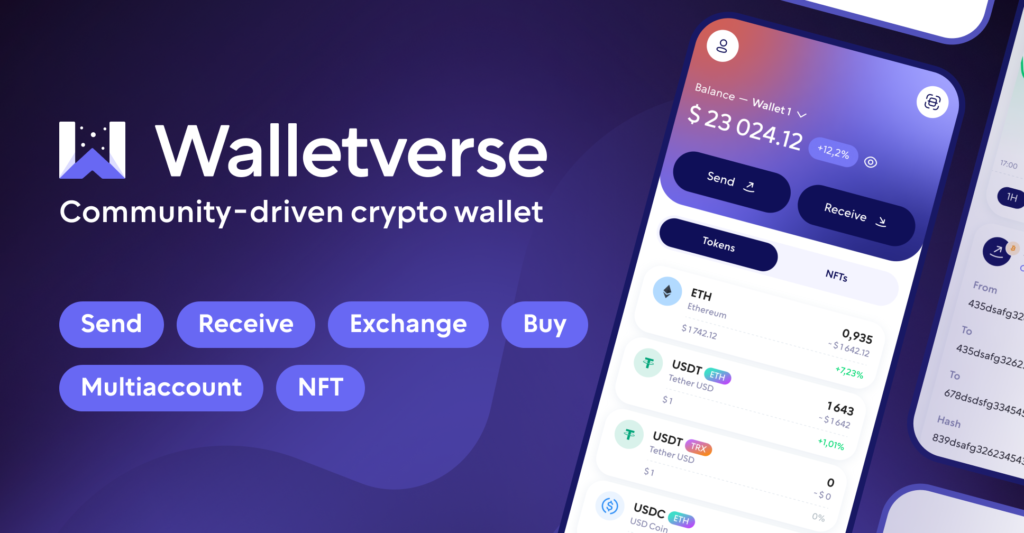
Walletverse is a mobile crypto wallet built for users who want to buy, store, send, and exchange digital assets in one app. It supports more than 700 cryptocurrencies and allows users to buy crypto with Apple Pay, Google Pay, credit/debit cards, and fiat currencies such as USD, EUR, GBP, JPY, KZT, INR, CAD, AUD, and others.
For ERN users, Walletverse can be useful as a mobile entry point into crypto because it combines fiat purchase options with self-custody storage, Web3 access, multi-account functionality, dApps, and security tools. If ERN is not available for direct purchase, users can buy another supported asset first and then check whether an ERN or EPIC swap route is available.
Pros:
- Supports 700+ cryptocurrencies;
- Allows purchases with Apple Pay, Google Pay, and credit/debit cards;
- Supports multiple fiat currencies, including USD and EUR;
- Provides a non-custodial wallet model;
- Uses passcode and biometric authentication;
- Includes Web3, DeFi, dApps, and multi-account features;
- Offers staking for selected assets such as Solana, ETH, and TRX;
- Has a 4.8 rating on Google Play and a 5.0 rating on the App Store.
Cons:
- ERN availability should be checked inside the app before purchase;
- Mobile-only format may not suit users who prefer desktop wallets;
- Some swaps depend on third-party providers and liquidity.



2. MetaMask

MetaMask is one of the most widely used wallets for Ethereum and EVM-compatible assets. Since ERN originated as an ERC-20 token, MetaMask can be useful for users who want to store the token, import a contract manually, or connect to decentralized exchanges.
MetaMask is especially suitable for users who already understand Ethereum gas fees, token approvals, and DeFi swaps. For beginners, it may require more care because users must verify token contracts and avoid fake assets.
Pros:
- Strong Ethereum and ERC-20 support;
- Works with many decentralized exchanges;
- Available as a browser extension and mobile app;
- Allows custom token imports;
- Suitable for DeFi users.
Cons:
- Less beginner-friendly than fiat-focused mobile wallets;
- Users must manage gas fees manually;
- Incorrect token contract imports can create security risks.
3. Trust Wallet

Trust Wallet is a self-custody wallet that supports many cryptocurrencies, networks, and token types. It can be useful for users who want to manage crypto from a mobile device and connect to decentralized applications.
For ERN, users should confirm whether the token is available in the wallet or whether it needs to be added manually. If direct buying is unavailable, users may need to buy ETH, USDT, USDC, or another liquid asset first and then swap.
Pros:
- Supports many blockchains and tokens;
- Offers mobile access to dApps;
- Allows users to manage private keys;
- Can support custom token additions.
Cons:
- ERN may not be available for direct fiat purchase;
- Swap routes depend on liquidity;
- Users need to review network and contract details carefully.
4. Crypto.com DeFi Wallet

Crypto.com DeFi Wallet is a non-custodial wallet designed for users who want to manage crypto assets and interact with DeFi services. It can be useful for users who prefer a mobile wallet connected to a well-known crypto ecosystem.
For ERN, users should verify support before transferring funds. If ERN is not directly available, users may need to use another Ethereum-compatible wallet or swap route.
Pros:
- Non-custodial wallet structure;
- Supports DeFi use cases;
- Mobile-friendly interface;
- Connected to a recognizable crypto brand.
Cons:
- ERN availability may be limited;
- Swap routes depend on third-party liquidity;
- Ethereum fees can affect the final purchase cost.
5. Atomic Wallet

Atomic Wallet is a desktop and mobile wallet that supports many cryptocurrencies and built-in exchange features. It can be useful for users who want one app for managing different assets.
For ERN, users should confirm whether the token is supported and whether swaps are available. If not, an Ethereum-compatible wallet with DEX access may be needed.
Pros:
- Supports many crypto assets;
- Available on desktop and mobile;
- Includes built-in exchange options;
- Useful for multi-asset storage.
Cons:
- ERN support may not be available in all versions;
- Swaps depend on third-party providers;
- Users should compare fees before buying.
6. Binance Web3 Wallet

Binance Web3 Wallet is designed for users who want self-custody and Web3 access while staying connected to the Binance ecosystem. It can be convenient for users who already buy crypto through Binance and want to manage assets across DeFi services.
For Ethernity Chain, users should pay attention to the ERN-to-EPIC transition. Binance explains that Epic Chain evolved from Ethernity Chain and that EPIC is the native utility token for transactions, staking, and governance in the newer ecosystem.
Pros:
- Integrated with the Binance ecosystem;
- Supports Web3 and DeFi access;
- Useful for users who already buy crypto through Binance;
- Can simplify movement between exchange and wallet tools.
Cons:
- ERN or EPIC availability depends on region and product support;
- Users should review migration details before buying;
- Self-custody still requires careful wallet protection.
7. Exodus

Exodus is a multi-asset wallet available on desktop and mobile. It is known for a clean interface, portfolio tracking, and simple asset management.
For ERN users, Exodus may be useful if the token is supported directly or through integrated exchange services. Users should check token availability and compare fees before buying or transferring.
Pros:
- Available on desktop and mobile;
- Beginner-friendly interface;
- Good for portfolio tracking;
- Supports many digital assets.
Cons:
- ERN support may vary;
- Advanced DeFi access is more limited;
- Built-in exchange fees may be higher than DEX routes.
8. Guarda

Guarda Wallet supports a wide range of crypto assets and works across web, desktop, and mobile. It can be useful for users who want flexible wallet access from different devices.
For ERN, users should check whether the wallet supports the token directly or allows custom ERC-20 management. Because ERN has gone through ecosystem changes, checking the correct asset listing is important.
Pros:
- Available across several platforms;
- Supports many assets;
- Provides non-custodial storage;
- Suitable for users who want multi-device access.
Cons:
- ERN support should be verified before use;
- Swap fees and routes can vary;
- Interface may be less simple than mobile-only wallets.
9. OKX Wallet

OKX Wallet is a multi-chain Web3 wallet with swap, DeFi, NFT, and dApp functionality. It is useful for users who want a wallet connected to a broader exchange ecosystem and Web3 tools.
For ERN, OKX Wallet users should check whether the token, migration route, or EPIC-related market is supported. Availability may depend on the user’s region, platform listings, and liquidity sources.
Pros:
- Supports multi-chain Web3 activity;
- Offers swap and dApp features;
- Useful for active crypto users;
- Connected to a large exchange ecosystem.
Cons:
- Some tools may feel complex for beginners;
- ERN support may vary by region;
- Users should compare swap and network fees.
10. Coinbase Wallet

Coinbase Wallet is a self-custody wallet that supports Ethereum-based assets and Web3 access. It is separate from the Coinbase exchange and gives users control over their private keys.
For ERN buyers, Coinbase Wallet may be useful for storing ERC-20 assets or connecting to DeFi routes where ERN is available. Users should still check current token support, migration status, and trading routes before sending funds.
Pros:
- Supports Ethereum-based assets;
- Connects to DeFi applications;
- Offers a familiar interface;
- Suitable for users who know Coinbase products.
Cons:
- ERN may not be available for direct fiat purchase;
- Some features depend on region;
- Ethereum network fees can make small purchases expensive.
Buy ERN with Apple Pay
Buying ERN with Apple Pay depends on whether the wallet or payment provider supports ERN directly. In many cases, users first buy a more liquid asset such as ETH, USDT, USDC, or another supported cryptocurrency with Apple Pay, then swap it for ERN or the current supported ecosystem token if a route is available.
Walletverse supports crypto purchases with Apple Pay, which makes the fiat-to-crypto process easier for mobile users. Before confirming a purchase, users should check the selected asset, provider fee, network, and whether the wallet supports ERN directly or requires a swap.
Buy ERN with Google Pay
Google Pay can also be used to buy crypto in supported wallets and regions. The usual process is to choose a crypto asset, select Google Pay as the payment method, confirm the fiat amount, and complete the transaction through the wallet’s payment provider.
In Walletverse, users can buy crypto with Google Pay and manage assets in a non-custodial mobile wallet. If ERN is not available as a direct purchase option, users can buy another supported asset first and then check whether an ERN or EPIC exchange route is available.
How to Buy Ethernity Chain (ERN) with Fiat?
Buying ERN with fiat requires careful checking because the ecosystem has moved through a rebrand and migration process. Users should confirm whether they need ERN specifically or whether the platform now supports Epic Chain or EPIC.
- Choose a crypto wallet. Select a wallet that supports fiat purchases, token swaps, and Ethereum-compatible assets. Walletverse is a convenient option for users who want a mobile wallet with Apple Pay, Google Pay, card payments, multi-currency support, and 700+ crypto assets.
- Create or import your wallet. Install the wallet app and create a new wallet, or import an existing one using your recovery phrase. Keep the recovery phrase offline and never share it with anyone.
- Select your fiat currency. Choose USD, EUR, GBP, CAD, AUD, INR, KZT, JPY, or another supported fiat currency. Payment options depend on your region and the wallet’s on-ramp provider.
- Search for ERN. Look for Ethernity Chain or ERN inside the wallet. If the token is not listed, check whether the ecosystem now appears as Epic Chain or EPIC due to the rebrand.
- Choose a payment method. Use Apple Pay, Google Pay, debit card, credit card, or another supported fiat payment method. Review fees, payment limits, processing time, and the final amount before confirming.
- Buy a liquid asset first if needed. If ERN is not available for direct fiat purchase, buy ETH, USDT, USDC, or another supported asset first. This can make it easier to swap through Ethereum-compatible routes.
- Swap to ERN or the supported ecosystem token. Use a wallet swap feature or decentralized exchange route if available. Check contract details, slippage, gas fees, and liquidity before approving the transaction.
- Store the token securely. After purchase, store the asset in a wallet where you control access. Walletverse uses passcode and biometric authentication, while its self-custody model means users remain responsible for protecting their wallet credentials.
Why Wallet Choice Matters When Buying ERN
Wallet choice matters because ERN is not as simple as buying a major asset like BTC or ETH. Users need to check token support, migration status, swap routes, liquidity, and network fees before making a transaction.
Walletverse can be useful for users who want a mobile-first crypto experience with fiat payment methods, self-custody, biometric protection, Web3 access, and support for 700+ cryptocurrencies. For ERN buyers, the practical route may be to buy a liquid asset with fiat and then swap if a supported route is available.
Conclusion
Ethernity Chain (ERN) is a crypto asset connected to authenticated NFTs, entertainment IP, digital collectibles, and Web3 infrastructure. The project began as an NFT-focused marketplace and later evolved toward broader blockchain infrastructure, with the ecosystem now officially moving into Epic Chain after a DAO-approved rebrand.
Buying ERN with USD, EUR, Apple Pay, Google Pay, or other fiat methods depends on wallet support, payment provider access, token availability, and migration status. Walletverse can help users enter crypto with fiat, manage assets in a non-custodial mobile wallet, and protect access through passcode and biometric authentication.
Before buying ERN, users should check whether the platform lists ERN, EPIC, or both. They should also review liquidity, network fees, contract details, and the risks of buying smaller or migrating crypto assets.
Data current as of May 15, 2026.
FAQ
Most frequent questions and answers
ERN may be interesting for users who understand NFTs, entertainment blockchain infrastructure, and the project’s move toward Epic Chain. However, it is a volatile crypto asset, so users should review token support, migration details, liquidity, and personal risk tolerance before buying.
To buy ERN with USD, choose a wallet or exchange that supports fiat payments and ERN access. In Walletverse, users can buy crypto with USD through supported payment methods, then check whether ERN is available directly or whether they need to swap from another asset.
You can use Ethereum-compatible wallets and multi-asset wallets such as Walletverse, MetaMask, Trust Wallet, Coinbase Wallet, OKX Wallet, and similar options. Walletverse is suitable for users who want a mobile self-custody wallet with fiat payment methods, 700+ supported assets, biometric protection, and Web3 features.
ERN may be available through selected exchanges, decentralized exchanges, or wallet swap services. Because Ethernity Chain has rebranded to Epic Chain, users should check whether the platform lists ERN, EPIC, or supports migration between the two assets.
The cheapest way depends on fiat provider fees, card fees, network gas costs, and swap liquidity. In many cases, users compare direct ERN purchase with buying ETH, USDT, or USDC first and swapping later when fees are lower.
Yes, ERN may be bought with EUR if the wallet or fiat provider supports EUR payments and an ERN route is available. Walletverse supports multiple fiat currencies, including EUR, so users can buy crypto with EUR and then check available ERN or EPIC routes.
Yes, Apple Pay and Google Pay can be used in wallets that support these payment methods. Walletverse supports Apple Pay and Google Pay for crypto purchases, but users should check whether ERN is available directly or whether another asset must be bought first.
ERN was originally created as an ERC-20 token on Ethereum and has been connected with Layer 2 integrations. Users should still verify the current supported network and correct token contract before sending or receiving it.
Walletverse can be a good option for users who want a mobile crypto wallet with fiat payment options, self-custody, biometric authentication, and support for 700+ crypto assets. For ERN, users should first check whether the token is supported directly or whether they need to buy another crypto asset and swap.


