


Buy Clearpool (CPOOL) with USD, EUR and Other Fiat Currencies
Clearpool (CPOOL) is the utility and governance token of Clearpool, an on-chain credit and lending ecosystem focused on institutional borrowing, stablecoin lending, tokenized credit products, and real-world asset infrastructure.
This article was prepared by ilink, a FinTech and Web3 software developer with 14 years of experience and completed projects worldwide.
What is Clearpool (CPOOL)?
Clearpool is a decentralized credit marketplace and on-chain capital markets ecosystem. Its main purpose is to connect lenders with institutional borrowers and create blockchain-based credit markets for stablecoin liquidity, structured products, and real-world yield opportunities.
Coinbase describes Clearpool as a “decentralized capital markets ecosystem,” where institutional borrowers can access unsecured loans from the DeFi market. Phemex describes it as an “institutional-focused onchain credit marketplace.” These descriptions show the key idea behind Clearpool: it is built around credit, lending, and institutional liquidity rather than simple peer-to-peer token transfers.
Clearpool launched its CPOOL token generation event on October 28, 2021. The project was created during a period when DeFi lending was expanding beyond overcollateralized retail borrowing and moving toward more institutional credit models. Instead of requiring every borrower to lock more collateral than they borrow, Clearpool introduced credit pools where approved or assessed institutions could access liquidity, while lenders could earn yield based on pool activity and risk.
The ecosystem has grown beyond its early permissionless lending model. Clearpool now includes products such as Dynamic Pools, Prime, Fintech Vaults, revolving credit lines, and treasury-focused pools. Clearpool Prime is designed for permissioned institutional lending and borrowing, with KYC and AML requirements for whitelisted counterparties.
Clearpool also developed Ozean, an RWA-focused blockchain environment connected with tokenized yield and real-world asset infrastructure. In the Ozean ecosystem, CPOOL is connected with governance, staking benefits, and broader ecosystem participation.
CPOOL has several main functions:
- Governance participation in Clearpool-related decisions.
- Delegated staking with Clearpool Oracles.
- Borrower staking requirements for launching pools or vaults.
- Incentives and rewards connected with lending activity.
- Support for protocol utility and ecosystem growth.
- Role in Ozean governance and staking-related benefits.
Tokenomics are also important for users. Clearpool’s official documentation states that CPOOL launched on October 28, 2021. Public market trackers list a maximum supply of 1,000,000,000 CPOOL. Clearpool also describes CPOOL as deflationary through a protocol buyback and burning mechanism.
The project has published several ecosystem statistics that help show protocol activity without relying on live token price or market capitalization. In its 2025 yearly review, Clearpool reported $924.4 million in total loans originated, $67.2 million in total value locked, and $10.75 million in interest distributed to lenders. On its lending page, Clearpool also shows institutional lending infrastructure, active loan metrics, and pool-level data.
The wider crypto market gives additional context. Statista expects the number of cryptocurrency users worldwide to reach more than 993 million in 2026. Chainalysis reported that India, the United States, Pakistan, Vietnam, and Brazil led its 2025 Global Crypto Adoption Index. As more users enter crypto through fiat payment methods, stablecoins, wallets, and DeFi products, access to assets like CPOOL depends heavily on reliable wallets, exchanges, and safe on-ramp routes.
Clearpool may be interesting for users who follow DeFi credit, institutional lending, real-world assets, tokenized yield, and stablecoin-based financial infrastructure. However, CPOOL is still a volatile crypto asset. Users should research the project, check token availability, review liquidity, compare fees, and understand the risks of lending-related DeFi protocols before buying.
Where Can I Buy Clearpool (CPOOL) Cash - 10 Best Crypto Wallets
1. Walletverse
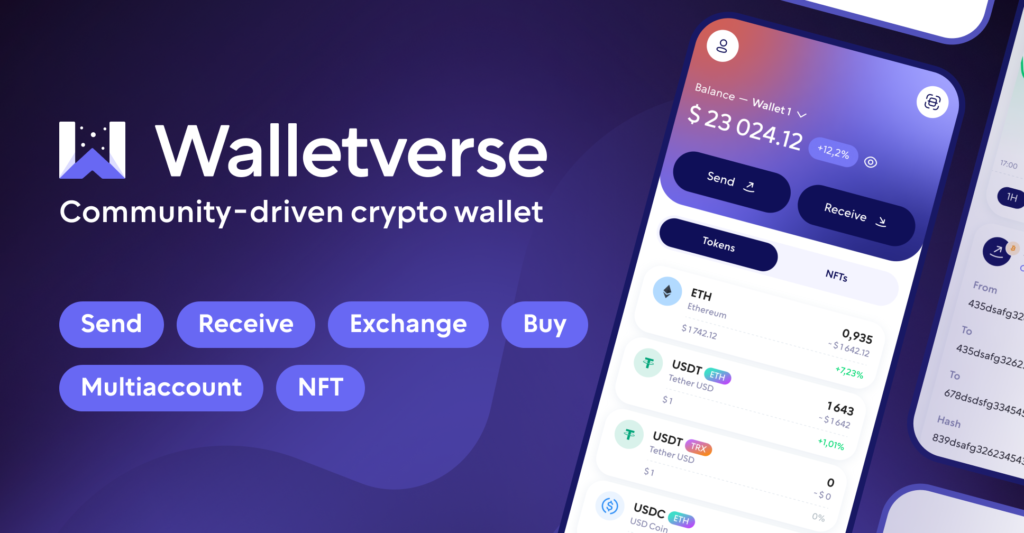
Walletverse is a mobile self-custody crypto wallet designed for users who want to buy, store, send, trade, and manage crypto from one app. It supports 700+ cryptocurrencies and is available on Google Play and the App Store.
The wallet is suitable for both beginners and advanced users because it combines a simple mobile interface with Web3, DeFi, dApps, multi-account support, fiat purchase options, swaps, staking, AML tools, and strong security features. Users can buy crypto with Apple Pay, Google Pay, credit or debit cards, and fiat currencies such as USD, EUR, GBP, JPY, KZT, INR, CAD, AUD, and others.
Walletverse is non-custodial, which means users control their own assets. Private keys are protected on the user’s device, while passcode and biometric authentication help secure access. The wallet also includes a proprietary GasFree USDT transaction system on TRON, allowing users to send USDT without holding TRX for gas fees.
For CPOOL users, Walletverse can be useful as a mobile entry point into crypto. If direct CPOOL support is not available through a provider, users can buy a more liquid asset first and then use a supported swap route after checking the correct token and network.
Pros:
- Supports 700+ cryptocurrencies and many fiat purchase options;
- Allows users to buy crypto with Apple Pay, Google Pay, cards, and multiple fiat currencies;
- Non-custodial wallet model gives users control over their assets;
- Passcode and biometric authentication improve everyday wallet protection;
- Supports dApps, multi-account management, swaps, and staking for Solana, ETH, and TRX;
- GasFree USDT transfers on TRON reduce friction for users who do not hold TRX.
Cons:
- Direct CPOOL availability may depend on provider and liquidity support;
- Mobile-only format may not suit users who prefer desktop wallets;
- Fiat purchase fees vary by country, currency, and payment provider.



2. MetaMask

MetaMask is one of the most widely used wallets for Ethereum and EVM-compatible networks. Since CPOOL is available on Ethereum and has also been used across EVM ecosystems, MetaMask can be useful for users who want to manage compatible tokens, connect to DeFi apps, and use decentralized exchanges.
MetaMask supports crypto purchases through third-party providers in many regions. Users can buy crypto with cards, bank transfers, Apple Pay, Google Pay, PayPal, and other regional payment methods where available. If CPOOL is not available directly in the buy interface, users may buy ETH, USDT, USDC, or another liquid asset first and then swap into CPOOL through a supported route.
Pros:
- Strong support for Ethereum and EVM-compatible tokens;
- Works with many DeFi platforms and decentralized exchanges;
- Available as a browser extension and mobile app;
- Supports multiple fiat on-ramp methods in selected regions.
Cons:
- Direct CPOOL buying may not be available everywhere;
- Users need to understand gas fees and network selection;
- Adding or receiving the wrong token contract can create risk.
3. Trust Wallet

Trust Wallet is a self-custody mobile wallet that supports many blockchains, tokens, NFTs, and dApps. It is popular with users who want a simple mobile wallet for buying, storing, and using crypto.
Trust Wallet supports fiat crypto purchases through third-party providers and allows users to buy crypto with Apple Pay and Google Pay in supported regions. For CPOOL, users should check whether the token is available directly inside the app or whether they need to buy another asset first and swap.
Pros:
- Beginner-friendly mobile wallet;
- Supports many blockchains, tokens, NFTs, and dApps;
- Offers Apple Pay, Google Pay, cards, and local payment methods through partners;
- Self-custody model gives users control over private keys.
Cons:
- Direct CPOOL purchase may not be available in every region;
- Provider fees and limits can differ;
- Users must verify the correct network before receiving CPOOL.
4. Uniswap Wallet
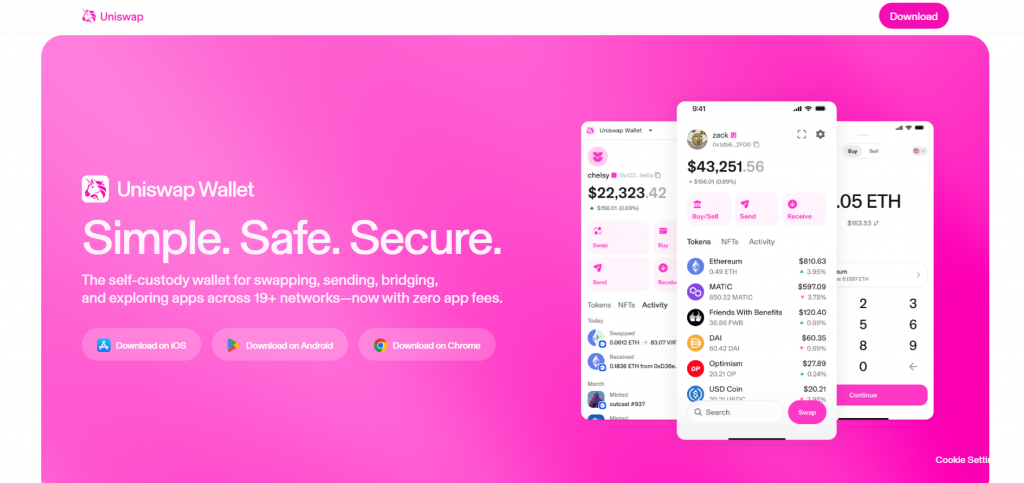
Uniswap Wallet is useful for users who want direct access to decentralized exchange activity. Since CPOOL is an ERC-20 token and has decentralized liquidity routes, Uniswap-related tools may help users swap ETH, USDT, USDC, or another supported asset for CPOOL.
This option is usually better for users who understand DeFi, gas fees, slippage, liquidity, and token contracts. Before swapping, users should check whether the CPOOL pool is active and whether liquidity is sufficient for the amount they want to trade.
Pros:
- Direct connection to decentralized exchange activity;
- Useful for swapping Ethereum-based tokens;
- Non-custodial model keeps users in control;
- Good fit for users who understand DeFi trading.
Cons:
- Not ideal for complete beginners;
- Swap slippage can increase the final cost;
- Ethereum gas fees may be high during network congestion.
5. SafePal

SafePal offers both software and hardware wallet options. It supports many networks, tokens, NFTs, dApps, swaps, and fiat purchase providers.
SafePal can be useful for CPOOL holders who want mobile wallet access with the option of stronger hardware-based security. Users should check whether CPOOL is supported directly or whether they need to add it manually on the correct network.
Pros:
- Offers both software wallet and hardware wallet options;
- Supports many blockchains, tokens, NFTs, and dApps;
- Includes fiat purchase and swap access through partners;
- Suitable for users who want stronger long-term storage.
Cons:
- Direct CPOOL purchase may not be available through every provider;
- Hardware setup adds extra steps;
- Users must verify network and contract details for custom tokens.
6. Binance Web3 Wallet

Binance Web3 Wallet is built into the Binance app and is designed for users who want access to Web3 activity, swaps, dApps, and exchange services from one environment.
Binance Alpha has pages for trading and buying Clearpool, which may make Binance relevant for users who want a simplified route to CPOOL where supported. Users should still check regional availability, deposit status, withdrawal support, and fees before making a purchase.
Binance Web3 Wallet can also help users move between centralized exchange activity and self-custody Web3 routes.
Pros:
- Connected with a major global crypto exchange ecosystem;
- Binance Alpha provides access to selected Web3 tokens such as CPOOL;
- Useful for users who already buy crypto through Binance;
- Supports Web3 access, swaps, and dApps.
Cons:
- Some features require identity verification;
- Regional restrictions may affect fiat deposits and token access;
- Users should check current CPOOL support before sending funds.
7. Ledger Live

Ledger Live works with Ledger hardware wallets and is suitable for users who prioritize self-custody and offline private key protection. It supports many crypto assets and can connect with third-party services for buying, swapping, and portfolio management.
For CPOOL, Ledger users should check whether the token is supported directly or whether it must be managed through an Ethereum or EVM-compatible wallet connection. This route is usually better for users who already understand self-custody and want stronger long-term protection.
Pros:
- Hardware wallet protection keeps private keys offline;
- Suitable for long-term storage;
- Supports many assets and third-party integrations;
- Can connect with compatible Web3 wallets for broader access.
Cons:
- Setup is more complex than a mobile wallet;
- Direct CPOOL buying may not be supported;
- Managing EVM tokens may require manual network and contract checks.
8. Bitget Wallet

Bitget Wallet is a non-custodial Web3 wallet that supports many networks, token swaps, dApps, market tools, and payment features. It is useful for users who want mobile access to DeFi and multi-chain assets.
Bitget’s public education materials describe Clearpool as a decentralized credit marketplace for institutional borrowers. Users can check whether CPOOL appears inside the wallet or swap interface and whether liquidity is active before confirming a trade.
Pros:
- Supports many blockchains, tokens, and Web3 tools;
- Includes swap, market, dApp, and payment features;
- Offers fiat access through selected partners;
- Useful for active users who want mobile DeFi access.
Cons:
- CPOOL support may depend on current routing and liquidity;
- Fiat features vary by country;
- Advanced tools may feel complex for beginners.
9. OKX Wallet

OKX Wallet is a Web3 wallet connected with the broader OKX ecosystem. It supports multi-chain assets, swaps, dApps, NFTs, and fiat crypto purchase options through OKX services.
Users who want to buy CPOOL may use OKX-related fiat routes where available, or buy a major asset first and then move into CPOOL through a supported trading or swap route. OKX also supports Apple Pay and Google Pay purchases in selected markets.
Pros:
- Combines exchange access and Web3 wallet functionality;
- Supports many digital assets and fiat currencies;
- Offers Apple Pay and Google Pay in selected regions;
- Useful for users who want CEX and Web3 activity in one app.
Cons:
- CPOOL availability depends on current listings and region;
- Some features require account verification;
- Payment methods can differ by country.
10. Coinbase Wallet

Coinbase Wallet is a self-custody wallet that supports Ethereum assets, NFTs, dApps, and Web3 activity. It is separate from the main Coinbase exchange app.
Coinbase’s public page describes Clearpool as a decentralized capital markets ecosystem, but wallet support and exchange trading support are not always the same. Coinbase Wallet may be useful for users who want to manage compatible assets and connect to Web3 routes, but users should verify CPOOL availability before relying on it.
Pros:
- Self-custody wallet with Ethereum and Web3 support;
- User-friendly interface for beginners;
- Works with dApps and NFTs;
- Useful for managing compatible tokens outside a custodial exchange.
Cons:
- Direct fiat-to-CPOOL buying may not be available;
- Exchange availability and wallet support are different things;
- Users must verify token and network details before receiving assets.
Buy Clearpool (CPOOL) Apple Pay
Buying Clearpool with Apple Pay may be possible if your wallet, exchange, or fiat provider supports CPOOL in your country. Apple Pay is convenient because users can confirm a payment through Face ID, Touch ID, or device passcode instead of entering card details manually.
A typical Apple Pay route looks like this:
- Open a crypto wallet or exchange app that supports Apple Pay.
- Go to Buy Crypto.
- Choose your fiat currency, such as USD, EUR, GBP, CAD, or AUD.
- Search for CPOOL.
- If CPOOL is available, enter the amount you want to buy.
- Select Apple Pay as the payment method.
- Review the provider fee, exchange rate, network fee, and final amount.
- Confirm the payment.
- Store CPOOL in a secure wallet after purchase.
If CPOOL is not available for direct Apple Pay purchase, users can buy USDT, ETH, USDC, BNB, or another supported asset first. After that, they can use a verified trading or swap route to get CPOOL.
Walletverse supports crypto purchases with Apple Pay in supported regions. This makes it useful for users who want a mobile-first way to buy crypto with fiat and manage assets through a non-custodial wallet.
Buy Clearpool (CPOOL) with Google Pay
Google Pay can make crypto purchases faster by allowing users to pay with a saved card. The exact buying process depends on the wallet, exchange, country, fiat provider, and token availability.
A typical Google Pay purchase flow includes:
- Open a wallet or exchange app that supports Google Pay.
- Select Buy Crypto.
- Choose your fiat currency.
- Search for CPOOL.
- Enter the purchase amount.
- Select Google Pay as the payment method.
- Review fees, limits, exchange rate, and network details.
- Confirm the transaction.
- Store CPOOL safely in a self-custody wallet or supported exchange account.
If CPOOL is unavailable for direct Google Pay purchase, buying a more liquid crypto asset first is usually the practical route. Users can then trade or swap into CPOOL through a supported route.
Walletverse supports Google Pay for crypto purchases in supported regions and gives users a mobile self-custody wallet for storing, sending, buying, and exchanging crypto.
How to Buy The Clearpool (CPOOL) with Fiat?
The easiest way to buy Clearpool with fiat depends on whether direct CPOOL buying is supported in your region. Some platforms may support direct CPOOL purchases with USD, EUR, or other currencies. Others may require users to buy USDT, ETH, USDC, or BNB first and then trade or swap into CPOOL.
Here is a practical step-by-step process:
1. Choose a wallet or exchange.
Select a crypto app that supports fiat purchases and CPOOL access. Walletverse, MetaMask, Trust Wallet, Binance Web3 Wallet, OKX Wallet, Bitget Wallet, SafePal, Coinbase Wallet, Uniswap Wallet, and Ledger Live are examples users may review.
2. Create or access your wallet.
If you use a self-custody wallet, create a wallet and safely back up your seed phrase. Never share it with anyone. If you use a centralized exchange, complete registration and verification if required.
3. Select your fiat currency.
Choose USD, EUR, GBP, CAD, AUD, INR, JPY, KZT, or another supported local currency.
4. Search for CPOOL.
If CPOOL is available directly, check the network, provider, and final amount. If it is unavailable, buy USDT, ETH, USDC, BNB, or another liquid asset first.
5. Choose a payment method.
Depending on the app and region, payment methods may include credit card, debit card, bank transfer, Apple Pay, Google Pay, or local payment providers.
6. Review the full cost.
Check provider fees, spreads, network fees, exchange rates, and withdrawal costs. The cheapest route is not always the one with the lowest visible fee, because spread and network costs can also affect the final amount.
7. Confirm the purchase.
Complete the payment only after checking the selected asset, network, and total cost.
8. Swap or trade if needed.
If you bought USDT, ETH, USDC, or BNB first, use a supported exchange or swap route to get CPOOL. Check liquidity and network compatibility before confirming.
9. Store CPOOL securely.
For long-term storage, use a secure wallet and keep your recovery phrase offline. Walletverse can be useful for users who want mobile self-custody, fiat buying, Apple Pay, Google Pay, swaps, dApps, biometric access, and multi-currency asset management.
Conclusion
Clearpool (CPOOL) is the utility and governance token of Clearpool, an on-chain credit ecosystem focused on institutional lending, stablecoin liquidity, tokenized credit products, and real-world asset infrastructure.
Users who want to buy CPOOL with USD, EUR, GBP, CAD, AUD, INR, JPY, KZT, or other fiat currencies should first check whether direct buying is available in their country. If direct access is limited, they can buy USDT, ETH, USDC, BNB, or another supported asset first and then use a verified trading or swap route.
Before buying, users should review the selected network, fees, liquidity, contract details, wallet support, exchange reliability, and protocol risks. Walletverse can be a practical option for users who want a mobile self-custody crypto wallet with fiat purchase methods, Apple Pay, Google Pay, card payments, swaps, dApps, multi-account support, biometric protection, and 700+ supported cryptocurrencies.
Data current as of June 11, 2026.
FAQ
Most frequent questions and answers
CPOOL may be interesting for users who believe in on-chain credit, institutional DeFi lending, tokenized yield, stablecoin markets, and real-world asset infrastructure. However, it is still a volatile crypto asset, so users should research Clearpool’s ecosystem, token utility, liquidity, and lending-related risks before buying.
You can buy CPOOL with USD if your chosen wallet, exchange, or fiat provider supports direct CPOOL purchases. If direct buying is unavailable, you can buy USDT, ETH, USDC, or BNB with USD first and then trade or swap into CPOOL through a supported route. Walletverse can help users buy crypto with fiat and manage assets in a mobile self-custody wallet.
You can use a wallet that supports the correct CPOOL network and token format. MetaMask, Trust Wallet, Binance Web3 Wallet, OKX Wallet, Bitget Wallet, SafePal, Coinbase Wallet, Uniswap Wallet, and Ledger Live may be useful depending on your needs. Walletverse is also useful for users who want mobile self-custody, fiat buying, swaps, dApps, and multi-currency asset management.
CPOOL is available through selected crypto platforms and may also be accessible through wallet-based swap routes. Binance Alpha has a Clearpool buying route, and market trackers list CPOOL across centralized and decentralized markets. Availability depends on country, platform, liquidity, network, and payment method.
The cheapest way is usually to compare payment methods before confirming. Bank transfers often cost less than instant card purchases, while swaps can include network fees and slippage. In Walletverse and other wallets, users should review provider fees, exchange rates, network fees, and the final received amount.
Yes, users may be able to buy CPOOL with EUR on supported platforms. If direct EUR-to-CPOOL buying is unavailable, users can buy USDT, ETH, USDC, or another supported asset with EUR first and then trade or swap into CPOOL.
Some crypto apps and exchanges support card purchases. Direct CPOOL card purchases depend on the provider, region, and current token support. If CPOOL is not listed directly, users may buy a major crypto asset with a card and then swap into CPOOL.
Creating a self-custody wallet usually does not require KYC. However, fiat purchases through credit cards, debit cards, Apple Pay, Google Pay, bank transfers, and regulated providers often require identity verification. KYC rules depend on country, provider, payment method, and transaction size.
Yes, Walletverse is designed for both beginners and advanced users. It offers a mobile-first interface, self-custody, passcode and biometric protection, fiat buying, swaps, dApps, staking options, and support for 700+ cryptocurrencies.
Before buying CPOOL, check token availability, supported networks, fees, liquidity, contract details, wallet security, and whether the platform is custodial or self-custodial. You should also review the final amount before confirming the payment.


