


Buy Atari (ATRI) with USD, EUR and Other Fiat Currencies
Atari (ATRI), also known as Atari Token, is a crypto asset connected to gaming, entertainment, digital goods, blockchain payments, and the historical Atari blockchain ecosystem.
For users who want to buy ATRI with USD, EUR, GBP, CAD, AUD, INR, KZT, JPY or other fiat currencies, the process usually starts with a crypto wallet, fiat on-ramp, centralized exchange, debit card, credit card, Apple Pay, Google Pay, or a swap through Ethereum-compatible or Polygon-compatible liquidity.
This article was prepared by ilink, a FinTech and Web3 software developer with 14 years of experience and completed projects worldwide.
What is Atari (ATRI)?
Atari (ATRI) is a cryptocurrency token originally connected to the Atari blockchain ecosystem and the broader idea of using crypto inside gaming, entertainment, digital goods, NFTs, rewards, and online services.
The Atari name is strongly associated with video game history. Atari was founded in 1972 and became known for classic games and franchises such as Pong, Asteroids, Centipede, and Missile Command. Because of this history, the idea of an Atari-branded token attracted attention from users interested in gaming, collectibles, digital ownership, and blockchain-based entertainment.
ATRI was created as a utility token for the Atari Token ecosystem. The original concept was to make ATRI usable across digital services, games, entertainment products, partner platforms, rewards, staking programs, and ecosystem development.
In simple terms, the token was positioned as a crypto payment and utility asset for interactive entertainment. Its early purpose was connected to practical use inside gaming and digital content environments rather than only speculative trading.
The core idea behind Atari Token included:
- Payments inside gaming and entertainment platforms;
- Digital goods and online services;
- Rewards and ecosystem incentives;
- NFT-related activity;
- Staking-related programs;
- Partner integrations;
- A broader Atari-branded blockchain ecosystem.
ATRI is commonly listed as an Ethereum-based ERC-20 token. The Ethereum contract address listed by token explorers is:
0xdacD69347dE42baBfAEcD09dC88958378780FB62
This contract address is important because several assets can use similar names or tickers. Before buying, sending, or swapping ATRI, users should always confirm that they are interacting with the correct Atari Token contract.
The Atari Token ecosystem also had a Polygon connection. In 2021, Atari announced a partnership with Polygon to bring Atari Token, NFTs, and token-related products to Polygon’s Layer 2 environment. The goal was to improve user experience through lower fees and faster confirmations than users typically experienced on Ethereum mainnet.
This means users may see ATRI-related assets or routes connected to Ethereum, Polygon, or older marketplace infrastructure. Network selection is therefore important, because sending a token to the wrong network can lead to loss of funds.
Public token-tracking sources list a total supply of 7,771,000,000 ATRI. Token explorers also show more than 20,000 holders and tens of thousands of transfers for the Ethereum contract. These figures help users understand the token’s historical scale, but they do not guarantee liquidity, safety, future demand, or price performance.
Atari Token also has an important later-stage history that users should understand. In April 2022, Atari SA announced the termination of all license agreements with ICICB Group and its subsidiaries. Atari also stated that the Atari Chain Limited joint venture, promoted Atari Tokens, related websites, whitepapers, and social media channels were unlicensed, unsanctioned, and outside Atari’s control.
The company said that a snapshot of ATRI token holdings had been taken on April 18, 2022, and that a future exchange would be implemented for eligible ATRI token holders from that snapshot. This history matters because ATRI is no longer a simple active-growth gaming token story.
Users should separate three things:
- Atari as a famous gaming and entertainment brand;
- ATRI as the historical Atari Token;
- Any newer or future token plans that may be separate from the original ATRI token.
Current market availability also requires caution. CoinGecko currently states that ATRI tokens have stopped trading on all exchanges it lists and that information will be updated if market activity resumes. Kraken also states that Atari Token is not available on Kraken.
This does not automatically mean that no route exists anywhere, but it does mean users should verify liquidity carefully before trying to buy. For older or inactive tokens, market availability can change, and some swap routes may have limited or unreliable liquidity.
The main topics connected to ATRI include:
- Gaming utility;
- Entertainment payments;
- Digital goods;
- NFTs;
- Ethereum token infrastructure;
- Polygon integration history;
- Brand licensing history;
- Token swap and liquidity risk.
Overall, ATRI’s value depends on whether there is still real liquidity, market access, and user interest around the historical Atari Token.
Several factors may influence ATRI’s long-term relevance:
- Liquidity;
- Exchange availability;
- Wallet support;
- Ethereum and Polygon network conditions;
- Brand-related history;
- Holder activity;
- Current project status;
- Broader crypto market sentiment.
As with any crypto asset, ATRI can be volatile and risky. Users should always check the official token contract, supported network, provider fees, liquidity, current project status, and personal risk tolerance before buying.
Where Can I Buy Atari (ATRI) - 10 Best Crypto Wallets
1. Walletverse
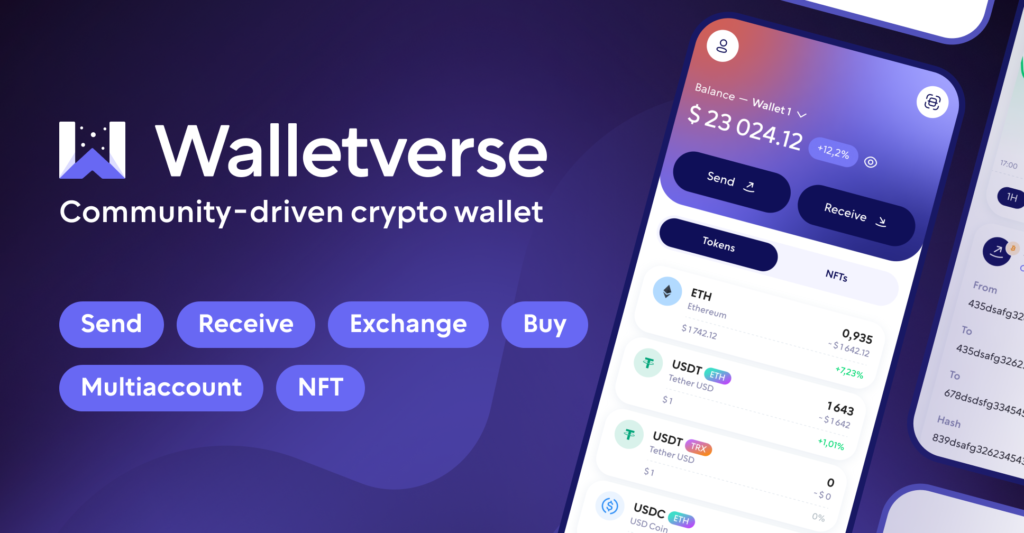
Walletverse is a mobile self-custody crypto wallet created for users who want to buy, store, send, receive, and exchange crypto in one app.
It supports 700+ cryptocurrencies and gives users access to Web3 tools, DeFi features, dApps, multi-account management, fiat on-ramp options, and crypto swaps.
For users who want to buy Atari (ATRI) with fiat, Walletverse can be used as a practical starting point.
If ATRI is available through the selected provider or swap route, users can buy or exchange it directly inside the app.
If direct ATRI buying is unavailable, users may buy ETH, USDC, USDT, MATIC or another supported asset with Apple Pay, Google Pay, credit card, debit card, or a local fiat provider, then swap it to ATRI through a compatible route if liquidity exists.
Walletverse is non-custodial.
This means users control their own assets, while private keys remain under their control.
The Walletverse team cannot access user funds.
The app also includes passcode and biometric authentication, AML and KYT checks, Solana, ETH and TRX staking, and a proprietary GasFree USDT Transaction System on TRON.
This GasFree feature allows users to transfer USDT on TRON without holding TRX, because fees can be paid directly in USDT.
Pros
- Beginner-friendly mobile interface;
- Supports 700+ cryptocurrencies;
- Self-custody structure with user-controlled assets;
- Apple Pay, Google Pay, cards, and multiple fiat currencies;
- Passcode and biometric security;
- Built-in swaps, dApps, Web3 access, staking, and multi-account support;
- GasFree USDT transfers on TRON.
Cons
- Mobile-only experience;
- Direct ATRI availability depends on providers, liquidity, and network support;
- Users must protect their recovery phrase because the wallet is self-custodial.



2. Trezor
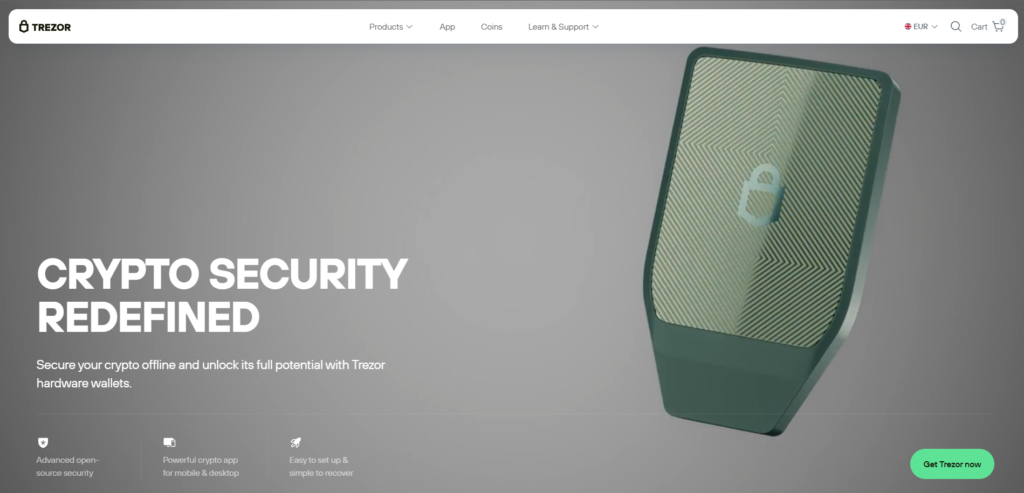
Trezor Suite is the wallet interface for Trezor hardware wallets.
Trezor devices can be used to store Ethereum-style tokens through compatible interfaces.
For ATRI users, Trezor may be useful if the priority is secure storage rather than fast mobile trading.
Users can buy ATRI through an exchange or fiat provider and then move it to a supported self-custody setup.
Pros
- Hardware wallet protection;
- Strong focus on self-custody;
- Useful for long-term holders;
- Private keys stay offline.
Cons
- Requires a hardware wallet purchase;
- Less convenient for quick mobile purchases;
- Users must carefully manage backup and recovery details.
3. Trust Wallet

Trust Wallet is a multi-chain self-custody wallet that supports many blockchains and Ethereum-based assets.
It offers token storage, swaps, fiat buying, dApp access, and NFT support.
For users who want to buy ATRI, Trust Wallet may be useful if they want one mobile wallet for many crypto assets and networks.
Users can buy ETH, USDC, USDT or another supported asset with fiat through supported providers, then swap to ATRI if a suitable route is available.
Trust Wallet can also be useful for users who hold assets across several networks and want one app for general crypto management.
Pros
- Supports many blockchains and assets;
- Self-custody wallet model;
- Apple Pay, Google Pay, cards, and bank transfer support through partners;
- Good for users with multi-chain portfolios;
- Includes swaps and Web3 access.
Cons
- Fees vary by third-party provider;
- Direct ATRI buying may not be available in every region;
- Users must carefully check whether they are using the correct token and network.
4. Rabby Wallet

Rabby Wallet is an EVM-focused self-custody wallet designed for DeFi users.
It supports Ethereum, Polygon, Arbitrum, BNB Chain, and many other EVM-compatible chains.
Rabby provides transaction simulation, risk warnings, and clearer signing information than many older browser wallets.
For ATRI users, Rabby may be useful when interacting with Ethereum or Polygon swaps, token approvals, and decentralized exchanges.
It is especially helpful for users who want more visibility before signing transactions.
Pros
- Strong Ethereum and EVM support;
- Transaction simulation and risk alerts;
- Good for DeFi users;
- Helpful for checking approvals and contract interactions.
Cons
- More suitable for browser and desktop users than mobile-first beginners;
- Fiat buying options are less central than in some mobile wallets;
- Direct ATRI access depends on available routes and liquidity.
5. SafePal

SafePal offers mobile, browser extension, and hardware wallet options.
It supports many blockchains and tokens, including Ethereum-based and EVM-compatible assets.
SafePal includes buy, sell, swap, DeFi access, and hardware wallet protection for users who want stronger security options.
For ATRI users, SafePal may be useful if they want software wallet convenience with the option to add hardware protection.
Users may buy supported crypto with fiat, then exchange it to ATRI if a compatible route exists.
Pros
- Software and hardware wallet options;
- Supports many blockchains and tokens;
- Built-in buy, sell, swap, and DeFi tools;
- Suitable for users who want stronger storage protection.
Cons
- Hardware wallet setup takes extra time;
- Direct ATRI buying may require a swap route;
- Users must check chain and contract details before transfers.
6. Exodus

Exodus is a self-custody wallet available on mobile, desktop, and browser.
It supports many crypto assets and provides buying, sending, receiving, swaps, staking for selected assets, and portfolio tracking.
For ATRI users, Exodus may be useful if they want a simple multi-platform wallet experience.
Users may buy ETH, USDC or another supported asset with fiat and then exchange it to ATRI if a route is available.
Exodus is often chosen by users who prefer a clean interface and visual portfolio tracking.
Pros
- Easy interface for beginners;
- Mobile, desktop, and browser options;
- Supports many crypto assets;
- Built-in buy and swap features;
- Useful portfolio tracking tools.
Cons
- Advanced DeFi users may prefer MetaMask or Rabby;
- Direct ATRI support should be checked before purchase;
- Swap and fiat fees depend on integrated providers.
7. Ledger Live

Ledger Live is the companion app for Ledger hardware wallets.
It can be used to manage many crypto assets and Ethereum-compatible tokens, depending on network and token support.
For ATRI holders, Ledger may be useful if they want stronger long-term storage protection.
Users may buy ATRI through an exchange or compatible swap route and then store it with hardware wallet security if the token and network are supported.
Pros
- Hardware wallet security;
- Good for long-term storage;
- Supports many Ethereum-compatible assets through connected wallets;
- Private keys remain offline.
Cons
- Requires buying a hardware device;
- Less convenient for frequent small transactions;
- Token visibility may require adding custom assets or using a connected wallet.
8. MetaMask

MetaMask is one of the most widely used self-custody wallets for Ethereum and EVM-compatible networks.
Because ATRI is commonly listed as an ERC-20 token and has Polygon integration history, MetaMask can be useful for users who want to manage Atari Token through Ethereum or Polygon-compatible routes.
Users may buy ETH, USDC, USDT or another supported asset through integrated providers, then swap to ATRI if a valid route exists.
MetaMask also allows users to manually import token contracts, which is useful for older or less visible assets.
Pros
- Strong Ethereum and EVM network support;
- Works with many decentralized exchanges;
- Allows manual token import by contract address;
- Useful for users who understand DeFi and self-custody;
- Supports Ethereum and Polygon-style workflows.
Cons
- Beginners may find gas fees and network switching confusing;
- Fiat buying fees depend on third-party providers;
- Users must manually verify contract addresses and avoid fake tokens.
9. Coinbase Wallet

Coinbase Wallet is a self-custody wallet from Coinbase.
It supports Ethereum, Polygon, Base, Solana, and several other major networks.
For ATRI users, Coinbase Wallet may be useful because it can connect exchange-based buying with self-custody storage and Web3 access.
Users may buy ETH, USDC or another supported asset, move it to Coinbase Wallet, and swap into ATRI through a compatible route if available.
Coinbase Wallet may be especially useful for users who already use Coinbase and want a familiar self-custody interface.
Pros
- Self-custody wallet from a well-known crypto brand;
- Supports Ethereum and other major Web3 networks;
- Useful for users who already use Coinbase;
- Good connection between exchange buying and wallet storage.
Cons
- Direct ATRI support may vary by region and route;
- Some users may need to move funds between Coinbase and Coinbase Wallet;
- Users still need to verify token contracts carefully.
10. OKX Wallet

OKX Wallet is a Web3 wallet connected to the broader OKX ecosystem.
It supports Ethereum, Polygon, Arbitrum, BNB Chain, Solana, and many other networks.
For ATRI buyers, OKX Wallet may be useful because it combines wallet management, swaps, DeFi access, and route comparison tools.
Users may buy crypto with fiat where supported, then swap into ATRI if a suitable route is available.
OKX Wallet can be practical for active users who want to compare liquidity across several networks.
Pros
- Supports many EVM and non-EVM networks;
- Strong Web3 and DeFi functionality;
- Integrated wallet and exchange ecosystem;
- Useful for active users comparing routes and liquidity.
Cons
- Some services may be unavailable in certain regions;
- Interface may feel complex for beginners;
- Users should understand the difference between exchange custody and wallet self-custody.
Buy Atari (ATRI) with Apple Pay
Buying Atari with Apple Pay can be convenient for users who want a fast mobile checkout experience.
The exact process depends on the wallet, fiat provider, exchange, country, network, and ATRI availability.
Some providers may support ATRI directly.
In many cases, users may need to buy ETH, USDC, USDT, MATIC or another supported asset first and then swap to ATRI afterward.
A typical Apple Pay flow looks like this:
- Install a crypto wallet that supports Ethereum or Polygon-compatible assets, such as Walletverse, MetaMask, Trust Wallet, Coinbase Wallet, OKX Wallet or another compatible wallet.
- Create or import a wallet.
- Save the recovery phrase offline and never share it with anyone.
- Open the Buy section.
- Choose ATRI if it is available.
- If ATRI is unavailable, buy ETH, USDC, USDT or MATIC.
- Select Apple Pay as the payment method.
- Complete identity verification if the provider requires it.
- Review the final quote, including provider fees and spread.
- Confirm the payment.
- Swap the purchased asset to ATRI through a supported route if liquidity exists.
- Check that ATRI arrives in the correct wallet address and on the correct network.
- Keep ETH or the required network-fee asset available for future transfers.
Walletverse can be useful for this process because it supports mobile crypto buying through Apple Pay, cards, local providers, and fiat currencies such as USD, EUR, GBP, CAD, AUD, INR, KZT, JPY and more.
Before confirming the payment, always review the total cost.
The final amount may include provider fees, Ethereum or Polygon network fees, spread, and payment-processing charges.
Buy Atari (ATRI) with Google Pay
Google Pay can help Android users buy crypto faster through supported wallets and fiat providers.
The process is similar to Apple Pay.
Users choose a wallet or platform, select ATRI if available, choose Google Pay, review the quote, and confirm the transaction.
If ATRI is not available directly, users can buy ETH, USDC, USDT or MATIC first and then swap it to ATRI through a supported route.
A typical Google Pay flow looks like this:
- Download a compatible wallet, such as Walletverse, MetaMask, Trust Wallet, OKX Wallet, SafePal or another wallet that supports Ethereum or Polygon-compatible assets.
- Create a wallet and protect it with a passcode and biometrics.
- Store the recovery phrase securely offline.
- Open the Buy section.
- Select ATRI if it is available.
- If ATRI is unavailable, buy ETH, USDC, USDT or MATIC first.
- Choose Google Pay as the payment method.
- Complete verification if required.
- Confirm the quote.
- Complete the purchase.
- Swap the purchased asset to ATRI.
- Check that ATRI arrives in the correct wallet address and on the correct network.
- Keep the correct network-fee asset available for future transactions.
Walletverse supports Google Pay and other fiat payment options, which can make it convenient for users who prefer a mobile-first crypto experience.
Availability depends on country, provider, liquidity, compliance checks, payment method, asset support, and network conditions.
How to Buy Atari (ATRI) with Fiat?
The easiest way to buy Atari with fiat is to use a wallet, exchange, or fiat provider that supports ATRI or compatible Ethereum and Polygon assets.
Because ATRI may not be directly available through every provider, users often choose one of two routes.
The first route is direct purchase.
If your provider supports ATRI directly, you can select ATRI, choose USD, EUR, GBP or another fiat currency, pay with Apple Pay, Google Pay, card or bank transfer, and receive ATRI in your wallet or exchange account.
The second route is indirect purchase.
If direct ATRI buying is unavailable, you can buy ETH, USDC, USDT, MATIC or another supported asset with fiat, then swap it to ATRI through a compatible exchange, wallet, or decentralized liquidity route.
Here is a simple step-by-step process:
- Choose a wallet or exchange that supports ATRI or Ethereum and Polygon-compatible assets.
- Confirm that the asset is Atari Token with the ATRI ticker.
- Check the contract address and network.
- Create an account or wallet.
- Complete identity verification if the fiat provider requires it.
- Select a fiat currency such as USD, EUR, GBP, CAD, AUD, INR, KZT or JPY.
- Buy ATRI directly if available.
- If ATRI is unavailable, buy ETH, USDC, USDT or MATIC.
- Transfer funds to a self-custody wallet if buying through an exchange.
- Open the swap section.
- Swap the purchased asset to ATRI only through a route with enough liquidity.
- Store ATRI in a secure self-custody wallet.
- Keep ETH or the required network-fee asset available for future transactions.
- Avoid fake token pages, unknown websites, and private offers from strangers.
- Check whether ATRI can be sold or swapped again before buying a large amount.
For beginners, Walletverse may be a practical choice because it combines fiat buying, self-custody, swaps, Web3 access, biometric protection, and support for many crypto assets in one mobile app.
For users focused on Ethereum and Polygon-compatible assets, MetaMask, Rabby, Coinbase Wallet, Trust Wallet, OKX Wallet, SafePal, Ledger, and Trezor may also be useful.
For users who prefer exchange liquidity first, centralized platforms listed by market aggregators may provide another route, followed by withdrawal to a self-custody wallet.
If a trusted route cannot be found, it is safer to wait rather than use an unknown provider.
Conclusion
Atari (ATRI) is a historical gaming and entertainment-related crypto token connected to the Atari Token ecosystem, Ethereum token infrastructure, Polygon integration history, NFTs, digital goods, rewards, and ecosystem payments.
The token attracted attention because of the Atari brand and the broader idea of using crypto inside interactive entertainment.
However, ATRI also has an important licensing and project-status history.
Atari SA announced in 2022 that the promoted Atari Tokens and related websites were outside its control, and current market-data sources show very limited listed trading activity.
Users who want to buy ATRI with USD, EUR or other fiat currencies can usually try two routes.
They can buy ATRI directly if a reliable provider supports it, or they can buy ETH, USDC, USDT or MATIC first and swap to ATRI through a compatible Ethereum or Polygon route if liquidity is available.
Walletverse is a convenient mobile option for users who want fiat buying, self-custody, Apple Pay, Google Pay, card payments, swaps, Web3 access, and security features in one app.
At the same time, Ethereum and Polygon-compatible wallets such as MetaMask, Trust Wallet, Coinbase Wallet, OKX Wallet, SafePal, Rabby, Exodus, Ledger, and Trezor may also be useful depending on user needs.
Before buying ATRI, always check the token contract, network, provider fees, liquidity, wallet support, exchange availability, current project activity, and risk level.
Data current as of June 19, 2026.
FAQ
Most frequent questions and answers
ATRI may be interesting for users who research gaming tokens, historical entertainment-brand crypto projects, NFTs, and older Ethereum-based utility tokens. However, ATRI is a high-risk crypto asset, so users should evaluate liquidity, current project status, licensing history, exchange support, token contract data, and personal risk tolerance before buying.
You can buy ATRI with USD directly if your wallet, exchange, or fiat provider supports it. If direct ATRI buying is unavailable, you can buy ETH, USDC, USDT or MATIC with USD through Walletverse or another compatible wallet, then swap it to ATRI through a supported route if real liquidity exists.
You can use a wallet that supports Ethereum or Polygon-compatible tokens. Walletverse is a strong mobile option because it supports self-custody, fiat buying, Apple Pay, Google Pay, card payments, swaps, dApps, biometric security, and 700+ cryptocurrencies.
ATRI may be available through selected exchanges, decentralized exchange routes, or compatible crypto wallets, depending on current liquidity and provider support. Because current market-data sources show limited listed trading activity, users should verify the route carefully before buying.
The cheapest way depends on your country, payment method, provider fees, spread, exchange liquidity, Ethereum or Polygon network fees, and withdrawal fees. In many cases, a bank transfer or low-fee exchange route may be cheaper than instant card purchases, while Walletverse can be convenient for users who prioritize mobile buying and self-custody.
Yes, Apple Pay may be available through supported wallets and fiat providers. Walletverse supports Apple Pay for buying crypto, and users may then buy or swap to ATRI if a suitable Ethereum or Polygon-compatible route is available.
Yes, Google Pay may be available through supported Android wallets and fiat providers. Walletverse supports Google Pay for crypto purchases, although direct ATRI availability depends on provider support, country, liquidity, and token route.
Yes, ATRI is commonly listed as an Ethereum ERC-20 token, and it also has Polygon integration history. Users should always verify the exact contract address and network before buying, sending or swapping it.
The Ethereum contract address commonly listed for Atari Token (ATRI) is 0xdacD69347dE42baBfAEcD09dC88958378780FB62. Always verify the address before buying because fake tokens can use the same name or ticker.
Walletverse can be useful for beginners because it combines a simple mobile interface, fiat buying, self-custody, swaps, biometric protection, and support for many cryptocurrencies. Users should still check whether ATRI is available directly or whether they need to buy ETH, USDC, USDT or MATIC first and then swap to ATRI.


