


Buy Frax (FRAX) with USD, EUR and Other Fiat Currencies
Frax (FRAX) is a dollar-pegged stablecoin connected with the Frax ecosystem, one of the earlier DeFi projects focused on stable assets, on-chain liquidity, and decentralized financial infrastructure. Unlike volatile crypto assets, FRAX was designed to track the value of the U.S. dollar and support crypto users who need a stable digital asset for trading, transfers, liquidity, and DeFi activity.
This article was prepared by ilink, a FinTech and Web3 software developer with 14 years of experience and completed projects worldwide.
In this guide, we explain what Frax is, how FRAX works, where users can buy or store it, and how to buy FRAX with USD, EUR, and other fiat currencies using crypto wallets, exchanges, Apple Pay, Google Pay, cards, and supported fiat payment providers.
What is Frax (FRAX)?
Frax (FRAX) is a stablecoin from the Frax Protocol, a DeFi ecosystem focused on stable assets and on-chain financial infrastructure. Historically, FRAX became known as a dollar-pegged stablecoin that used a fractional-algorithmic model, where the protocol adjusted collateralization based on market conditions. Frax’s legacy documentation describes the protocol as a system that adjusts its balance sheet ratio according to the market price of FRAX.
The idea behind FRAX was to create a crypto asset that could keep a stable value while remaining useful across decentralized finance. In simple terms, users could use FRAX as a dollar-like asset for trading, liquidity pools, payments, collateral, and DeFi strategies without needing to hold only volatile crypto assets.
Frax has evolved significantly since its original launch. Current Frax documentation explains that the ecosystem now issues several stable assets, including frxUSD, FPI, and frxETH, along with other non-stablecoin tokens and infrastructure components. The newer frxUSD stablecoin is described as fiat-redeemable and fully collateralized, with each frxUSD backed 1-to-1 by permitted cash-equivalent reserves.
This evolution is important because many users still search for “Frax (FRAX),” while the broader Frax ecosystem now includes several related assets and products. For buying, transferring, or storing any Frax-related token, users should always check the exact asset name, ticker, network, and contract address before confirming a transaction.
Frax is part of the wider stablecoin sector, which has become one of the most used areas of crypto. Visa’s Onchain Analytics data shows more than $272 billion in global circulating stablecoin supply and $10.2 trillion in adjusted global stablecoin transaction volume over the last 12 months. Visa also states that stablecoins are designed to operate continuously, 24/7 and 365 days a year.
The growth of stablecoins is also visible in broader market research. McKinsey reported that issued stablecoins grew from $120 billion to $250 billion in 18 months and cited forecasts that the sector could reach up to $2 trillion by 2028. a16z crypto reported that stablecoins powered $46 trillion in annual transaction volume in 2025, or $9 trillion after adjustment.
This context helps explain why stablecoins such as FRAX matter. They are used not only by traders, but also by users who want faster settlement, DeFi access, dollar-denominated crypto balances, and easier movement between volatile assets and stable digital money.
Where Can I Buy Frax (FRAX) with Cash? 10 Best Crypto Wallets
1. Walletverse
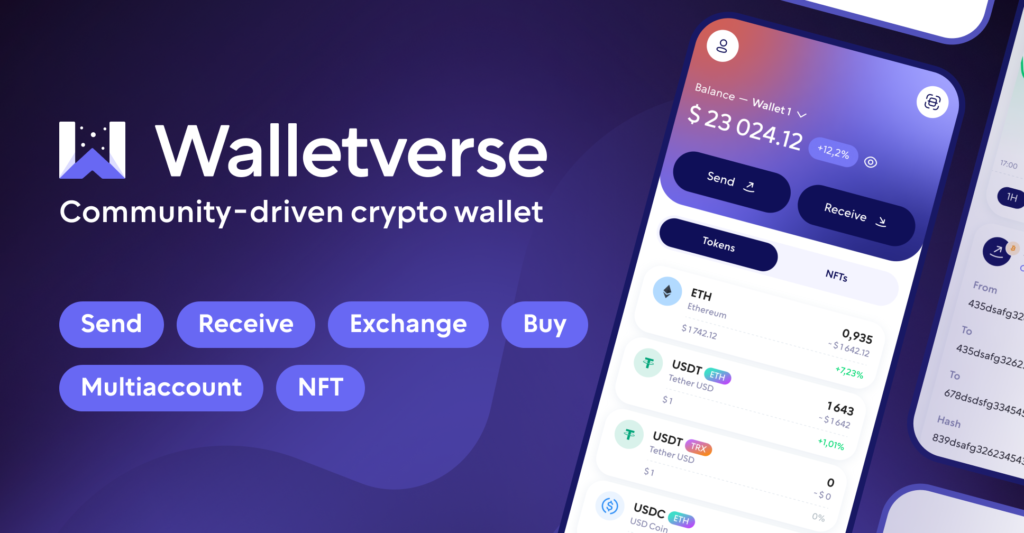
Walletverse is a mobile self-custody crypto wallet created for users who want to buy, store, send, and exchange crypto in one app. It supports Web3, DeFi access, dApps, multi-account management, and a wide range of digital assets.
Walletverse is suitable for both beginners and experienced crypto users. Users can buy crypto with Apple Pay, Google Pay, credit and debit cards, and fiat currencies such as USD, EUR, GBP, JPY, KZT, INR, CAD, AUD, and more. Walletverse materials describe support for 700+ crypto assets, while its app listings describe support for hundreds of cryptocurrencies, tokens, and blockchains.
For FRAX buyers, Walletverse can be useful as a mobile wallet for fiat purchases, asset management, self-custody storage, and Web3 access. If FRAX is not available for direct fiat purchase through a provider, users can buy another crypto asset first and then use a supported exchange or swap route.
Pros:
- Mobile-first self-custody wallet for everyday crypto use;
- Support for 700+ assets according to Walletverse materials;
- Apple Pay, Google Pay, bank cards, and multiple fiat currencies;
- Web3, DeFi, dApps, and multi-account functionality;
- Passcode and biometric authentication;
- GasFree USDT transfers on TRON;
- Google Play rating of 4.8 and App Store rating of 5.0.
Cons:
- Mobile-only format may not suit desktop-first users;
- Direct FRAX availability may depend on provider, region, and liquidity;
- Self-custody means users must protect their own recovery phrase.



2. MetaMask

MetaMask is one of the most widely used self-custody wallets for Ethereum and EVM-compatible networks. Since Frax-related assets are widely used across DeFi, MetaMask can be useful for users who want to manage tokens manually, connect to decentralized exchanges, and interact with liquidity protocols.
MetaMask is best suited for users who understand gas fees, token approvals, custom token imports, and decentralized exchange routes. It gives users strong control, but every transaction must be checked carefully.
Pros:
- Strong Ethereum and EVM-compatible network support;
- Useful for DeFi apps and decentralized exchanges;
- Browser extension and mobile app available;
- Good option for experienced Web3 users.
Cons:
- Less beginner-friendly than simple mobile wallets;
- Users must manage gas fees and approvals carefully;
- Wrong token contracts and fake assets can create serious risk.
3. Trust Wallet

Trust Wallet is a mobile self-custody wallet that supports many crypto assets, NFTs, and Web3 applications. It is often used by people who want one wallet for different blockchain networks and decentralized services.
For FRAX users, Trust Wallet may be useful for holding supported stablecoins, managing EVM-compatible assets, and connecting to swap routes. Users should confirm whether FRAX or a related Frax asset is supported before sending funds.
Pros:
- Broad multi-chain support;
- Simple mobile interface;
- NFT and dApp access;
- Suitable for users managing different crypto assets.
Cons:
- Direct FRAX buying may not always be available;
- In-app provider fees can vary;
- Advanced DeFi users may want more manual control.
4. Crypto.com DeFi Wallet

Crypto.com DeFi Wallet is a non-custodial wallet connected with the broader Crypto.com ecosystem. It supports DeFi access, swaps, NFTs, and multi-chain asset management.
For FRAX users, it may be useful if they already use Crypto.com services and want a separate wallet for self-custody and Web3 access.
Pros:
- Non-custodial wallet experience;
- DeFi and NFT support;
- Mobile-first interface;
- Useful for users familiar with Crypto.com products.
Cons:
- Best experience may depend on Crypto.com ecosystem usage;
- FRAX availability should be checked manually;
- Users are responsible for wallet backup and transaction safety.
5. SafePal

SafePal offers both software and hardware wallet options. It can be useful for users who want mobile access for daily crypto management and hardware wallet protection for longer-term storage.
For FRAX, SafePal may suit users who want to manage stablecoins and EVM-compatible assets while keeping stronger control over private keys.
Pros:
- Software and hardware wallet options;
- Useful for stronger self-custody setups;
- Multi-chain asset support;
- Good option for users who want mobile and cold-storage flexibility.
Cons:
- Hardware setup adds complexity;
- Direct FRAX buying may not be available;
- Users need to understand networks before transferring assets.
6. Binance Web3 Wallet

Binance Web3 Wallet is a wallet inside the Binance ecosystem that helps users access decentralized applications and swap routes. It can be useful for users who already buy crypto with fiat through Binance and want to move into Web3 activity.
For FRAX buyers, Binance Web3 Wallet may be useful if users first buy USDT, USDC, ETH, or another supported asset and then swap into FRAX through a decentralized route where liquidity is available.
Pros:
- Convenient for users already familiar with Binance;
- Can connect fiat buying with Web3 activity;
- Built-in access to decentralized routes;
- Useful for users who want both exchange and wallet functionality.
Cons:
- Availability depends on country and Binance services;
- Web3 wallet usage requires care with approvals;
- Direct FRAX availability should be checked before buying.
7. Exodus

Exodus is a non-custodial wallet known for its clean design, portfolio view, and desktop and mobile apps. It is popular with users who want a simple way to manage multiple crypto assets.
For FRAX, Exodus may be useful if token support is available or if users want to manage other crypto assets before using another supported exchange or swap route. Users should confirm FRAX support before sending funds.
Pros:
- Clean and beginner-friendly interface;
- Desktop and mobile apps available;
- Useful portfolio overview;
- Good for managing multiple crypto assets.
Cons:
- Not mainly designed for advanced DeFi activity;
- Swap fees and spreads can vary;
- FRAX may not be available directly in all regions or app versions.
8. Guarda

Guarda is a non-custodial wallet available on mobile, desktop, web, and browser extension. It supports many crypto assets and can be convenient for users who want wallet access across several devices.
For FRAX buyers, Guarda may be useful if they want to manage crypto from both desktop and mobile while keeping control of their private keys. Users should verify FRAX support before transferring assets.
Pros:
- Available on mobile, desktop, web, and browser extension;
- Non-custodial wallet model;
- Broad asset support;
- Useful for users working across several devices.
Cons:
- Third-party fiat fees can vary;
- FRAX availability should be checked before use;
- Interface may feel less simple than mobile-only wallets.
9. OKX Wallet

OKX Wallet is a Web3 wallet connected with the OKX ecosystem. It supports decentralized applications, swaps, NFTs, and multi-chain asset management.
For FRAX, OKX Wallet may be useful for users who want a trading-oriented Web3 wallet with access to decentralized routes and stablecoin swaps. Users should confirm the correct FRAX token and supported network before making a swap or transfer.
Pros:
- Strong Web3 and DeFi functionality;
- Multi-chain wallet support;
- Built-in swap and dApp access;
- Suitable for active crypto users.
Cons:
- Interface may feel complex for beginners;
- Availability can vary by region;
- Token support depends on network and liquidity routes.
10. Coinbase Wallet

Coinbase Wallet is a self-custody wallet from Coinbase. It is separate from the main Coinbase exchange account and allows users to manage tokens, connect to dApps, and store crypto under their own control.
For FRAX users, Coinbase Wallet may be useful for holding Ethereum-based assets and connecting to Web3 services. Users who buy crypto on a centralized exchange can move assets to Coinbase Wallet if they want more control over their own keys and DeFi access.
Pros:
- Beginner-friendly self-custody wallet;
- Strong connection with the Coinbase ecosystem;
- Web3 and token storage features;
- Useful for users moving from exchange to wallet.
Cons:
- Coinbase Wallet is not the same as a Coinbase exchange account;
- FRAX availability may vary by region and route;
- Users still need to protect their wallet backup.
Buy FRAX with Apple Pay
Buying FRAX with Apple Pay depends on whether the selected wallet, exchange, or fiat provider supports Frax directly. In some cases, users can buy FRAX directly with Apple Pay. In other cases, users may need to buy USDT, USDC, ETH, or another liquid asset first and then swap that asset for FRAX through a supported route.
Walletverse supports crypto purchases through fiat providers and popular payment methods in supported regions, including Apple Pay, Google Pay, bank cards, and multiple fiat currencies. This makes it useful for users who want to start with fiat and manage crypto in a mobile self-custody wallet.
Before buying FRAX with Apple Pay, users should check:
- Whether FRAX is available directly through the selected provider;
- Whether they need to buy USDT, USDC, ETH, or BNB first;
- Which network is being used;
- The total fee, including provider fees and blockchain gas;
- The official token contract and asset version;
- Whether there is enough liquidity for the swap.
Apple Pay can make the fiat purchase step faster, but it does not remove crypto risks. Users should still verify the token, network, exchange route, fees, and final transaction details before confirming.
Buy FRAX with Google Pay
Buying FRAX with Google Pay works in a similar way to Apple Pay. Users choose a wallet or exchange that supports Google Pay, select a fiat currency such as USD or EUR, complete the payment, and then either receive FRAX directly or buy another asset first and swap it.
Walletverse supports fiat purchase flows through integrated providers and payment options, while app store listings describe the wallet as supporting hundreds of cryptocurrencies, tokens, and blockchains. This can help users move from fiat into crypto while keeping assets in a mobile self-custody wallet.
A practical Google Pay route may look like this:
- Buy USDT, USDC, ETH, or BNB with Google Pay.
- Keep the asset in a self-custody wallet or transfer it to a supported exchange.
- Search for FRAX through an available trading or swap route.
- Verify the FRAX token, network, and contract before confirming.
- Store FRAX in a wallet where the token is supported.
This route is common for stablecoins that may be available on decentralized liquidity pools but not always available for direct fiat purchase through every wallet provider.
How to Buy The Frax (FRAX) with Fiat?
Step 1. Choose a crypto wallet or exchange
Start with a wallet or exchange that supports fiat payments, token swaps, and secure asset management. Walletverse is a useful mobile option for users who want self-custody, fiat on-ramp access, Web3 tools, dApps, multi-account support, and biometric security.
Step 2. Create your wallet and secure it
Download the wallet from the official app store page. Create a new wallet and store your recovery phrase offline. Do not save it in screenshots, cloud storage, email, or messaging apps.
Enable:
- Passcode protection;
- Biometric login;
- Device-level security;
- Small test transactions before larger transfers.
Step 3. Select your fiat currency
Choose the fiat currency you want to spend. Common options include USD, EUR, GBP, CAD, AUD, INR, JPY, and other local currencies depending on the provider.
Step 4. Pick a payment method
Select an available payment method, such as:
- Apple Pay;
- Google Pay;
- Credit card;
- Debit card;
- Bank transfer;
- Local payment provider.
Step 5. Search for Frax or FRAX
Search for Frax or FRAX inside the wallet, exchange, or provider interface. If FRAX is available directly, check the network, rate, provider fee, and final amount before confirming.
Step 6. Buy another crypto first if needed
If FRAX is not available for direct fiat purchase, buy a more liquid crypto asset first. Common options include USDT, USDC, ETH, or BNB. Then use a supported exchange, decentralized exchange, or Web3 wallet route to swap into FRAX.
Step 7. Verify the token and network
Because the Frax ecosystem has evolved and includes several related assets, users should verify the exact token they are buying. Current Frax documentation lists several stable assets in the ecosystem, including frxUSD, FPI, and frxETH, while legacy documentation describes FRAX as the dollar-pegged stablecoin.
Step 8. Store FRAX safely
After buying FRAX, store it in a wallet where you control access. If FRAX does not appear automatically, you may need to add the token manually using the correct contract details.
With self-custody wallets such as Walletverse, users control their own assets. This gives more independence, but it also means users must protect their recovery phrase, avoid suspicious approvals, and review every transaction before signing.
Important Things to Know Before Buying FRAX
FRAX is connected with stablecoin infrastructure, so its risk profile is different from volatile crypto assets. A stablecoin is designed to keep a stable value, but users still need to understand reserves, liquidity, redemption mechanisms, smart contracts, and regulatory conditions.
Key points to consider:
- FRAX is historically known as a dollar-pegged stablecoin from the Frax ecosystem;
- Frax has evolved into a broader stablecoin and DeFi infrastructure ecosystem;
- Current Frax documentation describes frxUSD as fiat-redeemable and fully collateralized;
- Frax legacy documentation describes FRAX as using AMO smart contracts and non-custodial subprotocols for stability;
- Stablecoin usage has grown significantly across payments, trading, DeFi, and on-chain settlement;
- Direct FRAX purchase availability depends on provider, exchange, region, network, and liquidity;
- Users should always verify the exact token, network, contract, fees, and wallet support before buying.
FRAX may appeal to users who want stablecoin exposure, DeFi access, liquidity management, and dollar-denominated crypto balances. However, stablecoins are not risk-free. They may involve smart contract risk, reserve risk, liquidity risk, regulatory risk, bridge risk, and self-custody risk.
Final Thoughts on Buying FRAX with Fiat
Frax (FRAX) is one of the better-known stablecoin assets in DeFi history. It became recognized for its dollar-pegged design and its role in the broader Frax ecosystem, which has expanded into stable assets, liquidity infrastructure, and modular blockchain products.
For users who want to buy FRAX with USD, EUR, or other fiat currencies, the process usually starts with a wallet or exchange that supports fiat payments. Walletverse can be a convenient mobile option because it supports self-custody, fiat buying, Web3 access, dApps, multi-account management, passcode protection, biometric authentication, and a broad range of crypto assets.
If FRAX is not available for direct fiat purchase, users can buy USDT, USDC, ETH, or BNB first and then swap into FRAX through a supported exchange or decentralized route. Before confirming any transaction, users should always check the correct token, network, contract, liquidity, provider fees, and wallet support.
Data current as of May 13, 2026.
FAQ
Most frequent questions and answers
FRAX may be useful for users who need a dollar-pegged stablecoin for DeFi, trading, transfers, or liquidity management. However, users should research the current Frax ecosystem, supported asset version, liquidity, redemption mechanics, and stablecoin risks before buying.
You can buy FRAX with USD through a wallet or exchange that supports fiat payments and Frax trading. If FRAX is not available directly, users can buy USDT, USDC, ETH, or BNB first and then swap into FRAX through a supported exchange or decentralized route.
You can use a crypto wallet that supports the network version of FRAX or the related Frax asset you want to hold. Walletverse is a convenient mobile self-custody option because it supports fiat purchases, Web3 access, dApps, multi-account management, passcode protection, biometric authentication, and hundreds of crypto assets.
FRAX may be available through selected centralized exchanges, decentralized exchanges, liquidity pools, and Web3 swap routes. Availability changes by region, network, liquidity, and provider, so users should check the wallet or exchange before buying.
The cheapest way depends on provider fees, exchange spreads, network gas fees, deposit methods, and liquidity. Users usually compare direct FRAX purchases with the cost of buying USDT, USDC, ETH, or BNB first and then swapping into FRAX through a supported route.
Yes, it may be possible to buy FRAX with EUR if the selected wallet, exchange, or fiat provider supports EUR payments and a route to Frax. If direct buying is unavailable, users can buy another supported crypto asset with EUR and then swap it for FRAX.
Walletverse supports buying and managing many crypto assets through a mobile self-custody wallet. Direct FRAX availability may depend on region, provider, network, and liquidity, so users should check the app first or use another supported exchange or Web3 swap route if needed.
FRAX is the legacy dollar-pegged stablecoin associated with the Frax Protocol, while current Frax documentation describes frxUSD as a fiat-redeemable, fully collateralized stablecoin issued by the Frax Protocol. Users should verify which Frax asset they are buying before making a transaction.


