


Buy gamestop-coin.vip (GME) with USD, EUR and Other Fiat Currencies
gamestop-coin.vip (GME) is an Ethereum-based meme token inspired by the GameStop retail-trading story, meme stock culture, and the wider online community around the GME ticker.
For users who want to buy GME with USD, EUR, GBP, CAD, AUD, INR, KZT, JPY or other fiat currencies, the process usually starts with a crypto wallet, fiat on-ramp, centralized exchange, card payment, Apple Pay, Google Pay, or a swap through Ethereum liquidity.
This article was prepared by ilink, a FinTech and Web3 software developer with 14 years of experience and completed projects worldwide.
What is gamestop-coin.vip (GME)?
gamestop-coin.vip (GME) is a meme token that operates on the Ethereum network. It is connected to the broader cultural story around GameStop, retail traders, internet communities, and the 2021 meme stock movement.
However, this token should not be confused with GameStop Corp. stock, which trades under the GME ticker on traditional stock markets. It should also not be confused with other crypto tokens using the GME name, because several unrelated GameStop-themed tokens may exist on different blockchains.
The gamestop-coin.vip version of GME is listed by market-data platforms as an Ethereum token. Coinbase lists it under the name GameStop (gamestop-coin.vip) and shows its network as Ethereum.
The listed Ethereum contract address is:
0xc56C7A0eAA804f854B536A5F3D5f49D2EC4B12b8
This contract address is important because meme tokens can have similar names, tickers, and branding. Before buying, users should always verify that the contract address matches the exact asset they want to purchase.
The project’s listed website presents GME Ethereum as a “memecoin for the meme that started it all.” This reflects the main nature of the asset. GME is not positioned as a layer-1 blockchain, infrastructure protocol, DeFi lending platform, oracle network, or payment system. It is mainly a community and meme-driven token.
Several factors may influence GME’s value:
- Liquidity and trading activity;
- Social media attention;
- Exchange availability;
- Ethereum network conditions;
- Holder sentiment;
- Broader interest in meme coins;
- Market demand for GameStop-related internet narratives.
The token’s max supply is commonly listed as 420,690,000,000 GME. On-chain explorers show more than 11,000 holders for the Ethereum contract, while market-data platforms show that the circulating supply is above 400 billion GME.
These numbers help users understand the scale of the token, but they should not be treated as a guarantee of safety, future demand, or long-term performance. Meme coins often move quickly because they are driven by community activity, social media trends, speculation, and liquidity rather than traditional business fundamentals.
This can create strong short-term attention, but it also creates high risk. Users should be especially careful with tokens that use famous brand names, stock tickers, or internet culture references. A recognizable name can attract attention, but it does not automatically mean official affiliation, legal approval, or long-term utility.
Before buying gamestop-coin.vip (GME), users should check:
- Whether they are buying the Ethereum token;
- Whether the contract address matches the intended asset;
- Whether liquidity is enough for the transaction size;
- Whether the token is supported by the wallet or exchange they use;
- Whether the asset has any official link to the company name it references;
- Whether price impact and fees are acceptable;
- Whether they can afford the risk of losing funds.
Overall, GME may appeal to users who follow meme coins, GameStop-related internet culture, Wall Street Bets-style narratives, and community-driven crypto assets. At the same time, it remains a speculative crypto asset. Users should research carefully, verify token details, and understand the risks before buying.
Where Can I Buy gamestop-coin.vip (GME) Cash - 10 Best Crypto Wallets
1. Walletverse
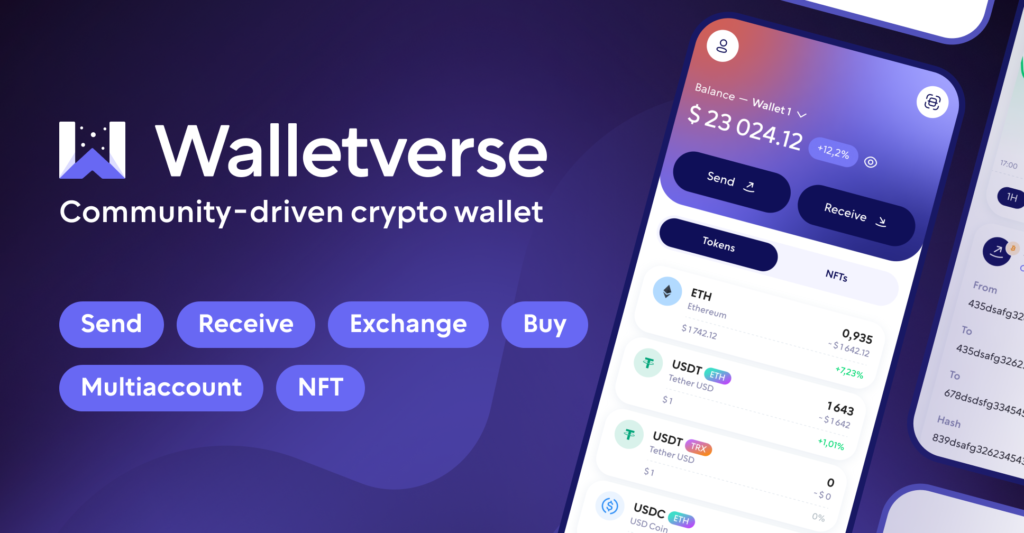
Walletverse is a mobile self-custody crypto wallet created for users who want to buy, store, send, receive, and exchange crypto in one app.
It supports 700+ cryptocurrencies and gives users access to Web3 tools, DeFi features, dApps, multi-account management, fiat on-ramp options, and crypto swaps.
For users who want to buy gamestop-coin.vip (GME) with fiat, Walletverse can be used as a practical starting point.
If GME is available through the selected provider or swap route, users can buy or exchange it directly inside the app.
If direct GME buying is unavailable, users may buy ETH, USDC, USDT or another supported asset with Apple Pay, Google Pay, credit card, debit card, or local fiat provider, then swap it to GME through a compatible Ethereum route.
Walletverse is non-custodial.
This means users control their own assets, while private keys remain under their control.
The Walletverse team cannot access user funds.
The app also includes passcode and biometric authentication, AML and KYT checks, Solana, ETH and TRX staking, and a proprietary GasFree USDT Transaction System on TRON.
This GasFree feature allows users to transfer USDT on TRON without holding TRX, because fees can be paid directly in USDT.
Pros
- Beginner-friendly mobile interface;
- Supports 700+ cryptocurrencies;
- Self-custody structure with user-controlled assets;
- Apple Pay, Google Pay, cards, and multiple fiat currencies;
- Passcode and biometric security;
- Built-in swaps, dApps, Web3 access, staking, and multi-account support;
- GasFree USDT transfers on TRON.
Cons
- Mobile-only experience;
- Direct GME availability depends on providers, liquidity, and network support;
- Users must protect their recovery phrase because the wallet is self-custodial.



2. Trezor
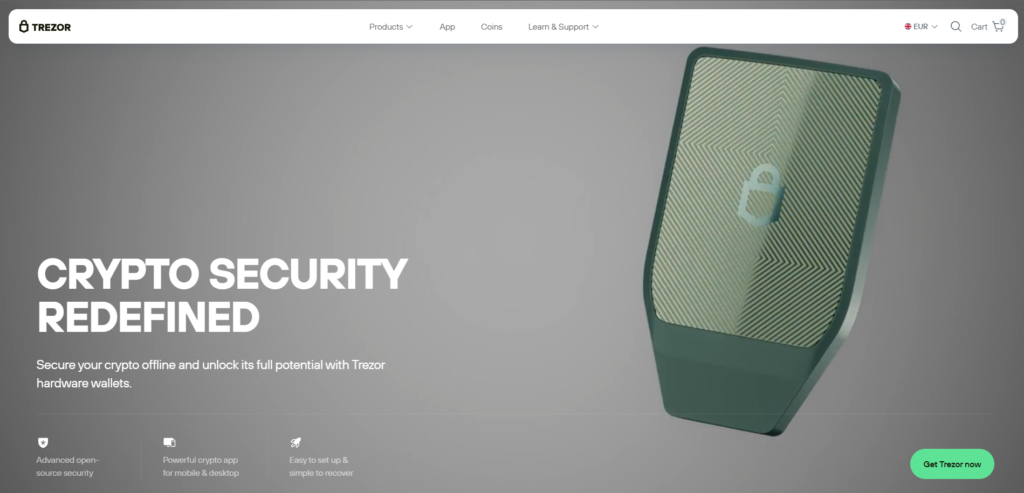
Trezor Suite is the wallet interface for Trezor hardware wallets.
Trezor devices can be used to store Ethereum-style tokens through compatible interfaces.
For GME users, Trezor may be useful if the priority is secure storage rather than fast mobile trading.
Users can buy GME through an exchange or fiat provider and then move it to a supported self-custody setup.
Pros
- Hardware wallet protection;
- Strong focus on self-custody;
- Useful for long-term holders;
- Private keys stay offline.
Cons
- Requires a hardware wallet purchase;
- Less convenient for quick mobile purchases;
- Users must carefully manage backup and recovery details.
3. Trust Wallet

Trust Wallet is a multi-chain self-custody wallet that supports many blockchains and tokens, including Ethereum-based assets.
It offers token storage, swaps, fiat buying, dApp access, and NFT support.
For users who want to buy GME, Trust Wallet may be useful if they want one mobile wallet for different crypto assets.
Users can buy ETH or stablecoins with fiat through supported providers, then swap to GME if a suitable route is available.
Pros
- Supports many blockchains and assets;
- Self-custody wallet model;
- Apple Pay, Google Pay, cards, and bank transfer support through partners;
- Good for users with multi-chain portfolios;
- Includes swaps and Web3 access.
Cons
- Fees vary by third-party provider;
- Direct GME buying may not be available in every region;
- Users must carefully check whether they are using the correct Ethereum token.
4. Rabby Wallet

Rabby Wallet is an EVM-focused self-custody wallet designed for DeFi users.
It supports Ethereum and many other EVM-compatible chains.
Rabby provides transaction simulation, risk warnings, and clearer signing information than many older browser wallets.
For GME users, Rabby may be useful when interacting with Ethereum swaps, token approvals, and decentralized exchanges.
It is especially helpful for users who want more visibility before signing transactions.
Pros
- Strong Ethereum and EVM support;
- Transaction simulation and risk alerts;
- Good for DeFi users;
- Helpful for checking approvals and contract interactions.
Cons
- More suitable for browser and desktop users than mobile-first beginners;
- Fiat buying options are less central than in some mobile wallets;
- Direct GME access depends on available routes and liquidity.
5. SafePal

SafePal offers mobile, browser extension, and hardware wallet options.
It supports many blockchains and tokens, including Ethereum-based assets.
SafePal includes buy, sell, swap, DeFi access, and hardware wallet protection for users who want more security.
For GME users, SafePal may be useful if they want software wallet convenience with the option to add hardware protection.
Pros
- Software and hardware wallet options;
- Supports many blockchains and tokens;
- Built-in buy, sell, swap, and DeFi tools;
- Suitable for users who want stronger storage protection.
Cons
- Hardware wallet setup takes extra time;
- Direct GME buying may require a swap route;
- Users must check chain and contract details before transfers.
6. Exodus

Exodus is a self-custody wallet available on mobile, desktop, and browser.
It supports many assets and provides buying, sending, receiving, swaps, staking for selected assets, and portfolio tracking.
For GME users, Exodus may be useful if they want a simple multi-platform wallet experience.
Users may buy ETH, USDC or another supported asset with fiat and then exchange it to GME if a route is available.
Pros
- Easy interface for beginners;
- Mobile, desktop, and browser options;
- Supports many crypto assets;
- Built-in buy and swap features;
- Useful portfolio tracking tools.
Cons
- Advanced DeFi users may prefer MetaMask or Rabby;
- Direct GME support should be checked before purchase;
- Swap and fiat fees depend on integrated providers.
7. Ledger Live

Ledger Live is the companion app for Ledger hardware wallets.
It can be used to manage many crypto assets and Ethereum-based tokens, depending on network and token support.
For GME holders, Ledger may be useful if they want stronger long-term storage protection.
Users may buy GME through an exchange or compatible swap route and then store it with hardware wallet security on Ethereum.
Pros
- Hardware wallet security;
- Good for long-term storage;
- Supports many Ethereum-compatible assets through connected wallets;
- Private keys remain offline.
Cons
- Requires buying a hardware device;
- Less convenient for frequent small transactions;
- Token visibility may require adding custom assets or using a connected wallet.
8. MetaMask

MetaMask is one of the most widely used self-custody wallets for Ethereum and EVM-compatible networks.
Because gamestop-coin.vip (GME) is listed as an Ethereum token, MetaMask can be useful for users who want to manage it directly on Ethereum.
Users may buy ETH, USDC or USDT through supported providers, then swap to GME through a compatible decentralized exchange route if available.
MetaMask is also useful for users who want to manually add the official contract address and check token details before interacting with a swap.
Pros
- Strong Ethereum support;
- Works with many decentralized exchanges;
- Allows manual token import by contract address;
- Good for users who understand DeFi and self-custody;
- Large ecosystem of dApps and wallet tools.
Cons
- Beginners may find network fees and approvals confusing;
- Fiat buying fees depend on third-party providers;
- Users must manually verify contract addresses and avoid fake tokens.
9. Coinbase Wallet

Coinbase Wallet is a self-custody wallet from Coinbase.
It supports Ethereum and several other major networks.
Because Coinbase lists GameStop (gamestop-coin.vip) as an Ethereum asset on its price pages, Coinbase Wallet may be useful for users who already use the Coinbase ecosystem and want to manage self-custody assets.
Users may buy ETH or another supported asset, move it to Coinbase Wallet, and swap into GME through a compatible route if available.
Pros
- Self-custody wallet from a well-known crypto brand;
- Supports Ethereum and major Web3 networks;
- Useful for users who already use Coinbase;
- Good connection between exchange buying and wallet storage.
Cons
- Direct GME support may vary by region and product route;
- Some users may need to move funds between Coinbase and Coinbase Wallet;
- Users still need to verify token contracts carefully.
10. OKX Wallet

OKX Wallet is a Web3 wallet connected to the broader OKX ecosystem.
It supports Ethereum, Arbitrum, BNB Chain, Polygon, Solana, and many other networks.
For GME buyers, OKX Wallet may be useful because it combines wallet management, swaps, DeFi access, and exchange-style tools.
Users may buy crypto with fiat where supported, then swap into GME if a suitable route is available.
Pros
- Supports many EVM and non-EVM networks;
- Strong Web3 and DeFi functionality;
- Integrated wallet and exchange ecosystem;
- Useful for active users comparing routes and liquidity.
Cons
- Some services may be unavailable in certain regions;
- Interface may feel complex for beginners;
- Users should understand the difference between exchange custody and wallet self-custody.
Buy gamestop-coin.vip (GME) with Apple Pay
Buying gamestop-coin.vip (GME) with Apple Pay can be convenient for users who want a fast mobile checkout experience.
The exact process depends on the wallet, fiat provider, exchange, country, and GME availability.
Some providers may support GME directly.
Others may require users to buy ETH, USDC, USDT or another supported asset first and then swap to GME afterward.
A typical Apple Pay flow looks like this:
- Install a crypto wallet that supports Ethereum-based assets, such as Walletverse, MetaMask, Trust Wallet, Coinbase Wallet, OKX Wallet or another compatible wallet.
- Create or import a wallet.
- Save the recovery phrase offline and never share it with anyone.
- Open the Buy section.
- Choose GME if it is available.
- If GME is unavailable, buy ETH, USDC or USDT.
- Select Apple Pay as the payment method.
- Complete identity verification if the provider requires it.
- Review the final quote, including provider fees and spread.
- Confirm the payment.
- Swap the purchased asset to GME through a supported Ethereum route.
- Check that GME arrives on the correct Ethereum address.
Walletverse can be useful for this process because it supports mobile crypto buying through Apple Pay, cards, local providers, and fiat currencies such as USD, EUR, GBP, CAD, AUD, INR, KZT, JPY and more.
Before confirming the payment, always review the total cost.
The final amount may include provider fees, Ethereum network fees, spread, and payment-processing charges.
Buy gamestop-coin.vip (GME) with Google Pay
Google Pay can help Android users buy crypto faster through supported wallets and fiat providers.
The process is similar to Apple Pay.
Users choose a wallet or platform, select GME if available, choose Google Pay, review the quote, and confirm the transaction.
If GME is not available directly, users can buy ETH, USDC or USDT first and then swap it to GME through a supported Ethereum route.
A typical Google Pay flow looks like this:
- Download a compatible wallet, such as Walletverse, MetaMask, Trust Wallet, OKX Wallet, SafePal or another wallet that supports Ethereum-based assets.
- Create a wallet and protect it with a passcode and biometrics.
- Store the recovery phrase securely offline.
- Open the Buy section.
- Select GME if it is available.
- If GME is unavailable, buy ETH, USDC or USDT first.
- Choose Google Pay as the payment method.
- Complete verification if required.
- Confirm the quote.
- Complete the purchase.
- Swap the purchased asset to GME.
- Check that GME arrives in the correct wallet address and on the correct network.
Walletverse supports Google Pay and other fiat payment options, which can make it convenient for users who prefer a mobile-first crypto experience.
Availability depends on country, provider, liquidity, compliance checks, payment method, and asset support.
How to Buy gamestop-coin.vip (GME) with Fiat?
The easiest way to buy gamestop-coin.vip (GME) with fiat is to use a wallet, exchange, or fiat provider that supports GME or compatible Ethereum assets.
Because GME may not be directly available through every fiat provider, users often choose one of two routes.
The first route is direct purchase.
If your provider supports GME directly, you can select GME, choose USD, EUR, GBP or another fiat currency, pay with Apple Pay, Google Pay, card or bank transfer, and receive GME in your wallet or exchange account.
The second route is indirect purchase.
If direct GME buying is unavailable, you can buy ETH, USDC or USDT with fiat, then swap it to GME through a compatible exchange, wallet, or decentralized liquidity route.
Here is a simple step-by-step process:
- Choose a wallet or exchange that supports Ethereum-based assets.
- Create an account or wallet.
- Complete identity verification if the fiat provider requires it.
- Select a fiat currency such as USD, EUR, GBP, CAD, AUD, INR, KZT or JPY.
- Buy GME directly if available.
- If GME is unavailable, buy ETH, USDC or USDT.
- Transfer funds to a self-custody wallet if buying through an exchange.
- Open the swap section.
- Swap the purchased asset to GME through a supported Ethereum route.
- Confirm the GME token contract before approving the transaction.
- Check Ethereum network fees before confirming the swap.
- Store GME in a secure self-custody wallet.
For beginners, Walletverse may be a practical choice because it combines fiat buying, self-custody, swaps, Web3 access, biometric protection, and support for many crypto assets in one mobile app.
For users focused on Ethereum and DeFi, MetaMask, Rabby, Coinbase Wallet, Trust Wallet, OKX Wallet, SafePal, Ledger, and Trezor may also be useful.
For users who prefer exchange liquidity first, centralized platforms listed by market aggregators may provide another route, followed by withdrawal to a self-custody wallet.
Conclusion
gamestop-coin.vip (GME) is an Ethereum-based meme token inspired by the GameStop retail-trading story and online meme-stock culture.
It is not the same as GameStop Corp. stock and should not be treated as an official company equity product.
Users who want to buy GME with USD, EUR or other fiat currencies can usually do it in two ways.
They can buy GME directly if their provider supports it, or they can buy ETH, USDC or USDT first and swap to GME through a compatible Ethereum route.
Walletverse is a convenient mobile option for users who want fiat buying, self-custody, Apple Pay, Google Pay, card payments, swaps, Web3 access, and security features in one app.
At the same time, Ethereum-focused wallets such as MetaMask and Rabby, multi-chain wallets such as Trust Wallet and OKX Wallet, and hardware wallets such as Ledger and Trezor may also be useful depending on user needs.
Before buying GME, always check the token contract, network, provider fees, liquidity, token legitimacy, wallet support, and risk level.
Data current as of June 18, 2026.
FAQ
Most frequent questions and answers
GME may be interesting for users who follow meme coins, GameStop-related internet culture, and community-driven crypto assets. However, it is a high-risk meme token, so users should evaluate liquidity, contract details, holder activity, social activity, exchange support, and personal risk tolerance before buying.
You can buy GME with USD directly if your wallet, exchange, or fiat provider supports it. If direct GME buying is unavailable, you can buy ETH, USDC or USDT with USD through Walletverse or another compatible wallet, then swap it to GME through a supported Ethereum route.
You can use a wallet that supports Ethereum-based tokens. Walletverse is a strong mobile option because it supports self-custody, fiat buying, Apple Pay, Google Pay, card payments, swaps, dApps, biometric security, and 700+ cryptocurrencies.
GME can be bought through selected centralized exchanges, decentralized exchange routes, and compatible crypto wallets. A common method is to buy GME directly where supported, or buy ETH, USDC or USDT first and then exchange it to GME.
The cheapest way depends on your country, payment method, provider fees, spread, exchange liquidity, Ethereum network fees, and withdrawal fees. In many cases, a bank transfer or low-fee exchange route may be cheaper than instant card purchases, while Walletverse can be convenient for users who prioritize mobile buying and self-custody.
Yes, Apple Pay may be available through supported wallets and fiat providers. Walletverse supports Apple Pay for buying crypto, and users may then buy or swap to GME if a suitable route is available.
Yes, Google Pay may be available through supported Android wallets and fiat providers. Walletverse supports Google Pay for crypto purchases, although direct GME availability depends on provider support, country, and liquidity.
Yes, major market-data pages list GameStop (gamestop-coin.vip) as an Ethereum-based token. Users should always check the exact contract address before buying, sending or swapping it.
The Ethereum contract address listed for gamestop-coin.vip (GME) is 0xc56C7A0eAA804f854B536A5F3D5f49D2EC4B12b8. Always verify the address before buying because fake tokens can use the same name or ticker.
Walletverse can be useful for beginners because it combines a simple mobile interface, fiat buying, self-custody, swaps, biometric protection, and support for many cryptocurrencies. Users should still check whether GME is available directly or whether they need to buy ETH, USDC or USDT first and then swap to GME.


