


Buy Kin (KIN) with USD, EUR and Other Fiat Currencies
Kin (KIN) is a Solana-based cryptocurrency created for digital services, apps, creators, payments, and small-value online transactions.
For users who want to buy KIN with USD, EUR, GBP, CAD, AUD, INR, KZT, JPY or other fiat currencies, the process usually starts with a crypto wallet, a fiat on-ramp, or an exchange that supports Solana-based assets.
This article was prepared by ilink, a FinTech and Web3 software developer with 14 years of experience and completed projects worldwide.
What is Kin (KIN)?
Kin (KIN) is a cryptocurrency originally created by Kik Interactive, the company behind the Kik messaging app. The project was introduced in 2017 with the goal of building a digital economy where users, developers, creators, and online communities could exchange value inside apps and digital services.
Unlike many crypto projects focused mainly on trading, Kin was designed around everyday digital payments. Its early purpose was to support small transactions, creator rewards, in-app purchases, tipping, and user engagement across consumer applications.
This makes Kin closely connected to the idea of micropayments. Traditional payment systems often make very small transactions difficult because card fees and platform fees can be too high. Kin was created to make small-value digital transactions easier, especially inside apps, games, social platforms, and creator tools.
Kin first launched on Ethereum as an ERC-20 token. Later, the project went through several technical stages before migrating to Solana in 2020. This migration was important because Solana offered faster transactions and lower fees, which are useful for high-volume consumer payment activity.
Phantom describes Kin as “a decentralized cryptocurrency” for global permissionless transactions. Coinbase also explains Kin as a token designed to support a digital economy where users, app developers, and content creators can earn and spend value across digital services.
One of Kin’s most important historical points is its regulatory background. In 2019, the U.S. Securities and Exchange Commission filed a case against Kik Interactive related to the 2017 Kin token sale. In 2020, the case ended with a final judgment and a $5 million penalty paid by Kik. This history is important for users researching Kin because it shaped the project’s public profile and long-term development.
Another important point is supply. Kin was originally designed with a very large token supply of 10 trillion KIN. After later ecosystem changes and burns, current market-data sources show a much lower current supply than the original maximum. Because supply figures can change when burns or technical updates happen, users should always verify the latest data before buying.
Kin’s Solana token address is:
kinXdEcpDQeHPEuQnqmUgtYykqKGVFq6CeVX5iAHJq6
As of current public market-data sources in June 2026, Kin is listed as a Solana token with a supply in the trillions. This large supply is one reason why KIN is usually discussed as a micropayment token rather than a scarce store-of-value asset like Bitcoin.
The main use cases for Kin include:
- App-based payments;
- Creator rewards;
- User incentives;
- Tipping;
- Digital content purchases;
- Small online payments;
- Community-driven payment experiments.
Overall, KIN’s future depends on whether the token can maintain real usage across apps, creators, communities, and payment experiments. Several factors may influence its long-term relevance:
- Adoption by consumer applications;
- Liquidity and exchange support;
- Activity across the Solana ecosystem;
- Developer interest;
- New app integrations;
- Broader demand for crypto-based micropayments.
As with any crypto asset, KIN can be volatile. Users should always check liquidity, supported networks, provider fees, the official token address, and personal risk tolerance before buying.
Where Can I Buy Kin (KIN) Cash - 10 Best Crypto Wallets
1. Walletverse
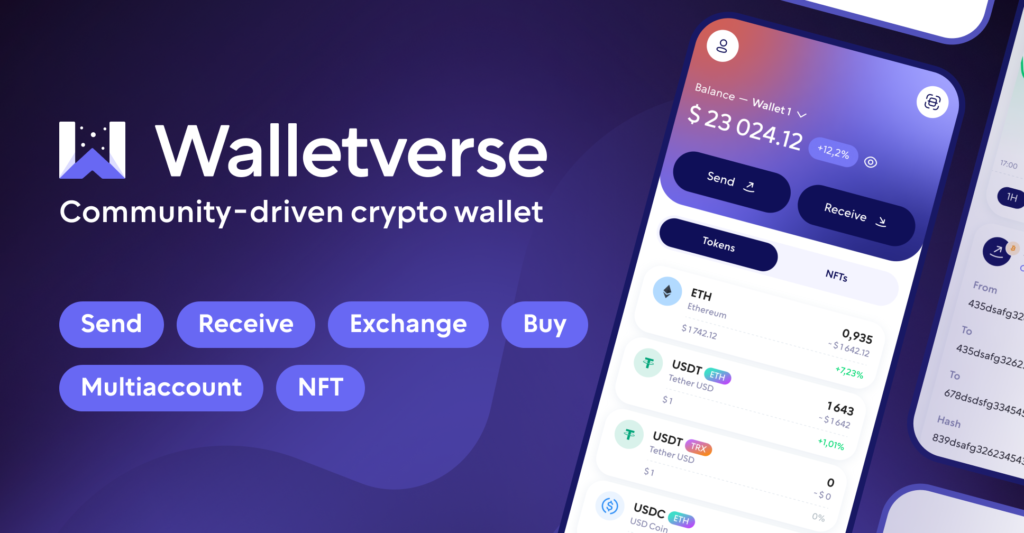
Walletverse is a mobile self-custody crypto wallet designed for users who want to buy, store, send, receive, and exchange crypto in one app.
It supports 700+ cryptocurrencies and provides access to Web3 tools, DeFi features, dApps, multi-account management, fiat on-ramp services, and swaps.
For users who want to buy Kin (KIN) with fiat, Walletverse can be used as a practical starting point.
If KIN is available through the selected provider or swap route, users can buy or exchange it inside the app.
If direct KIN buying is unavailable, users may buy SOL, USDC, USDT or another supported asset with Apple Pay, Google Pay, credit card, debit card, or local fiat provider, then swap it to KIN through a compatible route.
Walletverse is non-custodial, which means users control their own assets.
Private keys remain under the user’s control, and the Walletverse team cannot access user funds.
The app also includes passcode and biometric authentication, AML and KYT checks, Solana, ETH and TRX staking, and a proprietary GasFree USDT Transaction System on TRON.
This GasFree feature allows users to transfer USDT on TRON without holding TRX, because fees can be paid directly in USDT.
Pros
- Beginner-friendly mobile interface;
- Supports 700+ cryptocurrencies;
- Self-custody structure with user-controlled assets;
- Apple Pay, Google Pay, cards, and multiple fiat currencies;
- Passcode and biometric security;
- Built-in swaps, dApps, Web3 access, staking, and multi-account support;
- GasFree USDT transfers on TRON.
Cons
- Mobile-only experience;
- Direct KIN availability depends on providers and liquidity;
- Users must protect their recovery phrase because the wallet is self-custodial.



2. Phantom

Phantom is one of the most widely used wallets in the Solana ecosystem.
It supports Solana tokens, NFTs, dApps, swaps, staking tools, and fiat buying through integrated partners.
For KIN buyers, Phantom can be useful because KIN is a Solana-based token.
Users can buy SOL or USDC through supported fiat providers, then swap to KIN through available Solana liquidity routes.
Phantom is especially useful for users who regularly interact with Solana DeFi, token swaps, NFTs, and Web3 applications.
Pros
- Strong Solana ecosystem support;
- Simple dApp connection;
- Built-in token swaps;
- Suitable for Solana-based tokens such as KIN;
- Fiat buying available through selected providers.
Cons
- Direct KIN buying may not always be available;
- Provider availability depends on country;
- Users need SOL for Solana network fees.
3. Trust Wallet

Trust Wallet is a multi-chain self-custody wallet that supports many blockchains, including Solana.
It offers token storage, swaps, fiat buying, dApp access, and NFT support.
For users who want to buy KIN, Trust Wallet may be useful if they want one wallet for many crypto assets.
Users can buy crypto with fiat through supported providers, then move funds to Solana and swap to KIN where available.
Trust Wallet can be a practical choice for users who already manage assets across different networks and want one app for many coins and tokens.
Pros
- Supports many blockchains and assets;
- Self-custody wallet model;
- Apple Pay, Google Pay, cards, and bank transfer support through partners;
- Good for users with multi-chain portfolios;
- Includes swaps and Web3 access.
Cons
- Solana-native experience may feel less specialized than Phantom or Solflare;
- Fees vary by third-party provider;
- Users must carefully check networks before sending assets.
4. Solflare

Solflare is a Solana-focused wallet created for storing, staking, buying, swapping, and managing Solana assets.
It is often used by people who want deeper access to Solana tools and applications.
For KIN, Solflare can be useful because it supports Solana tokens and connects to Solana dApps.
Users may buy SOL with fiat where supported and then swap SOL or USDC to KIN if liquidity is available.
Solflare may be a good option for users who want to combine KIN storage with broader Solana portfolio management.
Pros
- Built specifically for Solana;
- Supports staking, swaps, NFTs, and dApps;
- Suitable for SPL tokens such as KIN;
- Fiat buying routes available through partners;
- Good for active Solana users.
Cons
- Less suitable for users who want broad multi-chain simplicity;
- Direct KIN buying may depend on available routes;
- Beginners may need time to understand Solana fees and token accounts.
5. SafePal

SafePal offers mobile, browser extension, and hardware wallet options.
It supports many blockchains and tokens, and includes buy, sell, swap, and DeFi features.
For KIN users, SafePal may be useful if they want software wallet convenience with the option to add hardware security.
Users can buy crypto with fiat through available providers, then swap to KIN through supported Solana routes.
Pros
- Software and hardware wallet options;
- Supports many blockchains and tokens;
- Built-in buy, sell, swap, and DeFi tools;
- Suitable for users who want extra cold-storage options.
Cons
- Hardware wallet setup takes extra time;
- Direct KIN buying may require a swap route;
- Users must carefully choose the Solana network when moving assets.
6. Exodus

Exodus is a self-custody wallet available on mobile, desktop, and browser.
It supports many assets and provides buying, sending, receiving, swaps, staking, and portfolio tracking.
For KIN users, Exodus may be useful if they want a simple interface and multi-platform access.
Users may buy SOL with fiat where supported, then swap to KIN if a route is available.
Exodus can be practical for beginners who prefer visual portfolio tools and simple navigation.
Pros
- Easy interface for beginners;
- Mobile, desktop, and browser options;
- Supports Solana and many other assets;
- Built-in buy and swap features.
Cons
- Advanced Solana users may prefer Phantom or Solflare;
- Direct KIN support should be checked before purchase;
- Swap and fiat fees depend on integrated providers.
7. Backpack
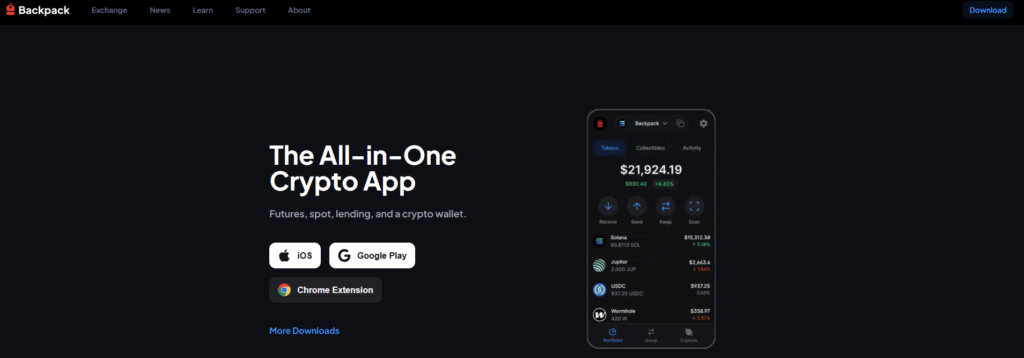
Backpack is a Web3 wallet and exchange ecosystem with strong Solana roots.
It supports Solana assets, NFTs, app-style Web3 experiences, swaps, and ecosystem interactions.
For KIN users, Backpack can be useful for managing Solana tokens and connecting to Web3 apps.
Depending on region and provider access, users may buy SOL or USDC first and then swap to KIN.
Backpack may be suitable for users who prefer a more Web3-native Solana experience and want both wallet and exchange-style tools.
Pros
- Strong Solana compatibility;
- Supports token management, NFTs, swaps, and dApps;
- Useful for active Web3 users;
- Modern interface for Solana ecosystem activity.
Cons
- Fiat access may vary by region;
- Some tools may feel advanced for beginners;
- Direct KIN buying may require a swap route.
8. Coin98
Coin98 is a multi-chain Web3 wallet designed for DeFi users.
It supports many networks, including Solana, and provides swaps, dApp access, and cross-chain asset management.
For KIN, Coin98 may be useful for users who already interact with DeFi and want broad network coverage.
Users may buy SOL or USDC first, then swap to KIN through Solana-compatible liquidity.
Pros
- Multi-chain wallet with Solana support;
- Built for DeFi users;
- Includes swaps and dApp access;
- Useful for users managing assets across different networks.
Cons
- Interface can feel busy for beginners;
- Some tokens may require manual search;
- Fiat options may vary by country and provider.
9. OKX Wallet

OKX Wallet is a Web3 wallet connected to the larger OKX ecosystem.
It supports many blockchains, including Solana, and includes swaps, DeFi tools, NFTs, and on-chain trading access.
For KIN buyers, OKX Wallet may be useful because users can combine exchange access, wallet management, and DeFi routes.
Depending on availability, users can buy SOL or USDC with fiat, then swap to KIN through a supported route.
Pros
- Supports Solana and many other networks;
- Strong Web3 and DeFi functionality;
- Integrated wallet and exchange ecosystem;
- Useful for active users comparing routes and liquidity.
Cons
- Some services may be unavailable in certain regions;
- Interface may feel complex for beginners;
- Users should understand the difference between exchange custody and self-custody.
10. Coinbase Wallet

Coinbase Wallet is a self-custody wallet from Coinbase.
It supports multiple networks and includes support for Solana and SPL tokens.
For users who already use Coinbase, Coinbase Wallet can be useful because it creates a familiar bridge between exchange buying and self-custody storage.
A user may buy SOL or USDC through an exchange route, transfer it to Coinbase Wallet, and then swap to KIN through a compatible Solana route if available.
Pros
- Self-custody wallet from a well-known crypto brand;
- Supports Solana and SPL tokens;
- Useful for users who already use Coinbase;
- Good connection between exchange buying and wallet storage.
Cons
- Direct KIN support may vary;
- Some users may need to move funds between Coinbase and Coinbase Wallet;
- Solana DeFi experience may be less specialized than Solana-first wallets.
Buy Kin (KIN) with Apple Pay
Buying Kin (KIN) with Apple Pay can be convenient for users who want a fast mobile payment flow.
The exact process depends on the wallet, fiat provider, exchange, and country.
Some providers may support KIN directly.
Others may require users to buy SOL or USDC first and then swap to KIN on Solana.
A typical Apple Pay flow looks like this:
- Install a Solana-compatible wallet, such as Walletverse, Phantom, Solflare, Trust Wallet, or another supported wallet.
- Create or import a wallet.
- Save the recovery phrase offline and never share it with anyone.
- Open the Buy section.
- Choose KIN if it is available.
- If KIN is unavailable, buy SOL or USDC on Solana.
- Select Apple Pay as the payment method.
- Complete verification if the provider requires it.
- Confirm the quote and complete the purchase.
- Swap SOL or USDC to KIN through a supported Solana route.
- Keep a small amount of SOL in the wallet for network fees.
Walletverse can be useful for this process because it supports mobile crypto buying through Apple Pay, cards, local providers, and fiat currencies such as USD, EUR, GBP, CAD, AUD, INR, KZT, JPY and more.
Before confirming the payment, always review the final amount.
The total cost may include provider fees, network fees, spread, and payment-processing charges.
Buy Kin (KIN) with Google Pay
Google Pay can help Android users buy crypto faster through supported wallets and fiat providers.
The process is similar to Apple Pay.
Users can either buy KIN directly if the provider supports it, or buy SOL or USDC first and swap to KIN afterward.
A typical Google Pay flow looks like this:
- Download a compatible wallet, such as Walletverse, Phantom, Solflare, Trust Wallet, OKX Wallet, or another Solana-supporting wallet.
- Create a wallet and protect it with a passcode and biometrics.
- Store the recovery phrase securely offline.
- Open the Buy section.
- Select KIN if it is available.
- If KIN is unavailable, buy SOL or USDC first.
- Choose Google Pay as the payment method.
- Confirm the quote.
- Complete the purchase.
- Swap the purchased asset to KIN on Solana.
- Check that KIN arrives in the correct wallet address.
Walletverse supports Google Pay and other fiat payment options, which can make it convenient for users who prefer a mobile-first crypto experience.
Availability depends on country, provider, liquidity, compliance checks, and asset support.
How to Buy Kin (KIN) with Fiat?
The easiest way to buy Kin (KIN) with fiat is to use a wallet or exchange that supports fiat payments and Solana assets.
Because KIN is a Solana-based token, users often choose one of two routes.
The first route is direct purchase.
If your provider supports KIN directly, you can select KIN, choose USD, EUR, GBP or another fiat currency, pay with Apple Pay, Google Pay, card or bank transfer, and receive KIN in your wallet.
The second route is indirect purchase.
If direct KIN buying is unavailable, you can buy SOL or USDC with fiat, then swap it to KIN through a Solana-compatible wallet or decentralized exchange route.
Here is a simple step-by-step process:
- Choose a wallet or exchange that supports Solana.
- Create an account or wallet.
- Complete verification if the fiat provider requires it.
- Select a fiat currency such as USD, EUR, GBP, CAD, AUD, INR, KZT or JPY.
- Buy KIN directly if available.
- If KIN is unavailable, buy SOL or USDC.
- Transfer funds to a Solana wallet if buying through an exchange.
- Open the swap section.
- Swap SOL or USDC to KIN.
- Confirm the KIN token address before approving the transaction.
- Keep a small amount of SOL for future network fees.
- Store KIN in a secure self-custody wallet.
For beginners, Walletverse may be a practical choice because it combines fiat buying, self-custody, swaps, Web3 access, biometric protection, and support for many crypto assets in one mobile app.
For users focused mainly on Solana tokens and dApps, Phantom or Solflare may also be useful.
For users who prefer exchange liquidity first, centralized platforms listed by market aggregators may provide another route, followed by withdrawal to a self-custody wallet.
Conclusion
Kin (KIN) is a Solana-based cryptocurrency with a long history in digital payments, app monetization, creator rewards, tipping, and micropayments.
It began as a Kik-backed ecosystem token in 2017 and later moved to Solana to support faster and lower-cost transactions.
Users who want to buy KIN with USD, EUR or other fiat currencies can usually do it in two ways.
They can buy KIN directly if their provider supports it, or they can buy SOL or USDC first and swap to KIN on Solana.
Walletverse is a convenient mobile option for users who want fiat buying, self-custody, Apple Pay, Google Pay, card payments, swaps, Web3 access, and security features in one app.
At the same time, Solana-focused wallets like Phantom and Solflare may be useful for users who actively manage Solana-based assets.
Before buying KIN, always check the token address, network, provider fees, liquidity, and risk level.
Data current as of June 18, 2026.
FAQ
Most frequent questions and answers
KIN may be interesting for users who believe in crypto micropayments, Solana-based payments, app monetization, creator rewards, and digital economies. However, KIN is still a volatile crypto asset, so users should evaluate liquidity, adoption, supply, exchange support, and personal risk tolerance before buying.
You can buy KIN with USD directly if your wallet, exchange, or fiat provider supports it. If direct KIN buying is unavailable, you can buy SOL or USDC with USD through Walletverse or another Solana-compatible wallet, then swap it to KIN.
You can use a Solana-compatible wallet that supports SPL tokens. Walletverse is a strong mobile option because it supports self-custody, fiat buying, Apple Pay, Google Pay, card payments, swaps, dApps, biometric security, and 700+ cryptocurrencies.
KIN can be bought through selected centralized exchanges, Solana-compatible wallets, and decentralized swap routes. A common method is to buy SOL or USDC with fiat first, then exchange it to KIN on Solana.
The cheapest way depends on your country, payment method, provider fees, spread, liquidity, and network fees. In many cases, buying SOL or USDC with a low-fee provider and then swapping to KIN on Solana may be cheaper than using a high-fee instant card route.
Yes, Apple Pay may be available through supported wallets and fiat providers. Walletverse supports Apple Pay for buying crypto, and users may then buy or swap to KIN if a suitable route is available.
Yes, Google Pay may be available through supported Android wallets and fiat providers. Walletverse supports Google Pay for crypto purchases, although direct KIN availability depends on provider support and liquidity.
Yes, KIN is currently used as a Solana-based token. This means users should use a Solana-compatible wallet and keep a small amount of SOL for transaction fees.
The KIN token address on Solana is kinXdEcpDQeHPEuQnqmUgtYykqKGVFq6CeVX5iAHJq6. Always verify the token address before buying or swapping, because fake tokens can appear on decentralized exchanges.
Walletverse can be useful for beginners because it combines a simple mobile interface, fiat buying, self-custody, swaps, biometric protection, and support for many cryptocurrencies. Users still need to check whether KIN is available directly or whether they should first buy SOL or USDC and then swap to KIN.


