


How to Buy Euro Coin (EURC) in 2026
- Updated: 2026-09-24
Want to buy EUROC? Euro Coin now trades under the ticker EURC. Circle retired the old EUROC symbol in 2023, but the token and its contract addresses stayed the same. Below, you’ll learn how to buy EURC with a card, swap into it without an exchange, and which wallets support it.
Euro-denominated stablecoins are becoming more relevant as stablecoin usage grows and businesses look for faster settlement and predictable pricing. As of September 2026, the total stablecoin market cap is about $306 billion, and EURC has around 403 million tokens in circulation.
Quick facts:
- Current market cap: ~$458 million (September 2026)
- Main networks: Arc, Avalanche, Base, Cronos, Ethereum, Plasma, Solana, Stellar, World Chain
- Updated: September 2026
What is Euro Coin (EURC)?
EURC is a euro-backed stablecoin issued by Circle and designed to represent euros on-chain. It was originally launched under the name EUROC and later standardized as EURC across listings and tooling.
EURC is commonly described as fully reserved (1:1) with euro-denominated reserves held at regulated financial institutions, with regular attestations referenced by major exchanges that list the asset.
How does Euro Coin (EURC) work?
EURC works like other fiat-backed stablecoins:
EURC is issued when euros are deposited with the issuer’s reserve structure (direct issuance is typically for eligible institutions).
EURC moves on public blockchains as a standard token (depending on chain).
EURC can be redeemed back to euros through supported rails (again, typically via institutional flows).
If your goal is personal use, you usually don’t “mint” EURC directly. You buy it in a wallet app, on an exchange, or swap it on-chain.
EURC is multi-chain (official mainnet addresses)
Circle publishes the official EURC token addresses for each supported network on its EURC contract addresses page. For example, the EURC address on Ethereum is 0x1aBaEA1f7C830bD89Acc67eC4af516284b1bC33c. This is the safest reference when you verify the token or add it to a wallet manually.
EUROC (EURC) Price and Market Data
EURC Price Today
EURC is a stablecoin pegged to the euro, so its price in euros stays at about €1. Each EURC is designed to be redeemable 1:1 for euros, and Circle backs every token with euro reserves held at regulated financial institutions in the European Economic Area.
In US dollars, the EURC price follows the EUR/USD exchange rate. In late September 2026, 1 EURC was worth about $1.14. When the euro strengthens against the dollar, the EURC price in USD goes up, and when the euro weakens, it goes down.
On exchanges, the price can briefly move a fraction of a cent away from €1 because of supply and demand. Large deviations are rare and usually short-lived, because traders buy or redeem EURC and bring it back to the peg.
EURC Market Overview
| Metric | Value |
|---|---|
| Price | ≈ €1.00 / $1.14 |
| Market cap | ≈ $458 million |
| 24h trading volume | ≈ $29 million |
| Circulating supply | ≈ 403 million EURC |
| Issuer | Circle |
| Blockchains | Arc, Avalanche, Base, Cronos, Ethereum, Plasma, Solana, Stellar, World Chain |
| Regulation | MiCA-compliant, backed 100% by euro |
Data as of September 2026, from CoinGecko and Circle.
Where can you buy EURC in 2026?
Most users buy EURC in one of three ways:
In-wallet purchase (fastest for beginners).
Buy EURC inside a wallet that supports card or Apple Pay/Google Pay purchases (availability depends on country and provider).Centralized exchange (best for large orders or limit orders).
Buy EURC on an exchange that lists it, then withdraw EURC to your self-custody wallet (make sure the network matches).On-chain swap (best for DeFi users).
Swap from USDC/USDT/ETH into EURC using a DEX on a supported network. Use the official contract address for that network.
How to Buy EUROC Without an Exchange
You don’t need an exchange account to buy EURC. In Walletverse, you can buy it with a card or swap other crypto for it, and the tokens go straight to your self-custody wallet.
Buy EURC with a Card, Apple Pay or Google Pay
- Open Walletverse.
- Tap Buy and choose Euro Coin (EURC).
- Enter the amount you want to buy.
- Choose a payment method: Visa, Mastercard, Apple Pay or Google Pay.
- Review the quote: the amount of EURC you’ll get, the fees and the exchange rate.
- Complete the purchase. EURC will arrive in your Walletverse wallet.
Available payment methods and fiat currencies depend on your country and the payment provider. Walletverse gives you access to several fiat on-ramp providers in one app, so you can pick the option that works for you. The provider may ask you to verify your identity before the first purchase.
Swap Crypto for EURC in the App
Already have USDC, USDT or ETH? Swap them for EURC right in Walletverse with the built-in DEX aggregator:
- Open Swap.
- Choose the token you have and select EURC as the token you want.
- Check the rate, the fee and the network.
- Confirm the swap.
You’ll need a small amount of the network’s gas coin to pay the fee, for example ETH on Ethereum. Rates and available pairs depend on liquidity providers.
How to buy EURC step by step
Buy on an exchange and withdraw to your wallet
Buy EURC on the exchange.
Open your wallet, select EURC, tap Receive, copy the address.
On the exchange, choose Withdraw.
Select the same network your wallet address belongs to (critical).
Send a small test amount first if the transfer is large.
Confirm and wait for network confirmations.
Swap into EURC via DeFi
Fund your wallet with the network’s gas token (ETH on Ethereum, SOL on Solana, etc.).
Open a DEX or swap aggregator.
Select the token you have and EURC as the token you want.
Verify you are using the official EURC token contract for that network.
Approve and swap.
Top 10 Best Crypto Wallets to Buy Euro Coin (EURC) in 2026
If you’re planning to buy, send, or store EURC, choosing the right wallet is essential for security and convenience. Here’s a comparison of the top 10 wallets for managing EURC:
1. Walletverse

A mobile multi-currency wallet built for everyday use: store, send, and swap crypto, plus Web3/dApps access. Supports 700+ cryptocurrencies and lets users buy crypto with Apple Pay / Google Pay / cards in multiple fiat currencies.
Pros
Self-custody (you control access)
700+ assets, multi-account, dApps/Web3 support
Fast mobile UX; passcode + biometrics
Helpful for day-to-day transfers and portfolio tracking
Cons
Mobile-only (no desktop app)


2. MetaMask

A classic choice for EURC on Ethereum and other EVM chains. Best if you use DeFi, bridges, or on-chain apps frequently.
Pros
Excellent EVM + DeFi compatibility
Easy to connect to dApps
Large ecosystem of integrations
Cons
Can be confusing for beginners (networks, gas, token contracts)
Phishing risk is higher due to popularity (users must be vigilant)
3. Coinbase Wallet

A widely used wallet for Ethereum and many other networks, good for EURC on EVM chains and for interacting with dApps. Often chosen by users who want a simple interface plus Web3 access.
Pros
Strong Web3/dApp support
Familiar UI for many users
Works well with EVM tokens like EURC (network-dependent)
Cons
Some advanced features can feel “walled” compared to power-user wallets
Still requires careful network selection and manual checks
4. Trust Wallet

A popular mobile wallet that supports Ethereum and ERC-20 tokens, making it a practical option for EURC on Ethereum/EVM networks.
Pros
Beginner-friendly mobile interface
Supports ETH + ERC-20 tokens (useful for EURC on EVM)
Good multi-chain coverage for everyday use
Cons
Mobile-only for many users’ workflows
DeFi features can still be confusing without experience
5. Ledger Nano (via Ledger Live or MetaMask)

Best for long-term storage of larger EURC holdings on Ethereum/EVM networks (and other supported chains) because keys stay offline.
Pros
High security via offline key storage
Good for long-term holding
Works with popular software wallets for sending/receiving
Cons
Costs money and adds setup steps
Less convenient for frequent small transactions
6. Trezor
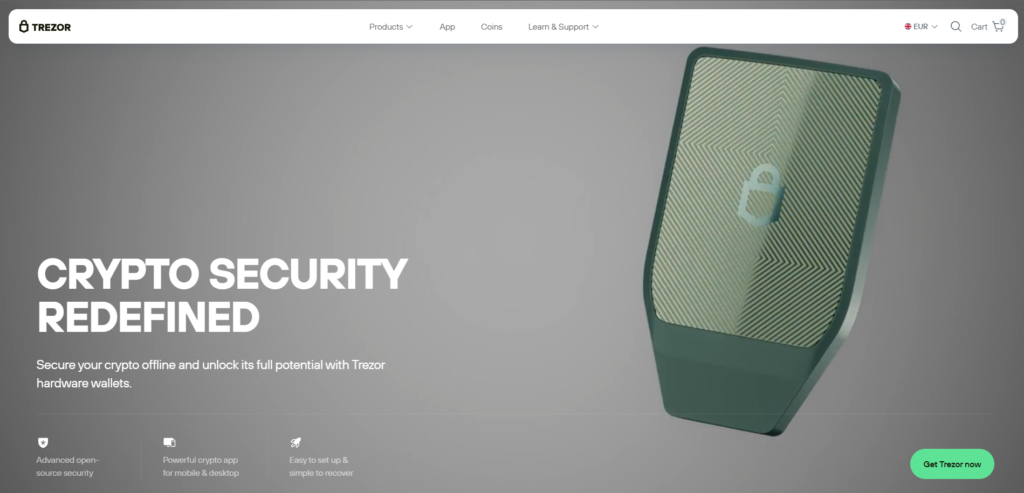
Trezor can store ERC-20 tokens by sending them to your Ethereum address (the wallet app can auto-detect ERC-20 tokens).
Pros
Strong security model (offline keys)
Good for long-term storage of EURC as an ERC-20 token
Works well for security-focused users
Cons
Hardware purchase + onboarding friction
Not ideal for fast “daily spending” flows
7. SafePal

SafePal is often chosen by users who want a mobile wallet experience plus an upgrade path to hardware security. SafePal positions broad chain coverage (hundreds of networks).
Pros
Mobile-first with optional hardware layer
Broad multi-chain coverage
Useful for users who want security + flexibility
Cons
UX can feel busy for beginners
Some workflows depend on network/tooling familiarity
8. Guarda Wallet
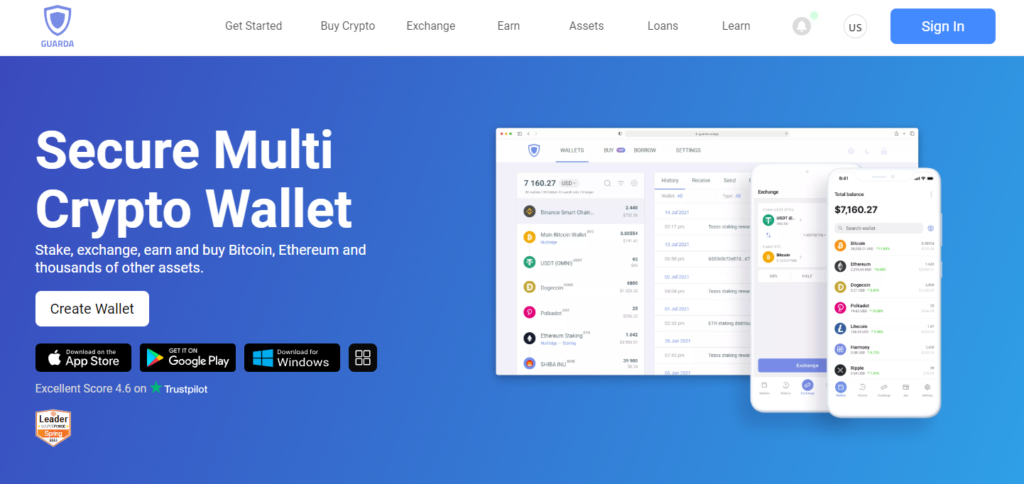
A multi-platform wallet option often used for managing multiple assets across devices; its listings highlight support for many asset types including ERC-20-style tokens.
Pros
Works across platforms (useful if you switch devices)
Broad asset coverage and practical utilities (swap/management)
Cons
Some features can be less “one-tap simple” than mobile-first wallets
Advanced workflows may require extra setup
9. Atomic Wallet
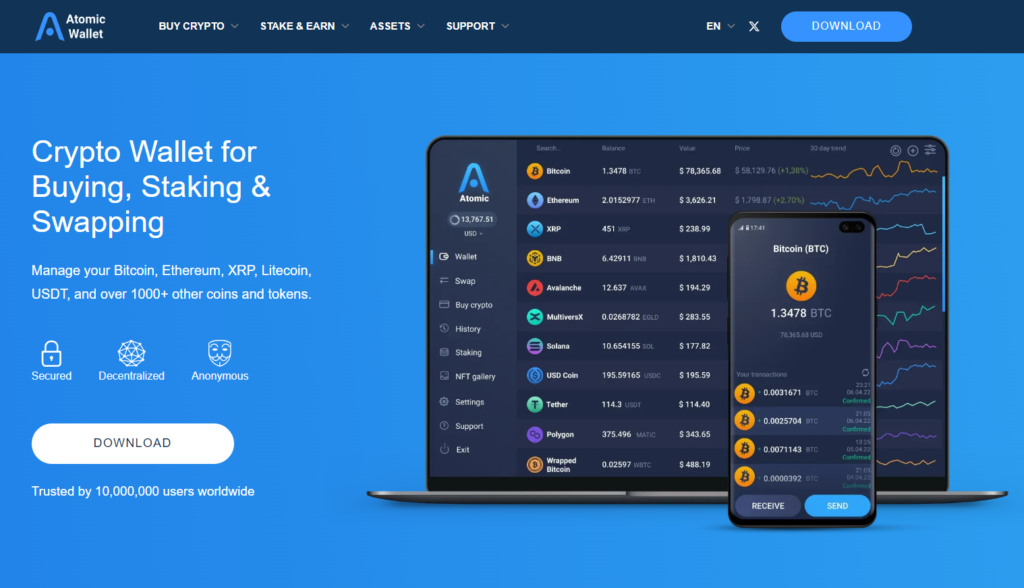
Atomic Wallet provides cross-platform functionality for desktop and mobile users, and it supports EURC as an ERC-20 token. It offers in-app staking, asset swapping, and portfolio tracking. The interface is straightforward, but it’s worth noting that the software is only partially open-source, which may concern users prioritizing transparency.
10. Exodus

Exodus is known for its elegant design and intuitive interface. Available on both desktop and mobile, it supports EURC and features live portfolio tracking and built-in exchange services. It’s beginner-friendly, though not fully open-source, which may be a drawback for some security-conscious users.
What to Do After Buying EURC
- Store EURC in your Walletverse wallet and keep full control over your funds.
- Send EURC to another wallet. Make sure the recipient uses the same network.
- Receive EURC using your Walletverse address or QR code.
- Swap EURC for other supported cryptocurrencies.
How to store EURC safely
You can store EURC in any wallet that supports its network and token format.
Mobile self-custody wallet: best for everyday use, fast transfers, DeFi access.
Hardware wallet: best for long-term holdings, larger balances.
Split strategy: keep “spend” EURC on mobile, “reserve” EURC on hardware.
If you’re choosing a wallet primarily for safety, prioritize self-custody (you control keys), strong device security (biometrics/passcode), and clear backup and recovery steps.
How to check your EURC balance and verify you have the real token
In your wallet
Open your wallet, search EURC, and view the balance. If EURC doesn’t appear, you may need to add the token by contract address.
On a block explorer (recommended for verification)
Use Circle’s official EURC mainnet address list, then check your wallet address on the relevant explorer.
Official EURC references by network (from Circle):
Avalanche C-Chain, Base, Ethereum, Solana, Stellar
This matters because scammers often create fake tokens with similar names. Matching the contract address to Circle’s published list is the simplest validation step.
Common mistakes when buying or transferring EURC
Sending EURC on the wrong network (example: withdrawing on Ethereum but receiving address is on Base).
Buying “EURC” from an unofficial token contract in DeFi. Always verify the contract address.
Forgetting gas fees (you still need the chain’s gas token even for stablecoins).
EURC is a practical euro-pegged stablecoin for users and businesses that want euro settlement on-chain, with multi-chain availability and official contract references published by Circle.
As stablecoins continue scaling in 2026, EURC is a clear option for euro-based flows, especially when you need faster transfers, transparent on-chain records, and predictable pricing compared to volatile assets.
FAQ
Most frequent questions and answers
Yes. EUROC was the original ticker of Euro Coin. In 2023, Circle changed it to EURC, but the token contracts stayed the same, so EUROC and EURC are the same asset.
EURC is described as fully reserved 1:1 with euro-denominated reserves held at regulated financial institutions, with regular attestations referenced by major market venues.
Circle publishes official EURC mainnet addresses for Avalanche C-Chain, Base, Ethereum, Solana, and Stellar.
Add the correct network first (for example Ethereum or Base), then import the token using the official EURC contract address for that network from Circle’s list.
Use a block explorer for the network you’re on and paste your public wallet address. To verify the token itself, match the EURC contract address with Circle’s published list.
You may pay:
Payment provider fees (if buying with card)
Exchange trading fees (if buying on an exchange)
Network gas fees (when transferring on-chain)
Yes, as long as the hardware wallet supports the network and token format you’re using. Many users store stablecoins on hardware for long-term security.
EURC is used in DeFi where euro liquidity is needed (trading, lending, euro-denominated strategies). Availability depends on the chain and specific DeFi protocols.


