


How to Swap USDC to ETH
Updated: October 2026
Swapping USDC to ETH is one of the most common trades in crypto: you move from a dollar stablecoin to Ether, the coin that pays for transactions on Ethereum and is used across DeFi and NFTs. How you do it depends on which network your USDC is on and whether you already have ETH to pay the network fee. This guide covers both — whether you call it swapping, converting or exchanging USDC to Ethereum, the process is the same.
Quick answer: if your USDC is on Ethereum, open a wallet with a built-in swap, choose USDC → ETH, review the quote and confirm. The first swap usually needs a token approval, and both steps need ETH for gas — unless you use a gasless swap option that takes the fee from your USDC.
USDC vs ETH: What's the Difference?
| USDC | ETH | |
|---|---|---|
| What it is | Stablecoin issued by Circle | Native coin of the Ethereum blockchain |
| Price | Designed to stay at $1; backed by cash and cash-equivalent assets, redeemable 1:1 for US dollars (per Circle) | Floats with the market |
| Main use | Holding dollar value, payments, trading pairs | Paying gas fees, staking, DeFi, NFTs |
| On Ethereum | An ERC-20 token | The asset used to pay network fees |
Is USDC the same as ETH? No. USDC is a token that runs on Ethereum and other blockchains; ETH is Ethereum’s own coin. You need ETH (or a gasless option) to move or swap USDC on Ethereum.
Step 1: Check Which Network Your USDC Is On
USDC is natively issued on 38 blockchains, including Ethereum, Base, Arbitrum, Polygon PoS and Solana (Circle, as of September 16, 2026). Where your USDC sits decides what kind of swap you need:
| Your USDC is on | What you can swap it to | What you need for fees |
|---|---|---|
| Ethereum | ETH on Ethereum — a regular same-chain swap | ETH on Ethereum (or a gasless swap) |
| Base | ETH on Base (same-chain), or ETH on Ethereum (cross-chain) | ETH on Base |
| Arbitrum | ETH on Arbitrum (same-chain), or ETH on Ethereum (cross-chain) | ETH on Arbitrum |
| Polygon PoS | ETH via a cross-chain swap | POL |
| Solana | ETH via a cross-chain swap | SOL |
Swap services often label these versions “USDC (Base)”, “USDC (SOL)” or “USDC (MATIC)”. Always select the one that matches your wallet.
How to Swap USDC to ETH on Ethereum: Step by Step
- Open your wallet and choose Swap. Select USDC as the token you pay with and ETH as the token you receive.
- Enter the amount and review the quote. Check the rate, the network fee, any service fee, slippage tolerance and the minimum amount of ETH you’ll receive.
- Approve USDC (first time only). ERC-20 tokens use an “approve” step that allows a swap contract to spend your tokens (ERC-20 standard). This is a separate transaction and costs gas.
- Confirm the swap. Sign the transaction in your wallet.
- Check the result. ETH appears in your balance once the transaction is confirmed. You can look it up by its transaction hash on Etherscan.
How to Swap USDC to ETH Without ETH for Gas
A common problem: you hold USDC on Ethereum but no ETH, so you can’t pay the network fee for the swap. There are swap options that take the fee from your USDC instead:
- MetaMask gasless swaps. On select networks, MetaMask deducts a small amount of the token you’re swapping from to cover the network fee (MetaMask Help).
- CoW Swap. Gas fees are paid in the sell token, so you don’t spend ETH (CoW Swap).
- 1inch Fusion mode. Professional “resolvers” fill your order and pay the on-chain gas, so you don’t need to hold native tokens (1inch).
Another option is to buy a small amount of ETH with a bank card first, then use it for gas.
How to Swap USDC on Base, Arbitrum, Solana or Polygon to ETH
- Base or Arbitrum: ETH is the gas token on these networks, so a same-chain swap from USDC to ETH works just like on Ethereum — but you need ETH on Base or Arbitrum (not on Ethereum mainnet) for the fee. If you want ETH on Ethereum mainnet, use a cross-chain swap or bridge.
- Solana or Polygon: ETH isn’t the native coin there, so you need a cross-chain swap that takes your USDC on that network and delivers ETH to your Ethereum address. Pay the source network’s fee in SOL or POL.
Because Ethereum, Base, Arbitrum and other EVM networks use the same address format, you can use the same 0x address on all of them (MetaMask Help). What matters is that you send and receive on the same network.
Swap USDC to ETH in Walletverse
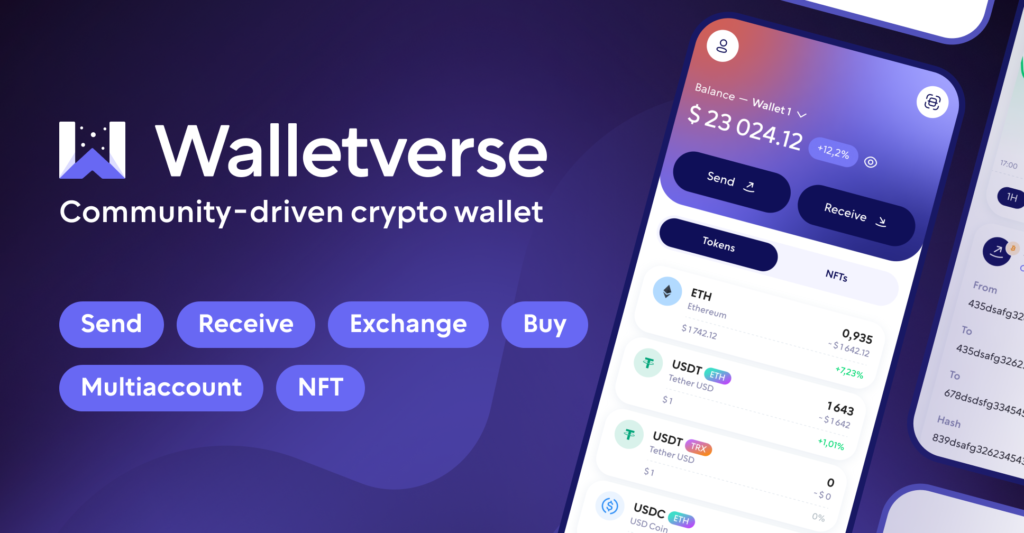
Walletverse is a self-custody wallet for iOS and Android that supports USDC, ETH and 700+ other cryptocurrencies and tokens. Swaps run through a built-in aggregator that connects 100+ DEX and CEX venues, including Uniswap and 1inch.
- Open USDC in Walletverse and choose Swap.
- Select ETH, enter the amount and review the rate and fees.
- Confirm. ETH appears in your Walletverse balance once the transaction is confirmed.
Your private keys are encrypted on your device and never leave it. If you have no crypto yet, you can buy USDC or ETH in the app with Visa, Mastercard or local payment methods, and with Apple Pay or Google Pay where available.


Fees to Expect When Swapping USDC to ETH
| Fee | What it is |
|---|---|
| Network (gas) fee | Paid to the network for each transaction; on Ethereum it’s paid in ETH |
| Approval fee | Gas for the one-time USDC approval transaction |
| Service fee | Some wallets add a fee to the quote — MetaMask, for example, charges 0.875% (MetaMask Help) |
| Price impact and slippage | The difference between the quoted and the final price, larger for big trades |
Compare the final amount of ETH you’ll receive across wallets and apps, not just the exchange rate.
Wallets That Let You Swap USDC to ETH
| Wallet | Built-in swap | Platforms |
|---|---|---|
| Walletverse | Yes — DEX and CEX aggregator | iOS, Android |
| MetaMask | Yes — gasless swaps on select networks | Mobile, browser extension |
| Trust Wallet | Yes | iOS, Android, browser extension |
| Coinbase Wallet | Yes | iOS, Android |
| Guarda | Yes | Web, desktop, mobile, extension |
| Atomic Wallet | Yes | Desktop, mobile |
| SafePal | Yes | iOS, Android, hardware wallets |
| Edge | Yes | iOS, Android |
Sources: official websites and app store listings of each wallet, checked October 2026.
Is It Risky to Hold USDC?
USDC is designed to stay at $1, but it isn’t risk-free. In March 2023, USDC briefly lost its dollar peg after Circle disclosed that $3.3 billion of its reserves were held at Silicon Valley Bank, which had failed; the peg recovered after Circle confirmed the reserves were safe (Circle, Reuters). ETH, on the other hand, has no peg at all — its price can rise or fall sharply. Swapping USDC to ETH means taking on that price risk.
FAQ
Most frequent questions and answers
Yes, you can easily swap USDC to ETH using supported crypto wallets like Walletverse or other services with token swap functionality.
Walletverse is a top choice. It supports fast in-app swaps between USDC and ETH, offers robust security, and is easy to use even for beginners.
Yes. USDC on Ethereum is an ERC-20 token, and ERC-20 tokens use your Ethereum address. The sender must choose the Ethereum network; if they send USDC on another network, it arrives on that network instead.
You can purchase USDC using Walletverse with Apple Pay, Google Pay, or credit/debit cards in multiple currencies such as USD, KZT, INR, and more.
Use a gasless option that deducts the fee from your USDC, such as MetaMask gasless swaps (on select networks), CoW Swap or 1inch Fusion mode. Alternatively, buy a small amount of ETH with a card to cover gas.


