


How to Swap XRP to BTC
Updated: October 2026
Converting XRP (often searched as “Ripple”) to Bitcoin moves your funds between two separate blockchains: the XRP Ledger, where transactions settle in seconds, and the Bitcoin network, where new blocks arrive about every 10 minutes. You can do it with an in-wallet swap or by trading the XRP/BTC pair on an exchange. This guide explains both, plus the XRP-specific details — the account reserve and destination tags — that often trip people up.
Quick answer: open a wallet that supports both XRP and BTC, choose Swap, select XRP → BTC, check the quote and confirm. Keep in mind that part of your XRP is locked as the account reserve and can’t be swapped.
XRP vs BTC at a Glance
| XRP | Bitcoin (BTC) | |
|---|---|---|
| Blockchain | XRP Ledger (XRPL) | Bitcoin |
| Settlement | About 3–5 seconds | New blocks roughly every 10 minutes |
| Supply | — | Only 21 million will ever be created |
| Address starts with | r (classic address) | 1, 3 or bc1 |
| Special rules | 1 XRP account reserve; destination tags for exchanges | Payments are irreversible |
Sources: xrpl.org, xrpl.org — Addresses, bitcoin.org FAQ, Investopedia.
XRP is the native digital asset of the XRP Ledger, an open-source public blockchain (xrpl.org). Ripple is a company that builds on the XRP Ledger; XRP and Ripple are not the same thing.
Before You Swap: Two XRP Rules to Know
1. The account reserve
Every XRP Ledger address must keep a minimum balance. The base reserve is 1 XRP per account, plus 0.2 XRP for each object the account owns, such as a trust line (xrpl.org — Reserves). Reserved XRP can’t be sent or swapped, so the maximum you can convert is your balance minus the reserve and the network fee.
2. Destination tags
Exchanges often use one XRP address for many customers and rely on a destination tag to credit the right account (xrpl.org — Destination Tags). If you send XRP to an exchange to trade it for BTC, always include the tag the exchange gives you. When you swap inside your own wallet, you don’t need one.
Option 1: Swap XRP to BTC in a Wallet
A cross-chain swap takes XRP from your XRP Ledger address and delivers native BTC to your Bitcoin address. No exchange account is needed.
- Open your wallet and make sure it holds both XRP and BTC addresses.
- Choose Swap and select XRP → BTC.
- Enter the amount. Leave the 1 XRP reserve (plus any owner reserve) in your account.
- Review the quote: the amount of BTC you’ll receive, the fees and the estimated time.
- Confirm. XRP leaves your account within seconds; BTC arrives after the Bitcoin transaction is confirmed — roughly 10 minutes per block.
Swap XRP to BTC in Walletverse
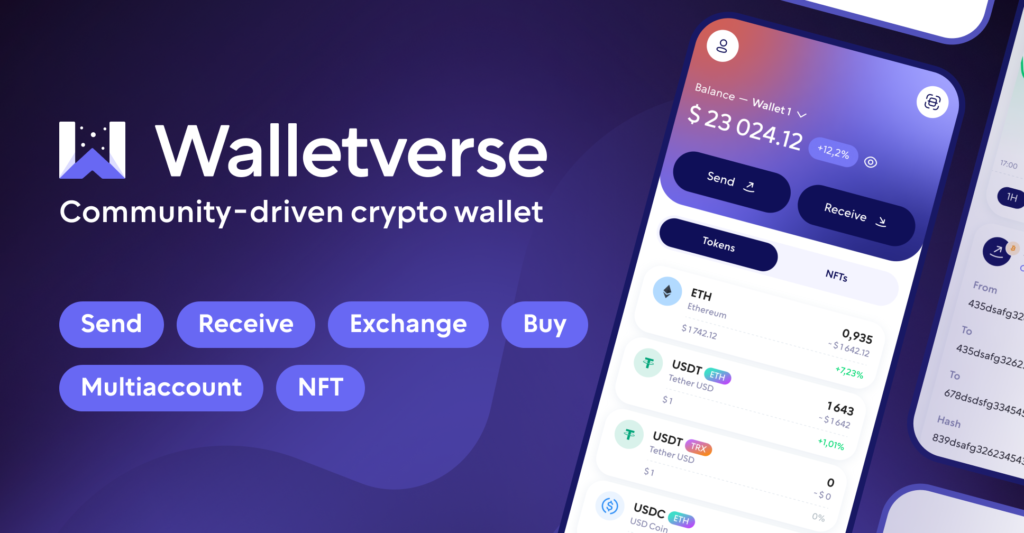
Walletverse is a self-custody wallet for iOS and Android that supports XRP, Bitcoin and 700+ other cryptocurrencies and tokens. Swaps run through a built-in aggregator that connects 100+ DEX and CEX venues with more than 10,000 trading pairs.
Open XRP in Walletverse, choose Swap, select BTC, review the rate and fees, and confirm. Your private keys stay encrypted on your device, and the app is protected by a passcode and biometrics. Before you send funds to an unfamiliar address, you can check its risk level with the built-in AML checks (powered by Crystal).


Option 2: Trade XRP for BTC on an Exchange
Many exchanges list the XRP/BTC trading pair — Kraken, for example, has an XRP/BTC market (Kraken). The process:
- Deposit XRP to the exchange — with the destination tag.
- Open the XRP/BTC market and place a market or limit order.
- Withdraw BTC to your own Bitcoin address, or keep it on the exchange.
Trading on an exchange gives you order types such as limit orders, but your funds are held by the exchange while they’re there, and you’ll usually need a verified account.
| In-wallet swap | Exchange (XRP/BTC pair) | |
|---|---|---|
| Account needed | No | Yes, usually with verification |
| Who holds the funds | You | The exchange, until you withdraw |
| Order types | Swap at the quoted rate | Market and limit orders |
| Steps | One swap | Deposit → trade → withdraw |
How to Swap BTC Back to XRP
The reverse works the same way: choose BTC → XRP in your wallet, or sell BTC on the XRP/BTC market on an exchange. Two things to remember:
- A new XRP address must receive at least 1 XRP (the base reserve) before it’s activated, so very small first swaps into a brand-new address may fail.
- If you withdraw XRP from an exchange to your own wallet, you don’t need a destination tag — unless the wallet says otherwise.
See our step-by-step guide on how to swap BTC to XRP.
Fees and Timing
| Cost or delay | What to expect |
|---|---|
| XRP Ledger fee | A fraction of a cent; transactions settle in about 3–5 seconds (xrpl.org) |
| Bitcoin network | New blocks roughly every 10 minutes; BTC payments are irreversible once confirmed (bitcoin.org) |
| Swap or trading fee | Set by the wallet, swap provider or exchange — compare the final BTC amount |
| Withdrawal fee | Exchanges may charge to withdraw BTC to your wallet |
Do You Pay Taxes When Swapping XRP to BTC?
Possibly. In the US, the IRS treats digital assets as property, and exchanging one digital asset for another can create a taxable gain or loss (IRS FAQ). Rules differ by country — check with a tax professional where you live.
Safety Tips
- Check both addresses. Classic XRP addresses start with “r”; Bitcoin addresses usually start with 1, 3 or bc1.
- Never forget the destination tag when sending XRP to an exchange.
- Send a small test amount when you use a new address or service.
- Double-check before confirming — Bitcoin payments can’t be reversed.
- Keep your recovery details offline and never share them.
Wallets That Support Both XRP and BTC
| Wallet | Type | Built-in swap | Platforms |
|---|---|---|---|
| Walletverse | Self-custody | Yes | iOS, Android |
| Trust Wallet | Self-custody | Yes | iOS, Android, browser extension |
| Guarda | Self-custody | Yes | iOS, Android, desktop, web |
| Atomic Wallet | Self-custody | Yes | Desktop, mobile |
| Edge | Self-custody | Yes | iOS, Android |
| Ledger | Hardware + Ledger Wallet app | Via Ledger Wallet | Hardware, desktop, mobile |
Sources: official websites of each wallet, checked October 2026.
FAQ
Most frequent questions and answers
Yes, using a crypto wallet or exchange that supports both coins and swap features.
You can buy BTC using a debit or credit card in apps like Walletverse, or on exchanges like Binance or Coinbase.
Walletverse is one of the best mobile wallets for this. It’s secure, self-custodial, easy to use, and supports both XRP and BTC with built-in swap functionality.
Open a wallet that supports both XRP and BTC, choose Swap, select XRP → BTC, review the quote and confirm — leaving the 1 XRP account reserve in your XRP address. Alternatively, deposit XRP to an exchange with the correct destination tag, trade the XRP/BTC pair and withdraw BTC to your own wallet.
You can convert XRP to Bitcoin (BTC) with Walletverse if the XRP → BTC route is currently available in the app through its integrated exchange providers. You can also use centralized exchanges, non-custodial swap services, or other wallets with built-in exchange functionality. Platforms such as Kraken, Coinbase, or Binance may support XRP/BTC conversion, depending on your country and current market availability.


