


Best Multi-Currency Crypto Wallet 2026 for Beginners and Advanced
Updated: November 2026.
A multi-cryptocurrency wallet lets you hold Bitcoin, Ethereum, stablecoins and other tokens on several blockchains in one app. Hot wallets like these are the most common type: Grand View Research estimates they held 56.2% of the crypto wallet market in 2025, which it valued at $15.5 billion (Grand View Research). This guide compares 10 multi-currency wallets and explains what to check before you put many coins in one place.
Quick answer:
- All-in-one mobile wallet: Walletverse, Trust Wallet or Exodus
- Ethereum and DeFi: MetaMask
- Solana plus Bitcoin and Ethereum: Phantom
- Widest network list: SafePal (200+ blockchains) or Bitget Wallet (130+)
- Software plus hardware: OneKey or Ledger
Multi-Currency vs Multi-Chain vs Cross-Chain
- Multi-currency wallet: holds many coins and tokens in one app.
- Multi-chain wallet: supports several blockchains, for example Bitcoin, Ethereum, Solana and TRON. Each network keeps its own address and rules, even inside one app.
- Cross-chain: moving value between networks, through cross-chain swaps or bridges. A multi-chain wallet doesn’t automatically support cross-chain swaps. Check this separately.
Best Multi-Cryptocurrency Wallets Compared
| Wallet | Type | Networks and assets (per App Store) | Swaps | Recovery | Rating |
|---|---|---|---|---|---|
| Walletverse | Mobile, self-custody | 600+ assets in listing, 700+ on site; ERC20, TRC20, BEP20, Avalanche C-Chain, Polygon, Solana | Aggregator of 100+ DEX and CEX venues | Self-custody, keys encrypted on device | 5.0 (42) |
| Trust Wallet | Mobile, self-custody | 100+ blockchains, 10+ million assets | dApp browser; swaps not detailed in listing | Self-custody, AES-encrypted keys | 4.7 (199,155) |
| Exodus | Mobile, self-custody | 1+ million assets | Across 50+ networks | Self-custody | 4.6 (37,804) |
| MetaMask | Mobile | Ethereum, Bitcoin, Solana, BSC, Base, Arbitrum, Polygon, TRON and more | Built-in, fees in quote | Self-custody; social login option | 4.7 (76,631) |
| Coinbase Wallet | Mobile | Base, Solana, BNB, Ethereum, Monad and more | Via DEX aggregators | Email, Google, Apple, recovery phrase or passkey | 4.5 (161,375) |
| Phantom | Mobile | Bitcoin, Ethereum, Solana, Polygon, Base, HyperEVM | Cross-chain | Self-custody, biometrics | 4.8 (64,248) |
| OneKey | Mobile and desktop + hardware | 60+ blockchains, 30,000+ tokens | Cross-chain and DEX aggregation | Keyless wallet or OneKey, Ledger, Trezor devices | 4.7 (683) |
| SafePal | App + hardware | 10,000+ crypto, 200+ blockchains | Not detailed in listing | Self-custody; S1 and S1 Pro hardware | 4.7 (17,460) |
| Bitget Wallet | Mobile | 130+ blockchains, 1+ million assets | Onchain trading | Email sign-up, no seed phrase | 4.7 (5,649) |
| Ledger | Hardware + app | 15,000+ crypto, 100+ blockchains | Via DEX and CEX aggregators | Keys on the device | 4.9 (15,213) |
Ratings and review counts from the US App Store, October 31 – November 3, 2026. Features from App Store listings and manufacturers’ sites.
The 10 Best Multi-Currency Crypto Wallets
1. Walletverse
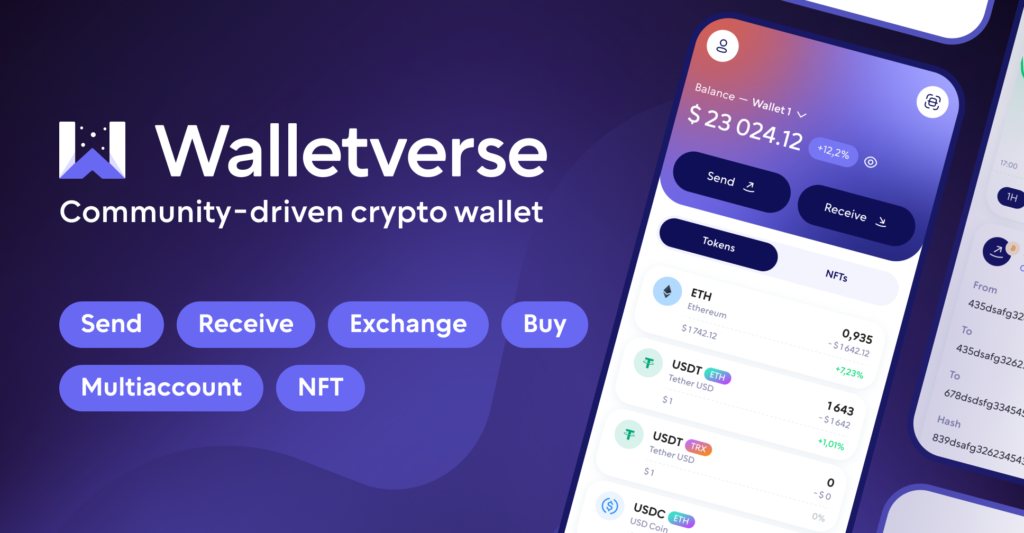
Walletverse is a free self-custody wallet for iOS and Android with 700+ cryptocurrencies and tokens.
- Multi-chain: ERC20, TRC20, BEP20, Avalanche C-Chain, Polygon and Solana, plus coins such as BTC, LTC and XRP
- Swap aggregator with 100+ DEX and CEX venues and 10,000+ trading pairs
- Buy crypto with Visa, Mastercard or local payment methods through MoonPay, Simplex, Banxa, Transak or Wert
- Multiple accounts and addresses, WalletConnect, staking for ETH, SOL and TRX
- Private keys encrypted on your device, passcode and biometrics, built-in AML checks powered by Crystal
Pros: many networks and swap venues in one app; AML checks. Cons: mobile only; no hardware wallet connection yet.


2. Trust Wallet
Trust Wallet says it’s trusted by over 200 million users, with 100+ blockchains, 10+ million assets, custom tokens and adjustable RPC nodes (App Store).
Pros: very wide coverage. Cons: many features can overwhelm beginners.
3. Exodus Wallet

Exodus has been around since 2015, with 1+ million assets, swaps across 50+ networks and staking for ETH, SOL, ADA, ATOM and more (App Store).
Pros: clean portfolio view of many coins. Cons: a hot wallet, so it’s less suited to large long-term holdings.
4. MetaMask

MetaMask says it’s trusted by over 100 million users. It now covers non-EVM networks too, including Bitcoin, Solana and TRON, alongside Ethereum and EVM chains (App Store).
Pros: the standard for Ethereum DeFi. Cons: complex for beginners; offers high-risk perpetual futures.
5. Coinbase Wallet

A self-custody wallet with easy recovery via email, Google or Apple, or a recovery phrase or passkey. It supports Base, Solana, BNB, Ethereum and Monad, among others (App Store).
Pros: beginner-friendly. Cons: no TRON in the listed networks.
6. Ledger

The Ledger Wallet app (formerly Ledger Live) supports 15,000+ crypto on 100+ blockchains, with Ledger hardware devices keeping the keys offline (App Store).
Pros: the safest option here for large multi-coin holdings. Cons: you have to buy a device.
7. Phantom

Phantom says it’s trusted by 20M+ users. It supports swaps across Bitcoin, Ethereum, Solana, Polygon, Base and HyperEVM, and lists fee-free swaps from stablecoins to cash (App Store).
Pros: strong Solana experience with cross-chain swaps. Cons: fewer networks than Trust Wallet or MetaMask.
8. OneKey

OneKey supports 60+ blockchains and 30,000+ tokens on mobile and desktop. It aggregates cross-chain and DEX liquidity, runs network and risk checks before every transaction and can pair OneKey, Ledger or Trezor devices (App Store).
Pros: works with three hardware brands; SignGuard warnings. Cons: fewer reviews than the largest wallets.
9. Bitget Wallet

Bitget Wallet says it’s trusted by over 100 million users, with 130+ blockchains and 1+ million assets. You can sign up with email, with no seed phrase (App Store).
Pros: easy onboarding; wide coverage. Cons: recovery depends on the provider’s system.
10. SafePal

Swapping Between Coins and Chains
- Same-chain swaps (for example ETH to USDC on Ethereum) run through DEX aggregators inside the wallet.
- Cross-chain swaps (for example SOL to BNB) move value between networks through a swap or bridge provider. Phantom, OneKey and Exodus list cross-chain or multi-network swaps.
- Before you confirm: check the receiving network, the final amount and all fees.
Supported Coins: What to Check
- Your exact networks. USDT, for example, exists on Ethereum, TRON and other chains. A wallet that supports “USDT” may not support every version.
- Native coins for fees. You need ETH for Ethereum, TRX for TRON, SOL for Solana and BNB for BNB Smart Chain transactions.
- Custom tokens. If a token is missing, check whether the wallet lets you add it by contract address.
- Discontinued networks. For example, BNB Beacon Chain (BEP2) has been retired (BNB Chain docs).
How to Protect a Multi-Currency Wallet
One recovery phrase usually controls all your coins on all networks, so losing it means losing everything at once.
- Back up the recovery phrase offline, on paper or metal, and never share it.
- Keep large balances on a hardware wallet, such as Ledger, SafePal S1 Pro or a device paired with OneKey.
- Check addresses before sending. Some wallets offer screening, like Walletverse’s AML checks or OneKey’s risk checks.
- Review token approvals and revoke ones you no longer need.
- Download apps only from official stores and keep them updated.
Crypto is volatile and high risk. This guide is not financial advice.
How to Buy Different Cryptocurrencies
- Install a multi-currency wallet and back up its recovery phrase.
- Buy crypto in the wallet through a card provider, or on an exchange.
- Withdraw to your wallet on the correct network for each coin.
- Swap between coins inside the wallet when you need to rebalance.
FAQ
Most frequent questions and answers
The best wallet depends on your needs. Walletverse is ideal for users looking for a user-friendly multi-currency wallet that supports over 600 cryptocurrencies. At the same time, Ledger Nano X is best for those seeking maximum security with a hardware wallet for multiple cryptocurrencies. Both options offer excellent features and flexibility, ensuring safe and convenient management of diverse assets.
A multi-chain wallet supports multiple blockchain networks, allowing users to store and manage cryptocurrencies such as Bitcoin, Ethereum, and altcoins. These wallets enable seamless interaction with various ecosystems, including decentralized finance (DeFi) and non-fungible tokens (NFTs). Users can manage assets across chains using a wallet supporting multiple blockchain networks in one unified platform.
A multi-chain wallet supports multiple blockchain networks, allowing you to store assets from different chains like Bitcoin and Ethereum. On the other hand, a cross-chain wallet facilitates transfers between different blockchain networks, enabling seamless movement of tokens across chains. Both options provide more flexibility than single-chain wallets, but cross-chain wallets focus on interoperability between blockchains.
While no wallet supports every cryptocurrency, many multi-currency wallets, like Trust Wallet and Walletverse, support hundreds of different assets, including major cryptocurrencies and lesser-known tokens. These wallets are perfect for managing a diverse portfolio and ensuring compatibility with the most popular blockchain networks.
Most multi-currency wallets can store hundreds of different coins and tokens. For example, Walletverse supports over 600 cryptocurrencies, including major assets like Bitcoin, Ethereum, Ripple, Shiba Ina, DOGE, HMSTR soon. This makes these wallets perfect for users who need a wallet to store tokens from different blockchains.
The security of a multi-currency wallet depends on its design and how users handle their private keys. Hardware wallets like Ledger Nano X provide the highest level of protection by storing private keys offline. In contrast, software wallets such as Exodus and Walletverse offer features like biometric authentication and encryption to safeguard assets. For the most secure experience, consider using a multi-asset wallet with security features such as multi-signature functionality and private key control.
Self-custody wallets such as Walletverse, Trust Wallet, Exodus, OneKey and SafePal support many cryptocurrencies with keys stored on your device. For the highest security, pair a hardware wallet such as Ledger or SafePal S1 Pro.
Yes. MetaMask, Phantom, Trust Wallet, Exodus, Walletverse and others support all three.


