


Best DeFi Wallet 2026 for Beginners and Advanced
The world of decentralized finance (DeFi) has revolutionized the way we interact with digital assets, offering innovative solutions for storing, trading, and staking cryptocurrencies. The total value locked in DeFi protocols currently stands at approximately $118.1 billion as of late 2025, reflecting market fluctuations . The global DeFi market size was valued at $32.42 billion in 2025 and is estimated to reach $47.36 billion in 2026 . Looking ahead, the DeFi market is projected to grow at a compound annual growth rate (CAGR) of 51.2% from 2026 to 2035, potentially reaching a staggering $2.02 trillion by 2035 . Other research forecasts suggest the market could hit $178.8 billion by 2030 with a CAGR of 41.1% , while more bullish projections see DeFi applications generating significant revenue, already reaching $38 billion in 2025 . This tremendous growth highlights the increasing importance of DeFi solutions, making it crucial to choose the best DeFi wallet to stay ahead in this rapidly expanding ecosystem.
Updated: February 2026.
What are DeFi wallets?
DeFi wallets are digital wallets that interact with decentralized finance applications on blockchain networks. Unlike regular wallets, they are non-custodial DeFi wallets, meaning users have complete control over their private keys, essential for accessing funds. The rise of DeFi started with the introduction of blockchain technology, which enabled decentralized app (dApp) integration. Crypto wallets have evolved since Bitcoin’s inception. DeFi wallets now offer multi-chain DeFi wallet support, allowing users to interact with blockchain ecosystems like Ethereum, Binance Smart Chain, and Solana.
Why are DeFi wallets better than regular crypto wallets?
The key advantage of a DeFi wallet over a regular crypto wallet lies in its ability to provide access to decentralized exchanges (DEX) and dApps, enabling users to participate in DeFi staking and yield farming. Regular crypto wallets are typically custodial, meaning a third party controls the private keys. In contrast, a self-custody wallet like a DeFi wallet gives users complete control over their assets.
Here’s why DeFi wallets are better than regular crypto wallets:
- Full control over private keys. Unlike custodial wallets, DeFi wallets allow users to control their private keys, ensuring that only they can access their funds.
- Access to DeFi services. DeFi wallets allow for dApp integration, enabling users to engage in staking, liquidity pools, and yield farming.
- Cross-chain compatibility. Many DeFi wallets are cross-chain DeFi wallets, supporting multiple blockchain networks for diversified asset management.
- Enhanced security. DeFi wallets offer features like secure multi-signature DeFi wallets and hardware DeFi wallet compatibility.
- Decentralization. DeFi wallets operate without a central authority, fully aligning with the principles of decentralized finance.
Are DeFi wallets safe?
Safety is a significant concern in digital assets, and DeFi crypto storage is no exception. Private key control in DeFi wallets ensures that only the wallet owner can access their assets, adding an extra layer of security. However, it’s crucial to understand that the security of a DeFi wallet largely depends on the user. For instance, while a secure multi-signature DeFi wallet offers enhanced protection by requiring multiple transaction approvals, users must still safeguard their private keys. Additionally, features like hardware DeFi wallet compatibility provide extra security by allowing users to store their assets offline.
Top 10 Best DeFi Wallets for Cryptocurrency in 2026
1. Walletverse
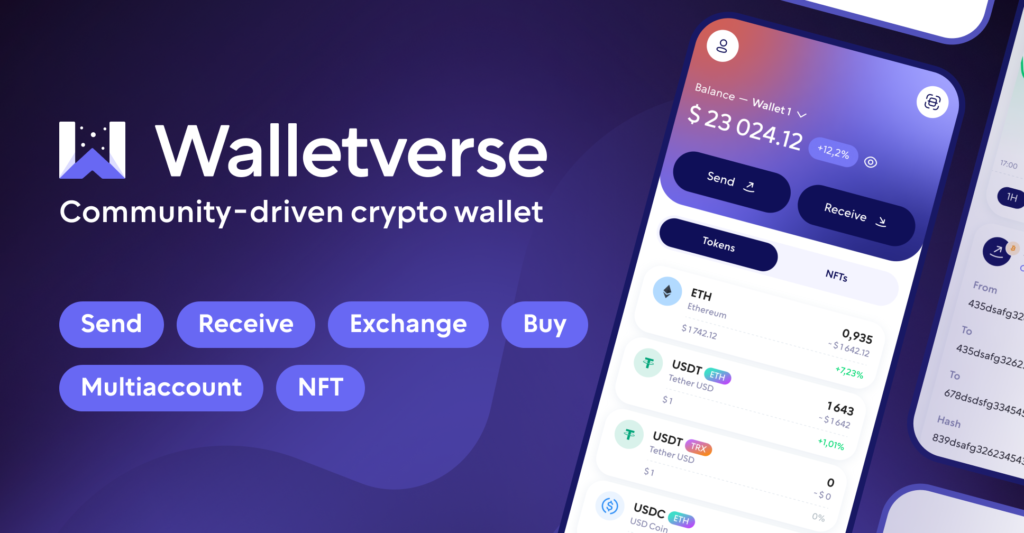
Walletverse is a comprehensive mobile crypto wallet that supports over 600 cryptocurrencies. As a DeFi crypto wallet, Walletverse offers various features tailored for beginners and advanced users. The app is designed for ease of use, making it a user-friendly DeFi wallet that simplifies crypto buying, sending, and storing. With support for dApps, multi-account management, and the ability to buy crypto using Apple Pay, Google Pay, and credit/debit cards, Walletverse offers a versatile DeFi experience. Pass-code and biometric authentication add another layer of security, making it one of the most secure DeFi wallets available.
Pros:
- Supports over 600 cryptocurrencies;
- Multi-chain DeFi wallet with a user-friendly interface;
- Strong security with biometric authentication;
- Staking.
Cons:
- Mobile-only app yet.


2. Trust Wallet
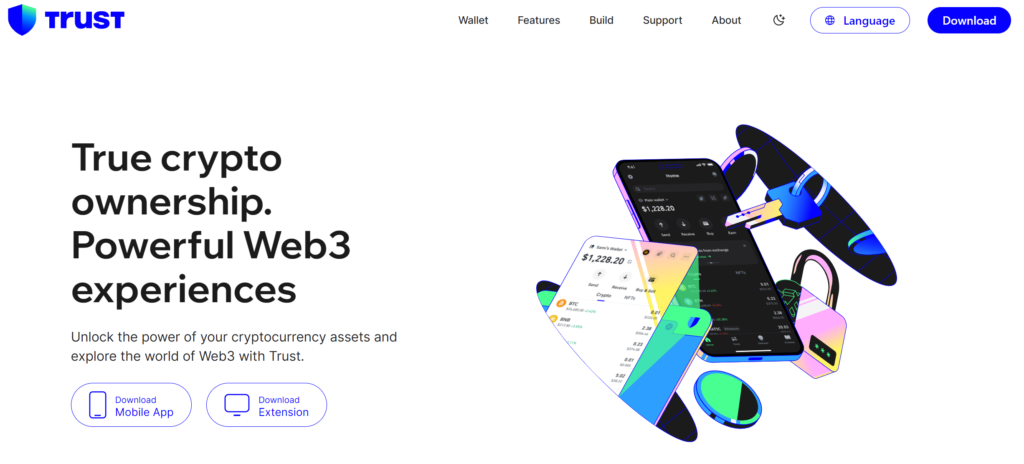
Trust Wallet, Binance’s official wallet, is an open-source, community-driven wallet that supports almost all cryptocurrencies. It’s designed to be a simple yet secure solution for managing digital assets. However, the wallet is only available on mobile, limiting its accessibility compared to multi-platform DeFi wallets.
Pros:
- Multi-currency wallet with decentralized storage;
- Private key control for security.
Cons:
- Mobile-only app.
3. Exodus Wallet

Exodus Wallet is a well-known non-custodial wallet supporting over 50 blockchain networks. Its multi-chain support allows users to manage assets across different networks, including Ethereum, Solana, and Binance Smart Chain. With DeFi staking capabilities and a built-in exchange, Exodus simplifies managing and trading crypto assets. However, it lacks two-factor authentication (2FA), which could concern users focused on security.
Pros:
- Extensive DeFi staking options;
- Hardware wallet integration with Trezor.
Cons:
- No two-factor authentication.
4. MetaMask

MetaMask is one of the most popular non-custodial DeFi wallets available. It offers flexibility with its multi-chain support, allowing users to swap tokens across different networks, such as Ethereum and the Binance Smart Chain. Private key encryption adds a layer of security, but users must be cautious about protecting their seed phrases.
Pros:
- DeFi wallet with support for multiple blockchains;
- Easy access to dApps and decentralized exchanges.
Cons:
- Requires careful management of seed phrases for security.
5. Coinbase Wallet

Coinbase Wallet is a non-custodial wallet that supports over 100,000 assets. It’s designed for easy use and provides access to various dApps. The wallet’s DeFi hub allows users to explore different ecosystems, including Ethereum and Solana. One standout feature is its ability to connect with Layer-2 solutions like Arbitrum, offering cheaper and faster transactions. Biometric authentication adds an extra layer of security, but some users may find its features limited compared to other DeFi wallets.
Pros:
- DeFi wallet with support for Layer-2 solutions;
- Cross-chain DeFi wallet for multiple blockchains.
Cons:
- Limited advanced security features.
6. Best Wallet
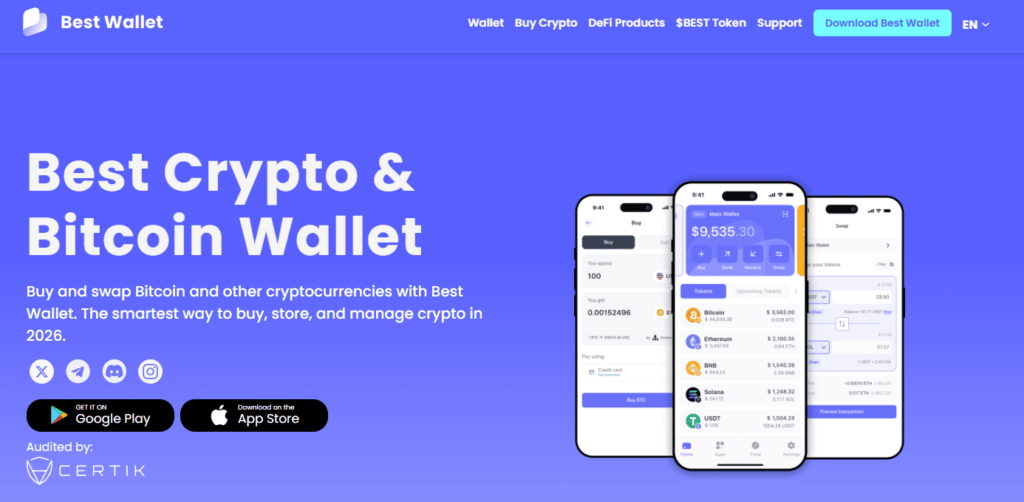
Best Wallet is a self-custody wallet that supports multiple blockchains and provides access to the broader DeFi ecosystem through an integrated crypto launchpad and decentralized exchange. Along with biometric authentication, Best Wallet offers personal cloud wallet backups and easy recovery that doesn’t require a seed phrase . It acts as a single interface to connect with multiple DEXs and presale opportunities via its crypto launchpad.
Pros:
User-friendly interface with multi-chain support makes it accessible to beginners.
Broad DeFi features including a crypto launchpad and portfolio management capabilities.
Cons:
Mobile-only with a shorter track record than some competitors.
Relies on cloud backups and device security rather than traditional seed phrase recovery.
7. Ledger Nano X

Ledger Nano X is a hardware wallet that offers bank-grade security for DeFi users who want to protect their private keys offline. It stores private keys on a CC EAL5+ certified chip and can connect to smartphones via Bluetooth or computers via USB without transmitting the actual private key . This makes it ideal for securing larger DeFi positions while still allowing interaction with dApps through Ledger Live.
Pros:
Private keys isolated offline with secure element chip technology.
Supports over 5,500 coins and tokens across multiple blockchains.
Cons:
Higher cost (typically $149) compared to software wallets.
Physical device adds friction for frequent transactions.
8.Phantom Wallet

Phantom has evolved from a Solana-native wallet into a multichain DeFi wallet, now offering support for Solana, Bitcoin, Ethereum, and Polygon. It provides a clean, intuitive interface with built-in staking, token swaps, and NFT management features. Phantom is particularly well-suited for users who want seamless interaction with Solana-based DeFi protocols while also accessing other chains.
Pros:
Exceptional user interface with smooth NFT gallery and spam controls.
Built-in staking and token swaps with clear fee previews.
Cons:
Multi-chain support for Ethereum/Bitcoin is newer and less feature-rich than the Solana side.
Swap fees of 0.85% can add up for frequent traders.
9. OneKey Wallet

OneKey App is a multi-chain DeFi wallet available on mobile, desktop, and as a browser extension. It supports a wide range of blockchains and offers competitive built-in swap fees at just 0.25%, with 0% fees for stablecoin-to-stablecoin exchanges . The wallet can be paired with OneKey hardware devices for enhanced security while maintaining a user-friendly interface.
Pros:
Low swap fees (0.25%) with 0% fees on supported stablecoin pairs.
Native hardware wallet integration for users who want to upgrade security.
Cons:
Newer to Western markets with a smaller user base than MetaMask.
Some advanced features require OneKey hardware for full functionality.
10. Guarda Wallet

Guarda is a versatile non-custodial DeFi wallet available on web, desktop, and mobile platforms. It supports over 50 blockchains and thousands of tokens, with built-in staking and exchange features. Guarda requires no registration or KYC for basic wallet functions, making it a strong choice for privacy-focused DeFi users who want to manage diverse portfolios across multiple devices .
Pros:
Cross-platform access with synchronization between web, desktop, and mobile.
No registration or KYC required for basic wallet functions.
Cons:
Some services rely on third-party providers with varying fees.
Customer support response times can vary during peak periods.
FAQ
Most frequent questions and answers
Yes, a decentralized finance wallet is an excellent choice for those seeking more control over their digital assets. Unlike custodial wallets, DeFi wallets ensure that you hold the private keys, meaning you are the sole owner of your funds. They also provide access to dApps, yield farming, and DeFi staking, making them highly versatile for users exploring the decentralized finance ecosystem.
Walletverse stands out as one of the best DeFi wallets for iPhone users. It offers a user-friendly DeFi wallet experience, supports over 300 cryptocurrencies, and integrates with primary payment methods like Apple Pay and Google Pay. The app is designed to be accessible for beginners and advanced users, making it a top choice for those looking to manage their crypto on an iPhone.
While DeFi wallets provide robust security, including private key control and often hardware wallet compatibility, no system is entirely immune to hacking. The most significant risk is user error, such as failing to protect private keys or seed phrases. Implementing strong security measures like biometric authentication, multi-signature wallets, and using hardware wallets for offline storage is essential. By following best security practices, the likelihood of hacking is significantly reduced.
Yes, many users earn passive income through DeFi staking and yield farming using their DeFi wallets. By staking assets or providing liquidity to decentralized exchanges (DEXs), users can earn rewards in the form of additional tokens. Some wallets also offer the ability to participate in governance and vote on protocol changes, giving you a say in how the platform evolves, which can lead to additional earning opportunities.


