


Buy Hifi Finance (HIFI) with USD, EUR and Other Fiat Currencies
Buying Hifi Finance (HIFI) with USD, EUR, and other fiat currencies is easier today than it was a few years ago, thanks to mobile wallets, self-custody apps, and in-wallet on-ramp services. Depending on the provider and your region, you can often buy crypto with a bank card, Apple Pay, Google Pay, or local fiat methods, then hold it in your own wallet or swap into HIFI if direct fiat support is limited.
This guide was prepared by ilink, a FinTech and Web3 software developer with 13 years of experience and completed projects worldwide.
What Is Hifi Finance (HIFI)
Hifi Finance is a decentralized lending protocol built on Ethereum that focuses on fixed-rate, fixed-term borrowing and lending. The project’s documentation describes Hifi as a protocol that lets users borrow at a fixed rate for a fixed term, while Coinbase explains that it addresses a core DeFi need: more predictable credit markets instead of purely floating-rate lending.
In simple terms, Hifi is designed for users who want more certainty around borrowing costs. Instead of relying only on variable DeFi rates that can move quickly with market conditions, Hifi uses a bond-like model where debt settles on a specified future date. That structure makes the protocol different from many general-purpose DeFi money markets.
Historically, the project traces back to Mainframe, which later became Hifi. Coinbase notes that “Mainframe, now known as Hifi,” evolved into a lending protocol built around borrowing against crypto assets, while the official whitepaper outlines the protocol’s early vision for tokenized on-chain debt and fixed-term credit.
HIFI is the protocol’s native token and is used in governance. According to the official documentation, the governance system derives from the Compound governance framework, which means token holders can participate in decisions affecting the protocol’s direction and parameters.
A useful way to understand Hifi Finance is through two short descriptions from trusted sources. The official docs define it as a “fixed-rate, fixed-term lending protocol,” while the main website says users can “borrow against their crypto” collateral. Those two ideas capture the project well: predictable DeFi credit and on-chain collateralized borrowing.
Where Can I Buy Hifi Finance (HIFI) with Cash? 10 Best Crypto Wallets
1. Walletverse
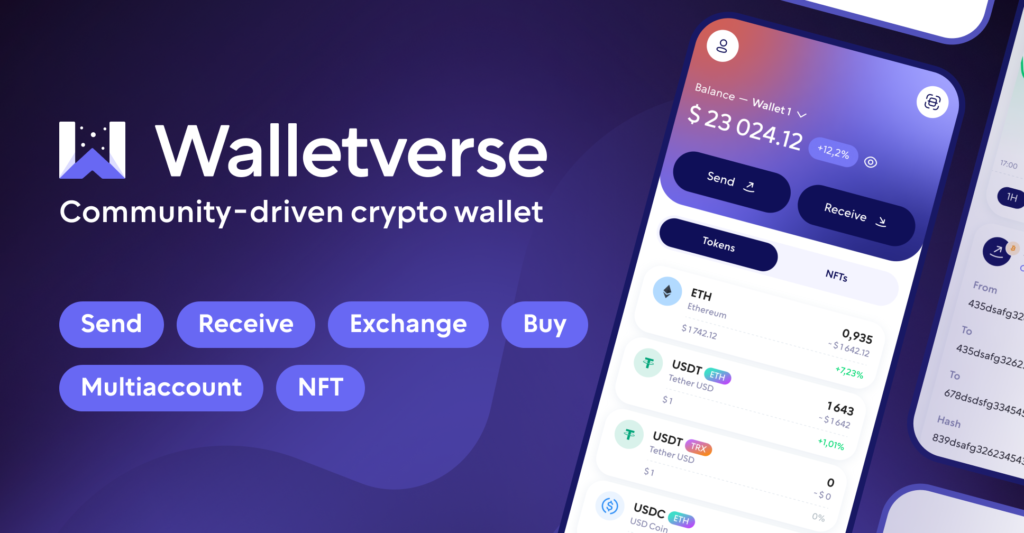
Walletverse is a mobile-first, non-custodial crypto wallet built for both beginners and advanced users. It is designed for buying, sending, storing, and exchanging crypto in a fast and user-friendly app. Based on the product information provided, it supports 700+ cryptocurrencies, multi-account use, dApps, fiat purchases, staking, and strong mobile security features such as passcode and biometric authentication.
A strong advantage of Walletverse is its focus on usability without giving up self-custody. It supports purchases through Apple Pay, Google Pay, credit and debit cards, plus multiple fiat currencies including USD, EUR, GBP, JPY, KZT, INR, CAD, and AUD. It also includes a GasFree USDT system on TRON, which helps remove the common beginner problem of needing TRX for fees.
- Pros:
- Non-custodial and mobile-first;
- Supports 700+ cryptocurrencies;
- Apple Pay, Google Pay, cards, and multiple fiat currencies;
- dApp access, staking, multi-account support;
- Passcode and biometric security;
- Beginner-friendly interface with advanced functionality.
- Cons:
- Mobile-only format may not suit users who prefer desktop wallets;
- Direct availability of a specific token like HIFI can vary by on-ramp provider and region;
- As with any self-custody wallet, recovery responsibility stays with the user.



2. MetaMask

MetaMask is one of the best-known self-custodial wallets in crypto. Its official site positions it as a wallet for buying, swapping, and connecting to dApps, with both mobile and browser access. For users interested in DeFi ecosystems, MetaMask remains one of the most recognizable choices.
It is especially useful for users who plan to interact with Ethereum and EVM-based apps. MetaMask also supports fiat purchases through its buy flow, including cards and bank transfers in supported regions.
- Pros:
- Strong dApp and Web3 integration;
- Self-custodial;
- Mobile app and browser extension;
- Built-in buy and swap flows.
- Cons:
- Can feel more technical for complete beginners;
- Network and gas settings may confuse first-time users;
- Direct HIFI purchase may not be available in every region.
3. Trust Wallet

Trust Wallet describes itself as a secure self-custody wallet supporting millions of assets across 100+ blockchains. It is widely used by people who want one app for buying, storing, swapping, and exploring Web3.
For fiat buyers, Trust Wallet offers card-based purchases and a beginner-friendly mobile experience. It is a strong fit for users who want broad asset coverage and a large ecosystem without moving to desktop software.
- Pros:
- Broad multi-chain support;
- Self-custody model;
- Simple mobile interface;
- Good for beginners exploring Web3.
- Cons:
- Some advanced DeFi actions still require user knowledge;
- Token availability depends on third-party providers;
- Hardware-level cold storage is not its main focus.
4. Ledger

Ledger combines hardware wallet security with the Ledger Wallet app, formerly known as Ledger Live. Ledger describes the app as an all-in-one place to buy, swap, stake, and manage crypto while keeping the security benefits of a signer device.
This is a strong choice for people who prioritize long-term storage and want stronger protection than a standard mobile hot wallet. Buying is available in-app through partners, but the experience works best when paired with Ledger hardware.
- Pros:
- Strong security model when paired with hardware;
- In-app buy, swap, and staking tools;
- Good for long-term holders;
- Trusted brand in hardware wallet space.
- Cons:
- Requires extra hardware cost for best security;
- Less convenient than mobile-only wallets for casual use;
- Setup can feel slower for first-time users.
5. Tangem
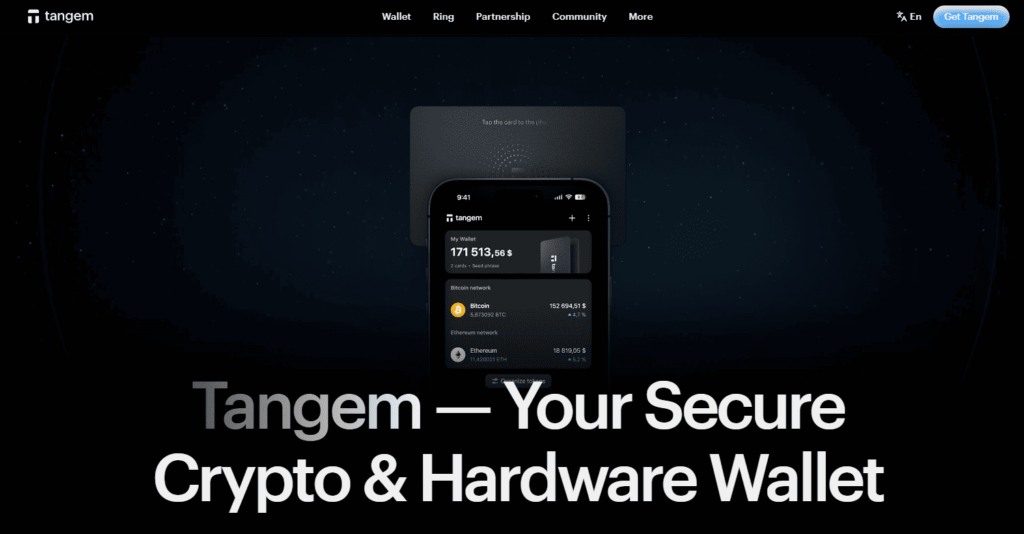
Tangem is a hardware wallet brand built around card-based cold storage and a mobile app. Its official site says users can store, buy, earn, send, swap, and spend thousands of tokens while keeping assets offline.
Tangem is a good option for buyers who want a hardware-style self-custody experience without using a USB-style device. It is especially attractive to users who want portability and simpler cold storage onboarding.
- Pros:
- Offline hardware-style protection;
- Non-custodial;
- Mobile app for management and purchases;
- Easy to carry and simple to use.
- Cons:
- Not as convenient for heavy DeFi interaction as browser wallets;
- Requires purchase of hardware cards;
- Asset-specific availability should be checked before buying.
6. Coinbase Wallet

Coinbase Wallet is Coinbase’s standalone self-custody wallet. Coinbase clearly distinguishes it from the hosted Coinbase exchange app and emphasizes that Coinbase Wallet gives users complete control over their crypto.
This wallet is a solid choice for users who want a more mainstream interface while still keeping control of their assets. It also works well for NFTs and on-chain activities across several major networks.
- Pros:
- Self-custody with familiar branding;
- Beginner-friendly onboarding;
- Good NFT and multichain support;
- Useful for users already familiar with Coinbase.
- Cons:
- Users sometimes confuse it with the hosted exchange wallet;
- On-ramp options vary by country;
- Advanced DeFi users may prefer more customizable wallets.
7. Exodus

Exodus is a long-running self-custodial wallet available on mobile and desktop. Its official site highlights in-wallet buying, swapping, staking, and Apple Pay or Google Pay support through integrated payment providers.
Exodus is often chosen by users who want a polished interface and cross-device access. It is particularly strong for people who want one wallet for holding many assets without diving too deep into technical configuration.
- Pros:
- Clean interface on desktop and mobile;
- In-wallet buy, swap, and staking tools;
- Supports Apple Pay and Google Pay in some flows;
- Good for portfolio management.
- Cons:
- Less tailored to power users who want deep manual settings;
- Availability of direct purchases depends on location;
- Fees and spreads vary by provider.
8. Guarda

Guarda is a non-custodial wallet that supports buying, exchanging, storing, and staking crypto across mobile, web, and desktop. Its official materials emphasize card purchases, broad token support, and control over private keys.
It is a practical option for users who want flexibility across different devices while still keeping a self-custody setup. Guarda can be especially appealing to users who prefer web access in addition to mobile.
- Pros:
- Web, desktop, and mobile access;
- Non-custodial;
- In-wallet fiat purchase options;
- Staking support.
- Cons:
- Interface is broader than some minimalist wallets;
- Direct HIFI support should be checked before purchase;
- Some services depend on integrated third parties.
9. Atomic Wallet

Atomic Wallet focuses on managing, buying, swapping, and staking crypto in one app. Its official site says users can hold NFTs and 1000+ assets, and buy crypto with bank cards and Apple or Android Pay in supported flows.
This makes Atomic a reasonable option for users who want a general-purpose software wallet with an all-in-one feel. It is particularly attractive to people interested in staking alongside regular wallet use.
- Pros:
- All-in-one buy, swap, and stake experience;
- Supports many assets;
- Simple portfolio management;
- Available on desktop and mobile.
- Cons:
- As with other hot wallets, security depends partly on device hygiene;
- Fiat purchase coverage varies by provider;
- Interface is more utility-driven than premium.
10. Zengo

Zengo stands out for using MPC security instead of the traditional single private-key model. The company describes it as a self-custodial wallet with no private key vulnerability and emphasizes recoverability plus buying options through Apple Pay, Google Pay, cards, and bank transfer partners.
That makes Zengo attractive for users who want self-custody but feel nervous about seed phrase management. Its security model is one of its clearest differentiators.
- Pros:
- MPC-based self-custody design;
- No traditional seed phrase vulnerability;
- Apple Pay and Google Pay support through partners;
- Strong fit for security-focused beginners.
- Cons:
- Purists may prefer classic seed-based wallet control;
- Direct asset availability varies;
- Some users prefer a broader DeFi tooling ecosystem.
Buy HIFI with Apple Pay
Buying HIFI with Apple Pay is usually done through a wallet or crypto app that integrates fiat on-ramp providers. Wallets such as Walletverse, Exodus, and Zengo support Apple Pay for eligible crypto purchases, while Tangem and some other wallets also support Apple Pay through integrated flows or partners. Actual asset availability depends on jurisdiction and on-ramp support.
In practice, there are two common routes. The first is to buy HIFI directly if your wallet’s payment provider lists it in your country. The second, and often more realistic path, is to buy a liquid asset like ETH or USDC with Apple Pay and then swap it for HIFI inside the wallet or through a connected exchange feature.
Walletverse is particularly convenient for mobile users who want to buy crypto with Apple Pay and manage assets in a non-custodial app. Based on the provided product information, it supports fiat purchases, self-custody, dApps, and broad token coverage in one interface.
Buy HIFI with Google Pay
Google Pay works in a very similar way. Some wallets and their payment partners support Google Pay as a purchase method, including Walletverse according to the provided product details, while Exodus and Zengo also mention Google Pay support in their official purchase flows. MetaMask’s ecosystem additionally supports fiat buying methods through integrated providers.
The main advantage of Google Pay is speed on mobile. It reduces friction during the purchase process, which can be especially useful for beginners making a first crypto buy. The main limitation is that not every provider lists every token directly, so users may still need to buy a major asset first and then convert into HIFI.
For Android-focused users, Walletverse fits this use case well because it is built around mobile-first self-custody and supports Google Play distribution together with multiple fiat purchase methods, according to the information provided.
How to Buy the Hifi Finance (HIFI) with Fiat
Here is the simplest step-by-step approach for buying HIFI with fiat:
- Choose a wallet that supports fiat purchases and self-custody, such as Walletverse or another wallet from the list above.
- Complete wallet setup and safely store your recovery details if required.
- Select a fiat purchase method such as credit card, debit card, Apple Pay, Google Pay, or local bank-supported options.
- Check whether HIFI is directly available through the on-ramp in your region.
- If HIFI is not directly listed, buy a supported asset such as ETH or USDC first.
- Swap that asset into HIFI inside the wallet or through an integrated trading flow.
- Review the network, fees, quoted rate, and final amount before confirming.
- Store your HIFI in your wallet and enable all available security settings.
If you want a mobile-first route, Walletverse is a straightforward option because it combines fiat purchasing, self-custody, and crypto management in one app. For users who value cold storage more than convenience, Ledger or Tangem may be stronger choices.
FAQ
Most frequent questions and answers
HIFI has a real DeFi use case because Hifi Finance focuses on fixed-rate, fixed-term borrowing and lending, which is a distinct niche in decentralized finance. That said, it is also a small-cap token with high volatility, so whether it is “good” depends on your risk tolerance, time horizon, and understanding of DeFi market risk.
The usual way is to open a wallet that supports fiat purchases, add funds using USD through card or a mobile payment method, and check whether HIFI is directly available. If not, buy a supported crypto such as ETH or USDC first and then swap it into HIFI. In Walletverse, for example, users can buy crypto with fiat payment methods and manage assets in a self-custody environment based on the product information you provided.
You can use mobile, desktop, or hardware-linked wallets depending on your priorities. Walletverse is suitable for users who want a mobile self-custody app with fiat purchases, dApps, and broad token support. Other strong options include MetaMask, Trust Wallet, Coinbase Wallet, Exodus, Guarda, Atomic Wallet, Zengo, Ledger, and Tangem.
You can usually buy HIFI through exchanges and, in some cases, through wallet-integrated on-ramp and swap services, for example Walletverse.


