


How to Convert Bitcoin to Ethereum: A Simple Guide for 2026
Converting Bitcoin (BTC) to Ethereum (ETH) is one of the most common crypto swaps. You may want ETH to use Ethereum-based applications, pay network fees, stake your assets, explore DeFi, or simply rebalance your crypto portfolio.
However, converting Bitcoin to Ethereum is not the same as sending crypto from one wallet address to another.
Bitcoin and Ethereum operate on separate blockchains. Native BTC moves on the Bitcoin network, while native ETH moves on Ethereum. As a result, you cannot simply send Bitcoin to an Ethereum address and expect it to turn into ETH.
Instead, you need a crypto wallet with an integrated swap feature, a centralized exchange, or another service capable of handling the conversion between the two networks.
This guide explains how to convert BTC to ETH in 2026, what the swap actually involves, how much it may cost, and what to check before confirming the transaction.
What Does Converting Bitcoin to Ethereum Mean?
A BTC-to-ETH conversion exchanges a certain amount of Bitcoin for an equivalent amount of Ether based on the current BTC/ETH exchange rate.
For example, when you enter the amount of BTC you want to convert, the swap service calculates how much ETH you can receive at the current rate. The final amount may also reflect network costs, liquidity, spread, and any applicable swap fees.
This is a cross-chain transaction because Bitcoin and Ethereum use different blockchain networks.
A swap service handles that complexity for you. From the user’s perspective, the process can be as simple as choosing BTC, choosing ETH, reviewing the quote, and confirming the exchange.
Why Convert Bitcoin to Ethereum?
Bitcoin and Ethereum serve different purposes within the crypto ecosystem.
Bitcoin is primarily designed as a decentralized monetary network and digital asset. Ethereum is a programmable blockchain that supports smart contracts, tokens, decentralized finance, Web3 applications, NFTs, staking, and many other blockchain-based services.
A user might convert BTC to ETH because they want to access Ethereum applications, obtain ETH to pay Ethereum gas fees, participate in staking or DeFi, rebalance their holdings, or move funds between the Bitcoin and Ethereum ecosystems.
None of these reasons means that ETH is necessarily a better investment than BTC. Both assets can be highly volatile, and converting one cryptocurrency into another involves market risk.
Ways to Convert Bitcoin to Ethereum in 2026
There are several ways to exchange BTC for ETH. The main difference between them is who controls your crypto during the process and how many steps are required.
| Method | How it works | Main advantage | Main consideration |
|---|---|---|---|
| Self-custody wallet with swap | Swap BTC for ETH from a wallet app | Convenient and keeps asset management in one place | Rates and available routes can vary |
| Centralized exchange | Deposit BTC, trade BTC/ETH, withdraw ETH | High liquidity and advanced trading tools | Requires an exchange account and temporary custody |
| Crypto swap service | Send BTC and receive ETH at your wallet address | Simple direct conversion | Provider, fees, limits, and rate should be checked |
| DeFi/cross-chain route | Uses wrapped assets, bridges, or decentralized liquidity | More control for experienced users | More complex and higher technical risk |
For users who already keep their crypto in a self-custody wallet, an integrated swap is usually one of the simplest approaches because it avoids manually moving assets through several platforms.
How to Convert Bitcoin to Ethereum in Walletverse
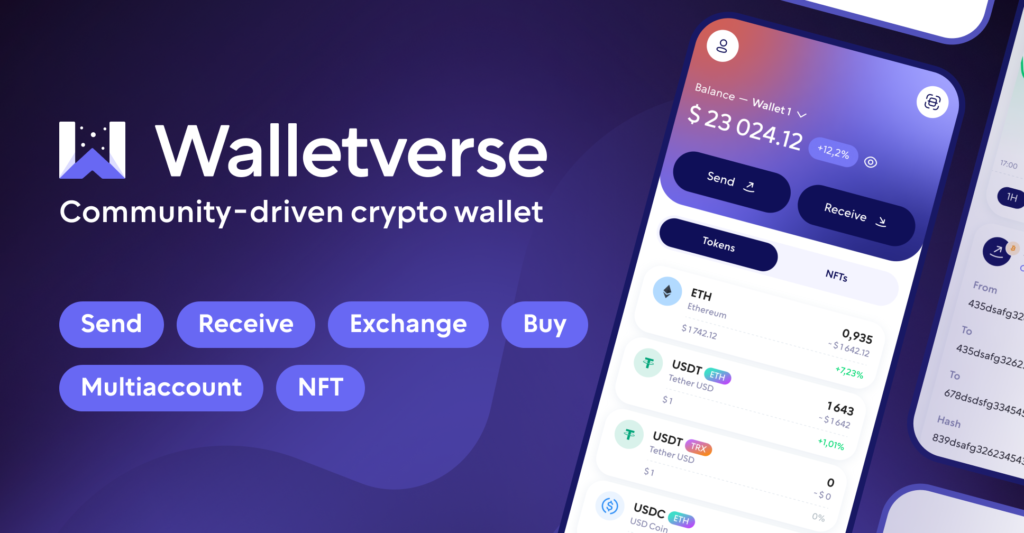
Walletverse is a mobile self-custody crypto wallet that supports Bitcoin, Ethereum, and hundreds of other cryptocurrencies. It also provides integrated swap functionality, allowing users to manage and exchange supported assets from the same app.
The general BTC-to-ETH process is straightforward:
Open Walletverse and select Bitcoin. Make sure your BTC balance is sufficient for the amount you want to exchange and any applicable network cost.
Open the swap or exchange feature. Select Bitcoin (BTC) as the asset you want to send and Ethereum (ETH) as the asset you want to receive.
Enter the BTC amount. Choose how much Bitcoin you want to convert.
Review the quote. Check the BTC amount, estimated ETH you will receive, available exchange rate, and transaction details before proceeding.
Confirm the swap. Carefully review everything once more and authorize the transaction from your wallet.
Check your Ethereum balance. After the swap has been processed, the received ETH should appear in your Ethereum wallet.
Because Walletverse is a self-custody wallet, you remain responsible for controlling and securing access to your wallet. You should never share your recovery information, private keys, or wallet password with another person or website.


BTC to ETH Fees Explained
There is no universal fee for converting Bitcoin to Ethereum. The total cost depends on how the conversion is routed and current blockchain conditions.
Bitcoin Network Fee
Moving BTC requires a Bitcoin network transaction. The cost changes depending on demand for block space and the transaction itself.
When the Bitcoin network is busy, users may have to pay more for faster confirmation.
Swap or Routing Cost
The platform or liquidity provider handling the conversion may include a fee, routing cost, or spread in the quote.
This is why comparing only the advertised exchange rate can be misleading.
Price Spread
The market price displayed by a crypto price tracker and the executable BTC-to-ETH quote may not be identical.
The difference is commonly referred to as the spread.
Slippage and Market Movement
Crypto prices can change while a transaction is being processed. For large conversions or volatile market conditions, the final execution price may differ from the initial market price.
The most useful number is therefore usually “ETH you receive”, not simply the BTC/ETH market ratio.
BTC vs ETH: What Changes After the Conversion?
After exchanging BTC for ETH, you hold a different asset on a different blockchain.
| Bitcoin (BTC) | Ethereum (ETH) |
|---|---|
| Runs on the Bitcoin network | Runs on the Ethereum network |
| Uses Proof of Work | Uses Proof of Stake |
| Primarily focused on decentralized money and settlement | Supports smart contracts and decentralized applications |
| BTC is used for Bitcoin transactions | ETH is used for transactions and gas on Ethereum |
| Cannot be natively staked | ETH can be used for staking |
| Native BTC is not an Ethereum token | Native ETH is the Ethereum network asset |
After receiving ETH, you can hold it, send it to another compatible Ethereum address, use it to pay gas, interact with Web3 applications, or access supported staking and DeFi services.
Always check the requirements and risks of any third-party application before connecting your wallet or approving a transaction.
Common BTC to ETH Conversion Mistakes
One of the most serious mistakes is confusing a transfer with a swap. Never attempt to convert Bitcoin by simply sending native BTC to an Ethereum address.
Another common mistake is choosing the wrong asset or network. Similar token names and compatible-looking addresses do not necessarily mean that two networks are interchangeable.
Users also sometimes focus on a zero or low advertised fee while ignoring the spread and final receive amount. Always evaluate the complete quote.
Finally, rushing through a crypto transaction is unnecessary. Blockchain transactions are difficult or impossible to reverse, so checking the asset, network, amount, and destination before confirming can prevent costly mistakes.
FAQ
Compare the final amount of ETH you will receive after fees, spread, and network costs. Walletverse lets you review the current swap quote before confirming the exchange.
Select BTC, choose ETH as the asset to receive, enter the amount, review the quote, and confirm the swap. In Walletverse, supported BTC-to-ETH swaps can be completed directly from the wallet.
Choose BTC, select ETH, enter the amount, review the rate and fees, then confirm the transaction. Walletverse keeps the process within a self-custody wallet.


