


Buy Gaj Finance (GAJ) with USD, EUR and Other Fiat Currencies
Buying Gaj Finance (GAJ) with USD, EUR, GBP, CAD, AUD, INR, JPY, KZT, and other fiat currencies usually starts with a crypto wallet or exchange that supports fiat-to-crypto payments.
Gaj Finance (GAJ) is a multichain DeFi and NFT token previously known as PolyGaj, with network references across Polygon, Avalanche C-Chain, and Ethereum.
In many cases, GAJ may not be available as a direct card purchase. A common route is to buy a widely supported crypto asset such as ETH, USDT, POL, AVAX, or another supported token with fiat, then swap it for GAJ through an available wallet, exchange, or decentralized exchange route.
Gaj Finance belongs to the DeFi and NFT segment of crypto. Public crypto data sources describe it as a multichain platform built around earning tools, staking, holding, bidding, DeFi products, and NFT-related features. Coinbase also states that Gaj Finance is not tradable on Coinbase, which means users should check other available wallet, swap, or exchange routes before trying to buy GAJ.
The demand for crypto access continues to grow. Triple-A estimated that more than 560 million people owned digital currencies worldwide in 2024. Chainalysis ranked India, the United States, Pakistan, Vietnam, and Brazil as the top five countries in its 2025 Global Crypto Adoption Index. CoinGecko also reported that stablecoin market capitalization reached a new all-time high of $311.0 billion in 2025.
For users who want to buy Gaj Finance with fiat, the main question is how to enter the market safely, find the correct GAJ token, and store it in a compatible wallet after purchase.
This article was prepared by ilink, a FinTech and Web3 software developer with 14 years of experience and completed projects worldwide.
Quick Answer: How Can You Buy Gaj Finance (GAJ) with Fiat?
The easiest way to buy Gaj Finance (GAJ) with fiat is to first buy ETH, USDT, POL, AVAX, or another supported crypto asset with USD, EUR, Apple Pay, Google Pay, credit card, or debit card.
After that, users can swap the purchased asset for GAJ through a supported wallet, exchange, or decentralized exchange route.
Before confirming the transaction, check the correct Gaj Finance contract, network, liquidity, swap fees, provider fees, and wallet compatibility.
Key Takeaways
- Gaj Finance (GAJ) was previously known as PolyGaj and is connected to a DeFi and NFT ecosystem;
- GAJ has been associated with Polygon, Avalanche C-Chain, and Ethereum network addresses, so users should verify the correct chain before buying or sending it;
- Direct GAJ purchases with fiat may not always be available, so many users first buy ETH, USDT, POL, AVAX, or another supported asset and then swap it for GAJ;
- Coinbase states that Gaj Finance is not tradable on Coinbase, so users should check other supported routes before buying;
- Walletverse can help users buy supported crypto with USD, EUR, Apple Pay, Google Pay, credit cards, and debit cards before moving to a GAJ swap route;
- Users should always check token contracts, liquidity, fees, wallet support, and network compatibility before confirming a GAJ transaction.
What is Gaj Finance (GAJ)?
Gaj Finance (GAJ) is a cryptocurrency project connected to decentralized finance and NFT-related products.
The project was previously known as PolyGaj. It started as a Polygon-based DeFi product and later expanded toward a multichain model. Public crypto data sources describe Gaj Finance as a platform created to combine DeFi and NFT use cases in one ecosystem.
The GAJ token is the native token of the Gaj Finance ecosystem. It has been connected to products and features such as staking, holding, bidding, earning opportunities, DeFi products, and NFT-related activity.
Gaj Finance originally gained attention because of its link to PolyGaj, a DeFi protocol built on Polygon. Polygon was relevant for early DeFi projects because it offered lower transaction fees and faster transactions compared with Ethereum mainnet, which made small swaps, staking, and farming activity more practical for retail users.
As the project developed, Gaj Finance moved toward a multichain approach. Public listings show GAJ network addresses on Polygon, Avalanche C-Chain, and Ethereum. This is important because users must choose the correct network before buying, swapping, importing, or sending GAJ.
Coinbase lists Gaj Finance with a circulating supply of about 1.9 million GAJ and a maximum supply of 2.1 million GAJ. These figures help users understand the token’s supply structure, but they should always check current data before making decisions.
Gaj Finance is part of the broader DeFi market. DeFi allows users to interact with smart contracts for swaps, liquidity, staking, farming, asset management, and self-custody. In 2025, CoinGecko reported that decentralized perpetual exchange volume reached a new all-time high, while stablecoin market capitalization also reached a record level. This shows that on-chain financial activity continues to grow beyond simple buy-and-hold crypto ownership.
For GAJ users, the main value of the token is its connection to a niche DeFi and NFT ecosystem. However, GAJ is a smaller asset, so buyers should be careful with liquidity, token contract verification, network selection, and wallet support.
Best Way to Buy Gaj Finance (GAJ) with Fiat
The best way to buy Gaj Finance with fiat is usually to buy a major crypto asset first, then swap it for GAJ.
A simple route can look like this:
- Choose a crypto wallet or exchange that supports fiat payments;
- Buy ETH, USDT, POL, AVAX, or another supported crypto asset with USD, EUR, or another fiat currency;
- Check where GAJ is available for swap or trading;
- Verify the correct Gaj Finance token contract and network;
- Swap the purchased crypto asset for GAJ;
- Store GAJ in a compatible self-custody wallet.
This route is useful because GAJ may not always be available for direct purchase with a bank card, Apple Pay, Google Pay, or local fiat payment method.
Where Can I Buy Gaj Finance (GAJ)? 10 Best Crypto Wallets
1. Walletverse
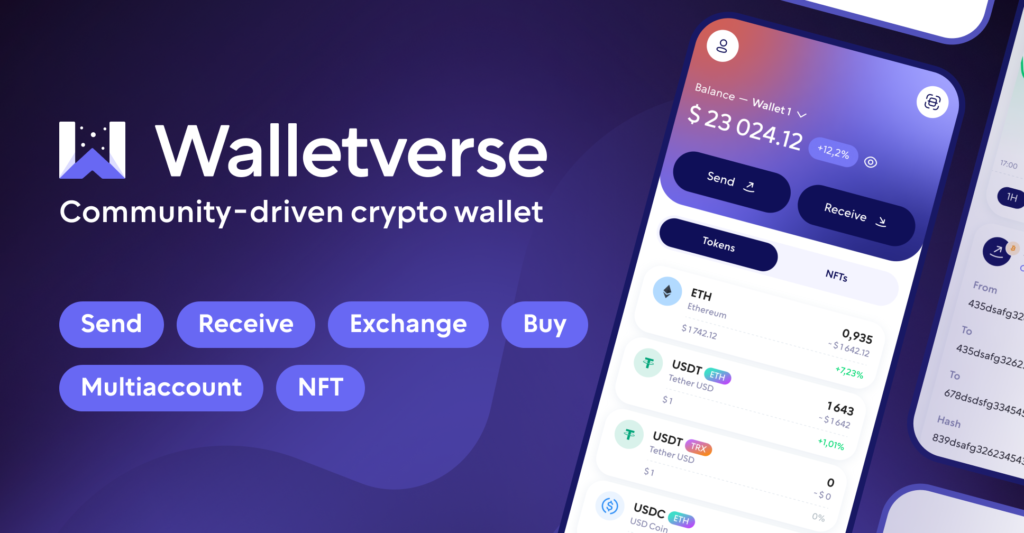
Walletverse is a mobile self-custody crypto wallet for users who want to buy, store, send, receive, and exchange digital assets in one app. It supports more than 700 cryptocurrencies and is available on Google Play and the App Store.
For GAJ users, Walletverse can be useful at the fiat entry stage. Users can buy supported crypto assets with Apple Pay, Google Pay, credit or debit cards, and fiat currencies such as USD, EUR, GBP, JPY, KZT, INR, CAD, AUD, and others.
A practical route is to buy ETH, USDT, POL, AVAX, or another supported crypto asset in Walletverse first. After that, users can check whether GAJ is available directly in the app or use another supported swap route.
Walletverse is non-custodial, which means users control their own assets. The wallet team cannot access user funds. The app also includes passcode protection, biometric authentication, AML and KYT tools, dApp access, multi-account support, DeFi features, and staking for selected assets such as Solana, ETH, and TRX.
Another useful feature is the GasFree USDT transaction system on TRON. It allows users to send USDT without holding TRX for gas, with fees paid directly in USDT. This can make basic on-chain activity easier for new users.
Pros:
- Supports more than 700 cryptocurrencies;
- Allows crypto purchases with Apple Pay, Google Pay, credit cards, debit cards, and multiple fiat currencies;
- Uses a non-custodial model where users control their own funds;
- Includes passcode and biometric authentication;
- Offers dApps, DeFi tools, multi-account functionality, and selected staking options;
- GasFree USDT transfers on TRON can simplify stablecoin transactions.
Cons:
- Available only as a mobile app;
- Direct GAJ availability should be checked inside the app before purchase;
- Users must protect their recovery phrase and device access.



2. Trezor
Trezor is another hardware wallet used for secure crypto storage. It supports many assets through native tools and third-party integrations.
For GAJ, Trezor may be useful if users manage it through a compatible EVM wallet interface. It is mainly suitable for users focused on secure self-custody.
Pros:
- Strong offline private key protection;
- Suitable for long-term storage;
- Established hardware wallet reputation;
- Can work with third-party Ethereum tools.
Cons:
- Requires setup and a physical device;
- Not designed mainly for direct fiat purchases;
- Token display and support should be checked before transfers.
3. Trust Wallet

Trust Wallet is a self-custody mobile wallet that supports many crypto assets, blockchains, and Web3 features. It can be useful for users who want a simple wallet with broad token coverage.
For GAJ buyers, Trust Wallet may help with storing compatible assets, connecting to Web3 tools, and accessing swap routes where supported.
Pros:
- Supports many blockchains and crypto assets;
- Has a beginner-friendly mobile interface;
- Includes Web3 browser and swap features;
- Suitable for users managing several tokens.
Cons:
- Direct fiat purchase support depends on providers and country;
- Some tokens may require manual import;
- Users should verify the GAJ contract before transferring funds.
4. Atomic Wallet

Atomic Wallet is a multi-currency wallet available on desktop and mobile. It supports many digital assets and includes buying, swapping, and storage features.
For GAJ users, Atomic Wallet may be relevant as a general wallet for managing assets used in GAJ purchase routes, depending on current token and network availability.
Pros:
- Available on desktop and mobile;
- Supports many cryptocurrencies;
- Includes built-in buy and exchange features;
- Useful for users who prefer non-browser wallet access.
Cons:
- Fiat purchases depend on third-party providers;
- Some swaps may have higher fees or limited liquidity;
- Users are fully responsible for backup phrase security.
5. Coinomi
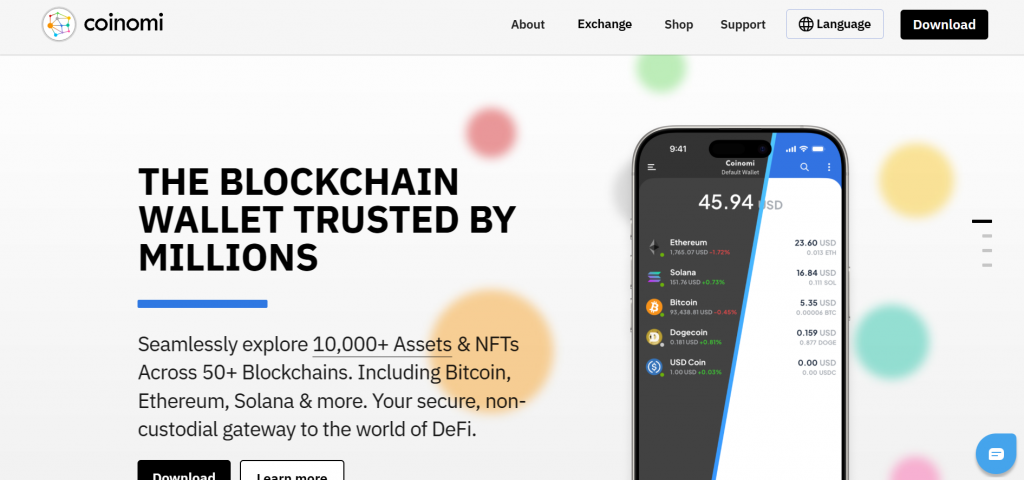
Coinomi is a multi-asset non-custodial wallet that has been used by crypto holders for many years. It supports a wide range of digital assets and is available on mobile and desktop.
For GAJ users, Coinomi may be considered as a general wallet option, especially for users who prefer a long-standing multi-asset wallet. Current GAJ support should still be checked before transferring tokens.
Pros:
- Long-standing multi-asset wallet;
- Non-custodial structure;
- Supports many cryptocurrencies;
- Available on mobile and desktop.
Cons:
- Interface may feel less modern than newer wallets;
- Direct GAJ buying may not be available;
- Current asset support should be checked before use.
6. Exodus

Exodus is a desktop and mobile wallet known for its simple design. It supports many crypto assets and includes integrated exchange features through partner providers.
For GAJ users, Exodus can be useful for buying supported crypto with fiat and managing digital assets. Users should still check whether GAJ is supported directly or whether another route is needed.
Pros:
- Simple and polished interface;
- Available on desktop and mobile;
- Supports many crypto assets;
- Good for beginners who want a clean wallet experience.
Cons:
- Direct GAJ support may be limited;
- Built-in swaps depend on liquidity and partner providers;
- Advanced DeFi users may need more flexible Web3 tools.
7. Ledger Live

Ledger is a hardware wallet designed for users who want stronger private key protection. It can be used with Ethereum and EVM-compatible wallet interfaces, which may make it useful for users who want to store GAJ after verifying network support.
Ledger is better suited for secure storage than instant fiat purchases.
Pros:
- Hardware-based protection for private keys;
- Good option for long-term storage;
- Can work with Ethereum-compatible wallet interfaces;
- Reduces exposure to mobile and browser-based threats.
Cons:
- Requires buying and setting up a physical device;
- Less convenient for quick purchases and frequent swaps;
- Users still need to verify network and contract details before transactions.
8. MetaMask

MetaMask is one of the most widely used wallets for Ethereum and EVM-compatible networks. Since GAJ has been associated with Ethereum, Polygon, and Avalanche C-Chain, MetaMask can be useful for users who want to manage custom tokens and connect to decentralized exchanges.
Users can import custom tokens by contract address, which is important for GAJ because the correct contract depends on the network being used.
Pros:
- Strong support for Ethereum and EVM-compatible networks;
- Allows custom token imports;
- Connects to many decentralized exchanges and Web3 platforms;
- Available as a browser extension and mobile app.
Cons:
- Network setup can be confusing for beginners;
- Fiat purchase options depend on third-party providers and region;
- Users need to avoid phishing links, fake tokens, and unsafe dApps.
9. Coinbase Wallet

Coinbase Wallet is a non-custodial wallet separate from the Coinbase exchange. It supports Ethereum-compatible assets and can connect to decentralized applications.
For GAJ users, Coinbase Wallet may be useful for managing compatible tokens and interacting with DeFi tools. However, Coinbase states that Gaj Finance is not tradable on Coinbase, so users should not assume that the Coinbase exchange supports direct GAJ trading.
Pros:
- Non-custodial wallet with a clean interface;
- Supports Ethereum-based assets and Web3 access;
- Good option for users familiar with Coinbase products;
- Can connect to decentralized exchanges and dApps.
Cons:
- Gaj Finance may not be tradable directly on Coinbase;
- Fiat access depends on providers and region;
- DeFi activity still requires understanding of gas fees and smart contracts.
10. Guarda Wallet

Guarda is a non-custodial wallet available on web, desktop, mobile, and browser extension. It supports many crypto assets and offers purchase, exchange, and selected staking features.
For GAJ users, Guarda may be useful for managing EVM-compatible assets, although users should confirm current token support before sending funds.
Pros:
- Available across several platforms;
- Uses a non-custodial wallet model;
- Supports many assets and networks;
- Offers purchase and exchange features for selected coins.
Cons:
- Direct GAJ purchase may not be available;
- Fees depend on third-party services and network conditions;
- The wide feature set may feel complex for new users.
Can You Buy Gaj Finance (GAJ) with Apple Pay?
Yes, you may be able to buy crypto with Apple Pay and then use that crypto to acquire Gaj Finance (GAJ).
In many cases, GAJ may not be available as a direct Apple Pay purchase. A more common process is to buy ETH, USDT, POL, AVAX, or another supported asset with Apple Pay, then swap it for GAJ where liquidity is available.
A simple Apple Pay route can look like this:
- Open a crypto wallet that supports fiat purchases;
- Select a supported crypto asset such as ETH, USDT, POL, or AVAX;
- Choose Apple Pay as the payment method if available;
- Complete the fiat purchase;
- Check whether GAJ is available through the wallet or another swap route;
- Swap the purchased asset for GAJ;
- Store GAJ in a compatible wallet.
Walletverse supports Apple Pay for buying supported crypto assets, which can help users enter the market from fiat before checking GAJ availability or swap options.
Before using Apple Pay, check:
- Whether Apple Pay is supported in your country;
- Which fiat currencies are available;
- Which crypto assets can be purchased directly;
- What provider fees apply;
- Whether GAJ is supported on the selected network;
- Whether the token contract is correct.
Apple Pay can make the fiat-to-crypto step easier, but GAJ purchase may still require an additional swap.
Can You Buy Gaj Finance (GAJ) with Google Pay?
Yes, users may be able to buy crypto with Google Pay and then exchange it for Gaj Finance (GAJ).
Google Pay is often used for fast card-based crypto purchases inside mobile wallets. Walletverse supports crypto purchases with Google Pay, credit or debit cards, and fiat currencies such as USD, EUR, GBP, JPY, KZT, INR, CAD, AUD, and others.
A practical Google Pay route can look like this:
- Install a wallet that supports Google Pay crypto purchases;
- Create or import a wallet;
- Set up passcode and biometric protection;
- Buy ETH, USDT, POL, AVAX, or another supported crypto asset with Google Pay;
- Check available GAJ swap routes;
- Verify the GAJ token contract;
- Complete the swap and store GAJ securely.
Google Pay can reduce friction during the fiat purchase. Still, users should check provider fees, network fees, swap fees, liquidity, and the final amount received before confirming the transaction.
How to Buy Gaj Finance (GAJ) with Fiat
Buying Gaj Finance with fiat is usually a two-step process. First, you buy a widely supported cryptocurrency with fiat. Then, you swap it for GAJ through an available route.
Step 1. Choose a wallet or exchange
Choose a wallet or exchange that supports fiat payments and the networks you plan to use. Walletverse can be useful for mobile users because it supports fiat purchases, 700+ cryptocurrencies, biometric protection, Web3 tools, dApps, and selected staking options.
Step 2. Create or import your wallet
Install the wallet from the official app store or website. Create a new wallet or import an existing one. If you create a new wallet, save your recovery phrase offline and never share it with anyone.
Step 3. Set up security
Enable passcode protection, biometric authentication, and any other available security features. This is especially important when using a mobile wallet for everyday crypto activity.
Step 4. Select a fiat payment method
Choose a payment method available in your region.
Common options include:
- Credit card;
- Debit card;
- Apple Pay;
- Google Pay;
- Local fiat payment providers;
- Bank-supported payment methods where available.
Step 5. Buy a supported crypto asset
Because GAJ may not always be available as a direct fiat purchase, many users first buy ETH, USDT, POL, AVAX, or another widely supported asset.
Choose the asset based on the GAJ trading route you plan to use.
Step 6. Find a GAJ swap route
Check whether GAJ is available inside the wallet’s swap feature. If it is not available, you may need to use a decentralized exchange or another supported platform.
Before swapping, check liquidity, fees, and the correct Gaj Finance token contract.
Step 7. Confirm the network and token contract
GAJ has been associated with multiple networks, including Polygon, Avalanche C-Chain, and Ethereum. Before sending or importing GAJ, verify the correct contract address through a trusted source.
This step helps users avoid fake tokens and wrong-network transfers.
Step 8. Complete the swap
Enter the amount, review the exchange rate, check network fees, and confirm the transaction.
For smaller tokens, price impact can be higher than for major assets, so review the final amount carefully.
Step 9. Store GAJ securely
After buying GAJ, keep it in a compatible wallet. A mobile or browser wallet may be convenient for active Web3 use. A hardware wallet may be better for long-term storage.
Step 10. Track your transaction
Use a blockchain explorer to confirm the transaction. Depending on the network used, you may need to check PolygonScan, SnowTrace, Etherscan, or another relevant explorer.
Safety Tips Before Buying Gaj Finance (GAJ)
GAJ is a niche DeFi and NFT-related token, so users should take extra care before buying.
Before purchasing GAJ, follow these safety rules:
- Verify the Gaj Finance token contract before buying or importing it;
- Check whether your wallet supports the correct network;
- Review provider fees, swap fees, and network fees;
- Avoid fake websites, fake support accounts, and fake token pages;
- Use self-custody wallets only if you understand recovery phrase security;
- Start with a small test transaction when using a new route;
- Never share your seed phrase, private key, or wallet backup.
A wallet can make the buying process easier, but users still need to manage risk. This is especially important when buying smaller DeFi tokens through third-party providers or decentralized exchanges.
Conclusion
Buying Gaj Finance (GAJ) with USD, EUR, and other fiat currencies is possible through wallets, exchanges, and fiat on-ramp providers, but the exact route may vary by country, payment method, network, and token availability.
In most cases, users buy a major crypto asset such as ETH, USDT, POL, or AVAX with fiat first, then swap it for GAJ through a supported route. This approach is often more practical than searching for a direct GAJ card purchase.
Walletverse can be a useful option for users who want a mobile self-custody wallet with fiat purchases, Apple Pay, Google Pay, card support, 700+ cryptocurrencies, Web3 tools, dApps, selected staking options, and biometric protection.
Before buying GAJ, users should verify that they are buying Gaj Finance (GAJ), check the correct contract, review liquidity, compare fees, and make sure their wallet supports the correct network.
Data current as of June 25, 2026.
FAQ
Most frequent questions and answers
GAJ may be suitable for users who understand DeFi and NFT-related risks and want exposure to a smaller ecosystem connected to staking, holding, bidding, and multichain crypto products. It is a niche asset, so users should check liquidity, project activity, token support, and personal risk tolerance before buying.
You can buy GAJ with USD by first purchasing ETH, USDT, POL, AVAX, or another supported crypto asset through a wallet or exchange. Then you can swap that asset for GAJ through an available route. Walletverse supports crypto purchases with cards, Apple Pay, Google Pay, and multiple fiat currencies, which can help with the first step.
You can use a compatible self-custody wallet that supports the network where you plan to hold GAJ. Walletverse, MetaMask, Trust Wallet, Coinbase Wallet, Guarda, Atomic Wallet, Ledger, and Trezor may be suitable depending on your needs. Before sending funds, check current GAJ support and verify the correct Gaj Finance contract.
GAJ can usually be acquired through crypto platforms or swap routes where the token has active liquidity. If direct fiat purchase is not available, users can buy ETH, USDT, POL, AVAX, or another supported asset first and then swap it for GAJ. Availability depends on region, network, exchange support, and payment provider.
The cheapest way to buy GAJ is usually the route with the lowest total cost across fiat provider fees, network fees, swap fees, and price impact. Users should compare the final amount received before confirming the transaction. Buying a liquid asset first and swapping on a lower-fee supported network may help reduce costs.
Yes, users may be able to buy crypto with EUR and then swap it for GAJ. Walletverse supports fiat purchases in EUR and other currencies, but direct GAJ availability should be checked inside the app or through a supported swap route.
Yes, card payments can be used to buy supported crypto assets in many wallets and exchanges. If GAJ is not available directly by card, users can buy another crypto asset first and then exchange it for GAJ where supported.
Walletverse supports more than 700 cryptocurrencies and is designed for self-custody storage, sending, buying, and exchanging crypto. Before sending GAJ, users should check whether GAJ is currently supported in the app and confirm the correct network and token contract.
GAJ has an Ethereum contract address and is also associated with other EVM-compatible networks such as Polygon and Avalanche C-Chain. Users should verify the correct contract for the exact network they use before importing or transferring GAJ.
If users buy or swap GAJ on Ethereum, they may need ETH to pay network fees. If they use Polygon or Avalanche C-Chain, they may need the native gas token for that network instead. Always check the fee currency before confirming the transaction.


