


Ethereum Staking Rewards: Current ETH APR & Rewards Guide
Ethereum staking allows ETH holders to participate in Ethereum’s Proof-of-Stake network and earn rewards for helping secure the blockchain.
The staking reward is not a fixed interest rate. It changes over time depending on Ethereum network conditions, validator participation, validator performance and other factors.
As of August 31, 2026, Ethereum.org displays a current staking APR of 2.5%, with more than 42.5 million ETH staked. Independent staking data provider Staking Rewards reports a 2.58% Ethereum reward rate and approximately 42.6 million ETH staked. Different services may show slightly different figures because their methodologies and update times can differ.
What Are Ethereum Staking Rewards?
Ethereum staking rewards are ETH earned for participating in Ethereum’s Proof-of-Stake consensus mechanism.
Validators help Ethereum reach consensus by checking blocks, attesting to the state of the blockchain and, when selected, proposing new blocks.
Ethereum uses economic incentives to encourage validators to behave correctly. Validators that perform their duties receive rewards, while validators that go offline can miss rewards and lose small amounts of ETH. Serious protocol violations can result in slashing, which removes part of a validator’s stake and forces the validator to exit the network.
How Much Can You Earn by Staking Ethereum?
A simple way to estimate Ethereum staking rewards is:
Estimated annual reward = ETH staked × annual staking rate
Using a hypothetical 2.5% annual rate:
| ETH Staked | Estimated Reward After One Year |
| 1 ETH | 0.025 ETH |
| 5 ETH | 0.125 ETH |
| 10 ETH | 0.25 ETH |
| 32 ETH | 0.80 ETH |
| 100 ETH | 2.50 ETH |
These examples are estimates only. They assume that the rate remains unchanged for an entire year and do not account for provider fees, validator performance, changes in network rewards or compounding.
Actual staking returns can be higher or lower.
Why Do Ethereum Staking Rewards Change?
Ethereum staking rewards are variable rather than fixed.
One factor is the amount of ETH participating in staking. Ethereum’s protocol adjusts validator economics according to network participation rather than offering every staker a guaranteed fixed percentage.
Validator performance also matters. Validators are expected to remain online and participate correctly in consensus. Missing validator duties can reduce rewards, while protocol violations can lead to penalties.
Block proposals can generate additional rewards because validators proposing blocks may receive transaction priority fees and MEV-related revenue.
Because these factors change, the Ethereum staking reward rate also changes.
Where Do Ethereum Staking Rewards Come From?
Ethereum staking rewards are generated through participation in the Ethereum network.
Consensus Rewards
Validators can earn protocol rewards for performing consensus duties such as attesting to blocks and proposing blocks.
These rewards are part of Ethereum’s Proof-of-Stake mechanism.
Transaction Priority Fees
Ethereum transactions can include priority fees.
When a validator proposes a block, certain transaction fees associated with that block can go to the block proposer. Ethereum.org lists unburned transaction fees among the rewards available to validators that propose blocks.
MEV
Validators proposing blocks can also receive revenue associated with Maximal Extractable Value, commonly called MEV.
Ethereum.org confirms that staking rewards can include fees and MEV when a validator proposes a block.
Because block proposals and network activity vary, this part of validator revenue is not constant.
Ethereum APR vs APY
APR and APY are related, but they do not mean exactly the same thing.
APR, or Annual Percentage Rate, expresses an annualized rate without assuming repeated compounding of rewards.
APY, or Annual Percentage Yield, takes compounding into account.
This distinction matters when comparing Ethereum staking services.
One service may advertise APR while another displays APY. For example, Ethereum.org currently presents its network staking figure as APR, while services such as Coinbase and Kraken present staking rates as APY.
Before comparing two staking rates, check whether both numbers use the same calculation method.
How Much ETH Do You Need to Stake?
The amount of ETH required depends on the staking method.
To activate your own Ethereum validator, you need at least 32 ETH.
Following the Pectra upgrade, a single Ethereum validator can have an effective balance of up to 2,048 ETH.
Users who do not have 32 ETH can still participate through pooled staking solutions. Ethereum.org states that some staking pools accept amounts as low as 0.01 ETH, although requirements depend on the specific third-party service.
Ways to Stake Ethereum
There are several ways to participate in Ethereum staking.
Solo Staking
Solo staking means running your own Ethereum validator.
It requires at least 32 ETH and dedicated hardware connected to the internet. The validator operator controls the keys and interacts directly with the Ethereum protocol.
Ethereum.org describes home staking as the most direct form of Ethereum staking because no third-party operator stands between the validator and the protocol.
The main responsibilities include maintaining the validator infrastructure, keeping the validator online and protecting validator keys.
Delegated Staking
Delegated staking allows an ETH holder with the required validator deposit to use a third-party operator to run validator infrastructure.
In this model, the service handles technical validator operations.
Ethereum.org notes that delegated staking introduces additional trust in the service provider compared with running a validator directly.
Pooled Staking
Pooled staking allows multiple users to combine ETH so they can participate without individually providing the full validator deposit.
Ethereum.org makes clear that pooled staking is not a native Ethereum protocol feature. Pooling solutions are built by third parties and therefore introduce additional smart-contract, operator or counterparty risks.
Some pools allow users to participate with substantially less than 32 ETH.
Liquid Staking
Some pooled staking services issue a token representing staked ETH and the user’s position in the staking system.
These tokens may be transferable or usable within decentralized finance applications.
Liquid staking can provide additional flexibility, but it also introduces risks associated with third-party smart contracts and the liquid staking token itself.
Centralized Exchange Staking
Some centralized exchanges offer Ethereum staking as a service.
This can reduce the technical work required from the user, but the exchange typically takes custody of the ETH and operates staking infrastructure on the user’s behalf.
Ethereum.org identifies centralized exchange staking as an approach with higher trust assumptions because users depend on the exchange and its infrastructure.
What Are the Risks of Ethereum Staking?
Ethereum staking can generate rewards, but it involves risk.
Variable Rewards
The staking rate can change.
A rate displayed today does not guarantee the same return during the next month or year.
Validator Downtime
Validators are expected to participate in consensus.
Ethereum.org states that validators that go offline can miss rewards and lose small amounts of ETH.
Slashing
Slashing is a protocol penalty for certain serious validator violations.
Ethereum.org gives signing two conflicting blocks as an example of behavior that can result in slashing. A portion of the validator’s ETH can be destroyed and the validator can be removed from the active validator set.
Third-Party Risk
Delegated, pooled and centralized staking introduce additional dependencies.
Depending on the method, these can include:
validator operators;
smart contracts;
staking protocols;
custodians;
centralized exchanges.
Ethereum.org emphasizes that moving away from direct home staking introduces additional software, contracts, operators or custodians between the user and the Ethereum protocol.
Smart Contract Risk
Pooled and liquid staking solutions can depend on smart contracts.
Because pooled staking is built by third parties rather than being a native Ethereum protocol feature, users should evaluate the risks of the specific staking protocol before depositing ETH.
ETH Market Risk
Staking rewards are denominated in ETH, while the market price of ETH can increase or decrease.
Receiving additional ETH therefore does not guarantee an increase in the fiat value of a portfolio.
Is Ethereum Staking Guaranteed?
No. Ethereum staking does not provide a guaranteed fixed return.
The amount earned can change because of:
network staking participation;
validator performance;
protocol rewards;
block proposal activity;
priority fees;
MEV;
penalties;
fees charged by third-party staking services.
Staking should therefore be understood as participation in Ethereum’s consensus mechanism with variable rewards, not as a fixed-interest savings product.
What Should You Check Before Staking ETH?
Do not compare staking services only by the largest advertised percentage.
Before staking Ethereum, check:
whether the displayed rate is APR or APY;
whether the rate is variable;
whether fees are deducted from rewards;
who operates the validators;
who controls the withdrawal keys;
whether the service uses smart contracts;
whether the ETH remains under self-custody or is transferred to a custodian;
how withdrawals work;
whether an exit queue can affect withdrawal time;
what penalties or other staking risks apply.
Different staking methods have different reward structures and trust assumptions.
Ethereum Staking with Walletverse
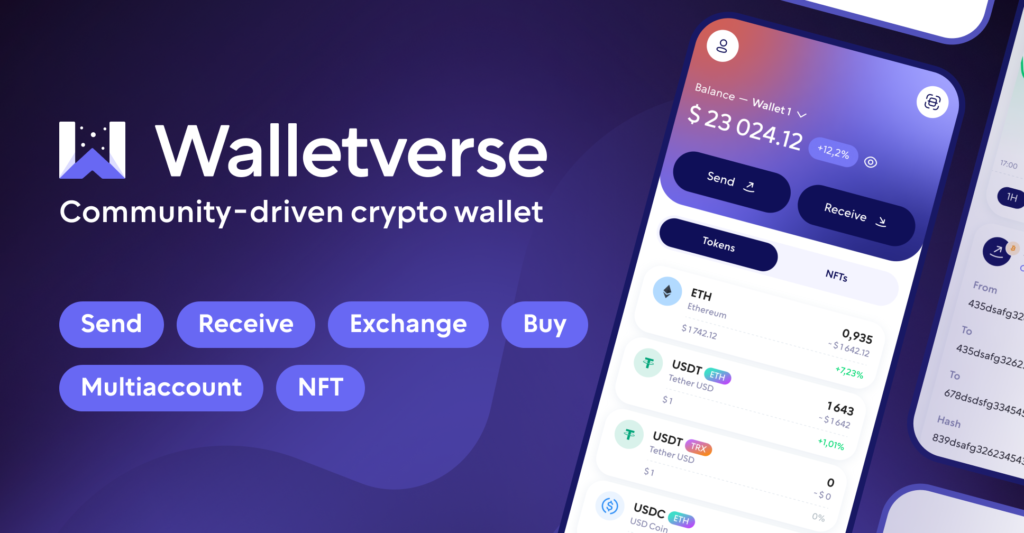
Walletverse is a mobile self-custody cryptocurrency wallet.
Walletverse publicly states that it supports more than 700 cryptocurrencies and that staking is available for selected assets including ETH, SOL and TRX. As a self-custody wallet, Walletverse states that users retain control over access to their crypto assets.
Walletverse also provides access to cryptocurrency management, swaps and Web3 functionality from a mobile application.
Because staking rates and conditions can change, users should review the current staking information shown in the Walletverse application before confirming any staking transaction.


FAQ
Most frequent questions and answers
At an annual rate of 2.5%, 1 ETH would generate approximately 0.025 ETH over one year if the rate remained unchanged. Actual rewards may differ because Ethereum staking rates are variable.
Walletverse offers one of the most secure and transparent options for staking Ethereum, combining self-custody with compliance and ease of use.
Yes, some platforms require a waiting period before unstaking. Unstaking early may result in loss of pending rewards or delays in fund availability.


