
How to Buy Bitcoin (BTC) in 2026: Step-by-Step Guide

Buying Bitcoin in 2026 takes about fifteen minutes. Understanding what you actually bought, what it really cost you, and who controls it afterwards takes a little longer — and that is the part where beginners lose money. This guide covers both.

Buy Bitcoin in 4 steps — the short version

If you want the whole answer in thirty seconds, here it is. Each step is expanded further down.

  1. Pick where you will buy. A regulated exchange, a non-custodial wallet app with a built-in on-ramp, a broker, a spot Bitcoin ETF, a peer-to-peer marketplace, or a Bitcoin ATM. These differ enormously in cost, and in whether you end up owning Bitcoin at all.
  2. Open an account and complete identity verification. Nearly every regulated route requires a government ID and a selfie. Automated checks take minutes; a manual review can take a couple of days.
  3. Fund the account and check the total cost before you confirm. The price you see is rarely the price you pay. Add the trading fee, the payment fee and the spread, then calculate your effective price per BTC.
  4. Decide where your Bitcoin lives. Leaving it on the platform is convenient and means the platform holds the keys. Withdrawing to a wallet you control means you hold them, along with the responsibility.

Where to buy Bitcoin: seven ways

There is no single best place to buy BTC. There is a best place for your situation, and it depends on how much you are buying, how quickly you need it, how much verification you will tolerate, and whether you want the asset itself or just exposure to its price.

Each option below follows the same five points, so you can compare them directly.

1. Crypto exchange (spot order)

  • Typical all-in cost: 0.1% to 0.6% trading fee, plus whatever your funding method costs
  • Speed: minutes to a few days, depending on the deposit rail
  • Identity verification: required
  • Do you get real BTC: yes, held by the exchange until you withdraw it
  • Best for: the lowest cost, larger amounts, and recurring purchases

This is the cheapest route in almost every market. You deposit fiat, place an order on a real order book, and pay a small percentage. The trade-off is a slightly steeper learning curve — order types, deposit holds, withdrawal whitelists — and the fact that your Bitcoin sits in the exchange’s custody until you move it.

2. Exchange “instant buy” widget

  • Typical all-in cost: 1.5% to 4% all in
  • Speed: instant
  • Identity verification: required
  • Do you get real BTC: yes, custodial
  • Best for: absolute beginners who value simplicity over price

The same companies that run cheap order books also offer a one-button purchase screen. It is genuinely easier. It also costs several times more, because the convenience is priced into the quote rather than shown as a fee. Fine for a first $50. Expensive as a habit.

3. Non-custodial wallet with a built-in on-ramp

  • Typical all-in cost: 1% to 4%, charged by the third-party payment provider
  • Speed: minutes
  • Identity verification: required, performed by the on-ramp provider
  • Do you get real BTC: yes, delivered straight into your own wallet
  • Best for: people who want to hold their own keys from the very first purchase

The Bitcoin arrives in a wallet you control, so there is no withdrawal step and no withdrawal fee. You are paying a payment processor rather than trading on an order book, so the rate is worse than an exchange. For small and medium purchases, the simplicity often justifies it; for large positions, it usually does not.

4. Traditional broker or investment app

  • Typical all-in cost: varies widely, often built into the spread rather than shown
  • Speed: instant during market hours, sometimes 24/7
  • Identity verification: required
  • Do you get real BTC: sometimes — check whether the product is actual Bitcoin or a derivative
  • Best for: investors who already use that broker and want everything in one place

The critical question here is what you are actually buying. Some brokers hold real Bitcoin on your behalf. Others sell you a contract that tracks the price. Others again will not let you withdraw the asset at all. Read the product description, not the marketing page.

5. Spot Bitcoin ETF

  • Typical all-in cost: roughly 0.19% to 0.25% per year in fund expenses, plus any brokerage commission
  • Speed: stock market hours only
  • Identity verification: required, through your brokerage account
  • Do you get real BTC: no — you own shares in a fund that holds Bitcoin
  • Best for: retirement accounts and investors who never want to manage private keys

A legitimate route with a real advantage: it works inside tax-advantaged accounts where holding Bitcoin directly usually does not. The cost is an annual fee that never stops, and the fact that you can never send, spend or self-custody what you hold. Covered in detail in its own section below.

6. Peer-to-peer marketplace

  • Typical all-in cost: 0% to 1% platform fee, but seller spreads can be wide
  • Speed: minutes to hours
  • Identity verification: varies by platform and amount
  • Do you get real BTC: yes
  • Best for: markets with limited banking access, or unusual payment methods

You trade directly with another person, with the platform holding the Bitcoin in escrow until payment clears. It works well in places where card and bank rails are unreliable. It also concentrates fraud risk in a way the other methods do not, so it demands judgement: established counterparties only, never release escrow early, and never move the conversation off the platform.

7. Bitcoin ATM

  • Typical all-in cost: very high — commonly 8% to 20% once the spread is counted
  • Speed: instant
  • Identity verification: usually required above small limits
  • Do you get real BTC: yes, sent to a wallet address you provide
  • Best for: cash purchases when no other option is available

Worth being blunt: this is the most expensive way to buy Bitcoin in almost every market, and the gap is not marginal. A machine advertising a “6% fee” may still quote a BTC price several percent above the market rate, so the real cost lands far higher. If the alternative is not buying at all, an ATM works. Otherwise, fifteen extra minutes with an exchange or wallet app saves a great deal.

Step by step: buying your first Bitcoin

Step 1 — Choose a platform and check that it is licensed where you live

Before you enter a single personal detail, confirm the platform is authorised to serve customers in your country or state.

In the United States, check for registration with FinCEN as a money services business, and for state-level money transmitter licensing. Availability genuinely varies by state — services have been unavailable in New York, Hawaii and Louisiana at various points.

In the European Union, the transitional period under MiCA ended on 1 July 2026. Providers serving EU customers now need authorisation as a Crypto-Asset Service Provider in an EU member state. If a platform cannot show a CASP licence, it should not legally be onboarding EU retail customers. Several well-known names withdrew from Europe rather than obtain one.

In the United Kingdom, look for FCA registration under the money laundering regulations. Kraken, for instance, publishes its FCA firm reference number directly on its buy page — that kind of transparency is a good sign.

Anywhere else, find the regulator’s public register and search the company name yourself. If the platform’s own website is the only place claiming it is licensed, treat that as unverified.

Step 2 — Create an account and complete identity verification

You will typically need a government-issued photo ID, a selfie or short video for liveness detection, your address and sometimes a proof-of-address document, and in some jurisdictions your tax identification number. Larger accounts may be asked about source of funds and intended activity.

Turn on two-factor authentication immediately, and do not use SMS. SIM-swap attacks remain one of the most common ways retail accounts are drained. Use an authenticator app or a hardware security key, and use passkeys where the platform offers them.

Verification usually completes in minutes. The usual causes of manual review are a blurry ID photo, a name mismatch, or a recently changed address — any of which can add one to three business days.

Step 3 — Fund your account

Match the funding rail to what you care about.

Cheapest is a bank transfer — ACH in the United States, SEPA in the EU, Faster Payments in the UK. Often free or nearly free, but funds may take one to three business days to settle, and the platform may hold withdrawals for several days after an ACH deposit.

Fastest is a debit card or a payment wallet. Instant, and you pay for it.

Most expensive is a credit card. Beyond the platform’s own fee, many card issuers classify crypto purchases as a cash advance, which means a separate issuer fee plus interest accruing from day one with no grace period. Check your card’s terms before doing this.

Step 4 — Place the order

Two order types matter for a first purchase.

A market order buys immediately at the best available price. It is simple, and you accept whatever the price is at that instant.

A limit order buys only at the price you specify or better. It may not fill at all, but you control the price and usually pay a lower maker fee.

For very small amounts the difference is negligible. For anything meaningful, a limit order on the spot market is almost always cheaper than the instant-buy button.

Step 5 — Verify what you actually received

Before you close the tab, do the arithmetic. Take the total amount of money that left your account, and divide it by the amount of Bitcoin that actually arrived. That gives you your effective price per Bitcoin — what you really paid, rather than what the screen said you would pay.

Compare that number against the market price at the moment you bought. The gap is your true, all-in cost. Do this once and you will never again take a “zero commission” claim at face value.

Step 6 — Move it to storage, or deliberately decide not to

If you are holding for the long term, withdraw to a wallet you control. Every time, without exception:

  1. Send a small test amount first — $5 to $20 — and confirm it arrives.
  2. Verify the entire receiving address, not just the first and last few characters.
  3. Confirm you are sending on the Bitcoin network, not a wrapped or bridged version on another chain.
  4. Only then send the rest.

Bitcoin transactions are irreversible. There is no chargeback, no support ticket and no recovery. A test transaction costs a few dollars and has saved an enormous amount of money over the years.

Bitcoin fees: what you really pay

The advertised fee describes one component. Your actual cost has four.

  1. The trading fee. Typically 0.1% to 0.6% on spot order books, and 1.5% to 4% on instant-buy widgets. Usually visible before you confirm.
  2. The payment or funding fee. Anywhere from 0% on a bank transfer to 5% on a credit card. Usually visible.
  3. The spread. The difference between the price you are quoted and the real market price. Around 0.1% on a deep order book, but 2% to 8% or more at ATMs and some brokers. Frequently not visible at all.
  4. The network fee. Paid to miners when you move Bitcoin on-chain. A few dollars in normal conditions, considerably more during congestion. Only appears when you withdraw.

The spread is where the money quietly goes. A service can honestly advertise “zero commission” while quoting you a Bitcoin price 3% above market. The commission genuinely is zero. The cost is not.

Security: seven ways people lost Bitcoin in 2026

Most losses are not sophisticated. They are the same handful of patterns, repeating.

  1. Fake wallet apps. Cloned apps appear in app stores under names one character away from the real one. Install only from the link on the official website, and check the developer name and review count before tapping install.
  2. Address poisoning. An attacker sends you a tiny transaction from an address whose first and last characters match one you have used before. Later you copy the address from your transaction history and send funds to the attacker instead. Verify the full address every single time.
  3. Clipboard malware. Malicious software silently replaces a copied Bitcoin address with the attacker’s. After pasting, always compare the pasted address against the source.
  4. Approval drainers. Primarily a smart-contract risk, but relevant if your wallet is multi-chain. Signing a malicious approval grants a contract permission to move your tokens indefinitely. Read what you are signing, and revoke old approvals periodically.
  5. Fake support. Nobody from a legitimate wallet or exchange will message you first, ask for your recovery phrase, or ask you to “sync” or “validate” your wallet. This is the single most common attack, and it is always the same script.
  6. SIM swaps. Your phone number is not a security factor. Move off SMS-based two-factor authentication to an authenticator app or a hardware key.
  7. Guaranteed-return schemes. Anything promising fixed daily percentages, doubling your holdings, or “recovery services” that will retrieve previously stolen crypto for an upfront payment is fraud. There are no exceptions to this one.

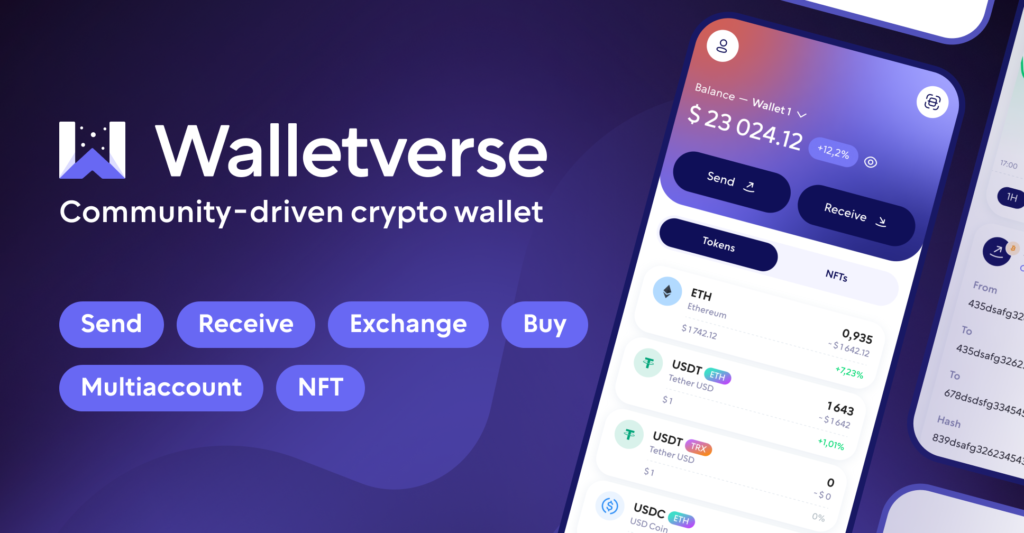
How to buy Bitcoin in Walletverse

Walletverse - best crypto wallet

Walletverse is a non-custodial mobile wallet. Private keys are generated on your device and stay there. We cannot access your funds, freeze your account, or recover your wallet if you lose your recovery phrase — that is the trade-off self-custody makes, and it cuts in both directions.

Buying BTC directly in the app:

  1. Install Walletverse from the App Store or Google Play, checking that the developer name matches before you install.
  2. Create a wallet and write your recovery phrase on paper. The app will ask you to confirm it. Do not skip this step, and do not screenshot it.
  3. Enable biometric unlock and a passcode in Security settings.
  4. Select Bitcoin and tap Buy. The purchase is processed by a licensed third-party on-ramp provider, which runs its own identity verification.
  5. Choose your payment method — card, payment app or bank account — and review the quoted total. Compare the quoted BTC amount against the live market price before confirming.
  6. Confirm. The Bitcoin arrives directly in your own wallet. There is no intermediate custodial balance and no withdrawal step.

FAQ

Most frequent questions and answers

A spot limit order on a major exchange, funded by bank transfer, then withdrawn in a single transaction. The all-in cost is typically well under 1%. The most expensive routes are Bitcoin ATMs, commonly 8% to 20% once the spread is counted, and credit cards.

Buying through a licensed provider is operationally safe. The price risk is a separate matter and it is significant — Bitcoin has fallen more than 75% from a peak on multiple occasions. The main avoidable risks are custody failures, phishing, and buying more than you can afford to lose.

The funds are almost certainly unrecoverable. Bitcoin transactions are final and there is no reversal mechanism. If the address happens to belong to an exchange, contacting their support gives a small chance of recovery. This is why a test transaction before any large send is non-negotiable.