


How to Transfer Crypto from Exchange to Wallet: A Step-by-Step Guide
- Updated 2026/10/05
Updated: October 2026
Moving crypto from an exchange such as Coinbase, Kraken or Binance to your own wallet takes a few minutes. You copy a receiving address from your wallet, paste it into the exchange’s Withdraw form, choose the right network and confirm. This guide shows each step, how to move crypto to a cold wallet, how to transfer between exchanges and wallets, and how to avoid the mistakes that cause lost funds.
Key takeaways:
- The network you select on the exchange must match the network of your wallet address.
- Some coins need a memo or tag — without it, funds may be lost.
- Blockchain transactions cannot be canceled or reversed, so send a small test transfer first.
- After sending, track the transfer with its transaction ID (TXID) in a blockchain explorer.
Why Move Crypto from an Exchange to a Wallet?
On an exchange, the platform holds the private keys for you (custodial account). In a self-custody wallet, only you hold them.
| Exchange account | Self-custody wallet | |
|---|---|---|
| Who controls the private keys | The exchange | You |
| Can withdrawals be frozen by a third party | Yes, the platform can pause or limit them | No — only you can sign transactions |
| Best for | Active trading, converting to fiat | Long-term holding, using dApps |
| Main risk | Hacks, outages or restrictions at the platform | Losing your recovery phrase |
Exchanges remain targets for attacks. In February 2025, the exchange Bybit said hackers had stolen digital tokens worth around $1.5 billion (Reuters). This is why many users keep only the amount they trade on an exchange and move long-term holdings to their own wallet.
The trade-off: with self-custody, there is no “forgot password” option. If you lose your recovery phrase, nobody can restore access.
Before You Start: 2-Minute Safety Checklist
Most transfer mistakes happen before you press “Withdraw”. Check these first:
- The coin and the network match. USDT, for example, exists on Ethereum (ERC-20), TRON (TRC20), BNB Smart Chain and other networks. Your wallet’s receiving address must be on the same network you select on the exchange.
- A memo or tag is required (for some coins). Coins such as XRP, XLM and HBAR use an extra identifier when you deposit to an exchange. Coinbase warns that omitting or entering an incorrect tag/memo “can delay transactions or cause the loss of funds.” According to Coinbase, tags/memos generally aren’t needed when you send to a self-custody wallet, because the address is unique to you — but if the receiving side shows one, always include it.
- Two-factor authentication (2FA) is on for your exchange account.
- You know the fees. The exchange shows the network fee and any withdrawal fee before you confirm. Many exchanges also have a minimum withdrawal amount.
- You’ll send a test transfer first if the amount is large.
How to Transfer Crypto from an Exchange to a Wallet: Step by Step
Step 1. Get a receiving address from your wallet
- Open your wallet app and select the coin you want to receive (for example, BTC, ETH or USDT).
- Tap Receive.
- Check the network shown next to the address.
- Copy the address or keep the QR code open.
Step 2. Open Withdraw (Send) on the exchange
- Log in to your exchange and open Withdraw or Send.
- Select the same cryptocurrency.
- Select the network. It must match the network from Step 1.
Step 3. Paste the address (and memo, if required)
- Paste the address. Compare the first and last few characters with the address in your wallet.
- If the form shows a Memo/Tag field and your wallet provides one, enter it exactly.
Step 4. Enter the amount and review the fees
You will usually see the network fee and sometimes a separate exchange withdrawal fee. Check the amount you will actually receive, then continue.
Step 5. Confirm the withdrawal
Most exchanges ask you to confirm with 2FA, an email link or both.
Step 6. Track the transfer with the TXID
Once the exchange sends the transaction, it shows a TXID (transaction hash). Paste it into a blockchain explorer for that network:
- Bitcoin: Blockchain.com Explorer
- Ethereum and ERC-20 tokens: Etherscan
- TRON and TRC20 tokens: Tronscan
- BNB Smart Chain: BscScan
- Many networks: Blockchair
If the transaction shows confirmations and the destination matches your wallet address, the funds are on the way. Your wallet balance updates once the network confirms the transaction.
How to Move Crypto from an Exchange to a Cold Wallet
A cold (hardware) wallet keeps your private keys on a separate device. The transfer works the same way, with one extra security step:
- Connect the hardware wallet and open its companion app (for example, Ledger Wallet or Trezor Suite).
- Choose the account and tap Receive.
- Verify the address on the device screen. Ledger advises checking that the address shown in the app matches the one displayed on the device’s secure screen. This protects you from malware that replaces addresses on your computer.
- Copy the verified address into the exchange’s Withdraw form and follow Steps 2–6 above.
Because a hardware wallet is designed for long-term storage, many users move larger amounts there and keep a smaller balance in a mobile wallet for everyday use.
How to Transfer Crypto Between Exchanges
The process is the same, but the receiving side is another exchange:
- On the receiving exchange, open Deposit, select the coin and the network, and copy the deposit address — plus the memo/tag if one is shown.
- On the sending exchange, open Withdraw, paste the address and memo, select the same network and confirm.
Deposits to exchanges are where a missing memo/tag most often causes problems: many exchanges use one address for many customers and rely on the memo to credit your account. Kraken, for example, asks you to include the tag/memo for XRP, XLM and STX deposits.
How to Transfer Crypto from One Wallet to Another
To move crypto between two wallets you control:
- In the receiving wallet, tap Receive and copy the address for the right network.
- In the sending wallet, tap Send, paste the address, enter the amount and confirm.
You pay only the network fee — there is no exchange fee. Make sure the sending wallet holds enough of the network’s native coin for the fee (for example, ETH on Ethereum or TRX on TRON), unless your wallet offers another way to pay it.
Common Transfer Mistakes and How to Avoid Them
| Mistake | What happens | How to avoid it |
|---|---|---|
| Wrong network | Funds may arrive on a network your wallet doesn’t support; Coinbase says it can’t recover funds sent on the wrong network | Match the network on both sides |
| Missing memo/tag | The exchange can’t identify your deposit; funds may be lost | Always include a memo when the receiving side shows one |
| Wrong address | Transactions are final and cannot be reversed | Copy-paste, then check the first and last characters |
| Large transfer without a test | A mistake costs the whole amount | Send a small amount first |
| Address replaced by malware | Funds go to an attacker | Verify the address on your hardware wallet screen; compare characters |
What to Do If a Transfer Is Missing or Stuck
- Check the status on the exchange. If there is no TXID yet, the exchange is still processing the withdrawal.
- Check the TXID in a blockchain explorer. If the transaction is confirmed and the address is yours, the funds are in your wallet — make sure the wallet shows the same network and, if needed, add the token.
- If you used the wrong network or forgot a memo, don’t send more. Contact the support of the platform that received the funds and give them the TXID. Whether funds can be recovered depends on that platform.
- If you sent to a wrong address, the transaction cannot be reversed. Coinbase advises contacting the recipient and asking them to return the funds.
Walletverse: A Self-Custody Wallet for Exchange Withdrawals
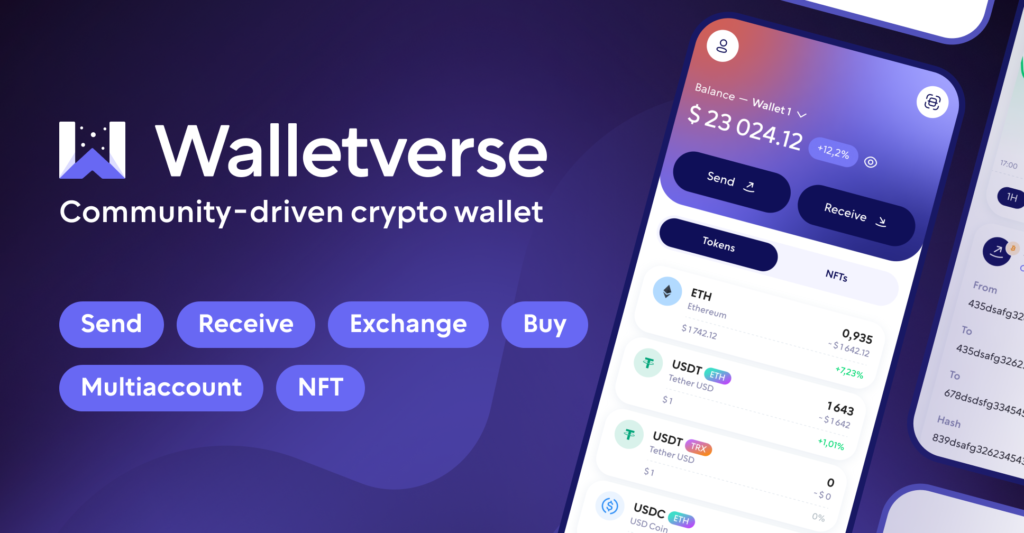
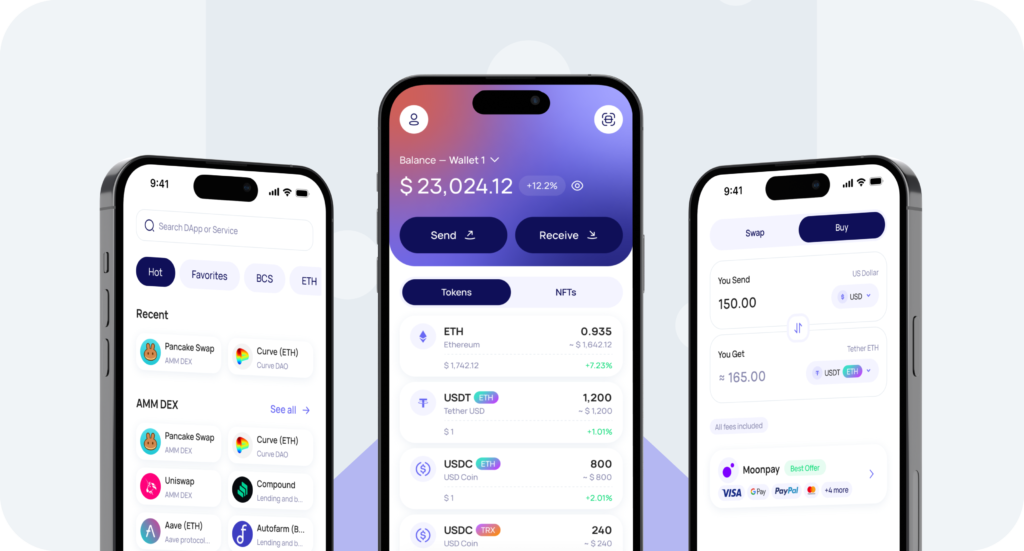
If you need a mobile wallet to receive your crypto, Walletverse is a self-custody wallet for iOS and Android:
- supports 700+ cryptocurrencies and tokens across multiple networks, with multiple accounts and addresses;
- private keys are encrypted on your device and never leave it;
- passcode and biometric protection;
- built-in AML checks (powered by Crystal) to check the risk level of addresses and transfers;
- GasFree USDT transfers on TRON — the fee can be paid in USDT;
- buy crypto with Visa, Mastercard or local payment methods, plus Apple Pay and Google Pay where available;
- swaps through a DEX and CEX aggregator, staking for ETH, SOL, TRX and more, and WalletConnect for dApps.
To receive funds, open the asset in Walletverse, tap Receive, check the network and use that address in your exchange’s Withdraw form.


FAQ
Most frequent questions and answers
If you’re actively trading, exchanges are convenient.
For longer-term holding, a self-custody wallet is often safer because you’re not exposed to exchange custody risk.
It depends on the blockchain and network congestion. Bitcoin and Ethereum can take longer during busy periods. Most exchanges also have internal processing time before broadcasting the transaction.
Don’t send more. Immediately contact the exchange and the wallet/service support. Recovery depends on the exact network mismatch and whether the receiving side can technically access that chain.
Yes, you can easily transfer Bitcoin from the exchange to your crypto wallet. Follow the steps: get your Bitcoin wallet address from Walletverse app and use it to withdraw Bitcoin from your exchange account.
Yes, you can transfer Ethereum from the exchange to your wallet by following steps similar to those for Bitcoin. Get your Ethereum wallet address from your crypto wallet Walletverse and paste it into the exchange’s “Send” or “Withdraw” section.
Yes, transferring cryptocurrency from the exchange to the wallet is safe if you ensure the wallet address is correct and your platform is secure. Using a cold storage wallet (like a hardware wallet) adds an extra layer of security.
You can move crypto to a cold storage wallet (hardware wallet). Follow the same steps to transfer funds, but ensure your hardware wallet is connected and ready to receive the cryptocurrency.
An exchange to wallet transfer is a withdrawal. Open Withdraw on the exchange, paste a receiving address from your own wallet, select the matching network, enter the amount and confirm with 2FA. Then track the transfer with the TXID. This is also how you take your crypto off an exchange completely.
Open your hardware wallet’s app, tap Receive, verify the address on the device screen, and use that address in the exchange’s Withdraw form.


