


Buy Bitcoin (BTC) with USD, EUR and other fiat
Turn your everyday money into Bitcoin in a few taps — and keep it in a wallet only you control. Walletverse is a self-custody app for iOS and Android: the Bitcoin you buy goes to your own wallet address, not to an exchange account someone else holds.
Bitcoin Price and Market Today
| Bitcoin (BTC) | |
|---|---|
| Price | About $82,000 |
| Market cap | About $1.64 trillion |
| Share of the total crypto market | About 58% |
| Circulating supply | About 20.1 million BTC |
| Maximum supply | 21 million BTC (bitcoin.org) |
| All-time high | $126,198 on 6 October 2025 (Digital Chamber) |
Source: CoinGecko, CoinGecko charts, snapshot from 22 October 2026. Prices change every second — check the live quote in the app before you buy.
Bitcoin’s price can move sharply in both directions: after its October 2025 peak, it fell by roughly half in the following months (SoFi). The amount of BTC you receive is calculated at the moment you pay.
How to Buy Bitcoin with Fiat in 4 Steps
Step 1 — Install Walletverse and create your wallet. Download the app from the App Store or Google Play. The wallet is created on your device, and your private keys are stored encrypted on it. Follow the in-app backup steps and keep your recovery details offline.
Step 2 — Open “Buy” and choose Bitcoin. Walletverse supports 700+ cryptocurrencies and tokens, so the same flow works later for ETH, USDT, XRP, SOL, DOGE and others.
Step 3 — Choose your currency, amount and payment method. Enter how much you want to spend in USD, EUR, GBP, CAD, AUD, AED, ARS, KZT, INR or another supported currency. Purchases are processed by licensed payment providers — MoonPay, Simplex, Banxa, Transak and Wert. Pay with Visa, Mastercard or a local payment method; Apple Pay and Google Pay are available where your provider supports them.
Step 4 — Confirm and receive BTC in your own wallet. Complete the payment with the provider, and the Bitcoin is sent directly to your Walletverse address. Card payments are usually faster than bank-based methods, which depend on your bank. Because the wallet is non-custodial, there’s no separate “withdraw to wallet” step.
How Much Does It Cost to Buy Bitcoin?
The total you pay is made of three parts:
- The provider fee — charged by the payment provider that processes your fiat payment. MoonPay, Simplex, Banxa, Transak and Wert set their own rates, which differ by payment method and country.
- The spread — the difference between the market rate and the rate you buy at, also set by the provider.
- The Bitcoin network fee — paid to miners to deliver BTC to your address. It depends on how busy the Bitcoin network is, not on how much you buy; higher fees encourage faster confirmation (bitcoin.org).
Before you confirm, check the final amount of BTC you’ll receive — that number already reflects the fees.
Do I Need to Verify My Identity?
Creating and using a self-custody wallet doesn’t involve an exchange account: Walletverse doesn’t hold your funds.
Identity checks apply to the fiat payment step and are handled by the provider you pay through. Buying crypto with a card or bank payment is regulated in most countries, so providers run checks that depend on the provider, your country, the amount and the payment method. Each provider shows its requirements before you pay.
Walletverse also includes AML checks (powered by Crystal), so you can see the risk level of an address before you send to it.
Other Ways to Buy Bitcoin
A wallet with a built-in “Buy” button is one option. Here are the others — and what to watch for with each:
- Centralized exchanges (such as Coinbase, Kraken or Binance). Usually the widest choice of payment methods and order types, but you need a verified account, and your BTC sits on the exchange until you withdraw it to your own wallet.
- Bank transfer and SEPA. Many exchanges accept bank transfers; in Europe, SEPA transfers in euros are common. They’re often cheaper than cards but slower.
- PayPal (US). PayPal lets eligible US users buy, sell and hold crypto and send it to external wallets; transfers can’t be cancelled or reversed (PayPal).
- Brokerage apps. Some brokerages let you buy BTC alongside stocks. Check whether you can withdraw the coins to your own wallet before you buy.
- Peer-to-peer (P2P) platforms. You buy directly from another person, often with escrow. More payment options, but a higher risk of fraud — use only platforms with escrow and reputation systems.
- Bitcoin ATMs. Convenient for cash, but fees are usually higher — and they’re a common scam channel: the FTC reports that losses to scams involving Bitcoin ATMs rose nearly tenfold since 2020, to over $110 million in 2023 (FTC). No real government agency or company will ask you to pay through a Bitcoin ATM.
Buy Bitcoin Without an Exchange: Swap From Other Crypto
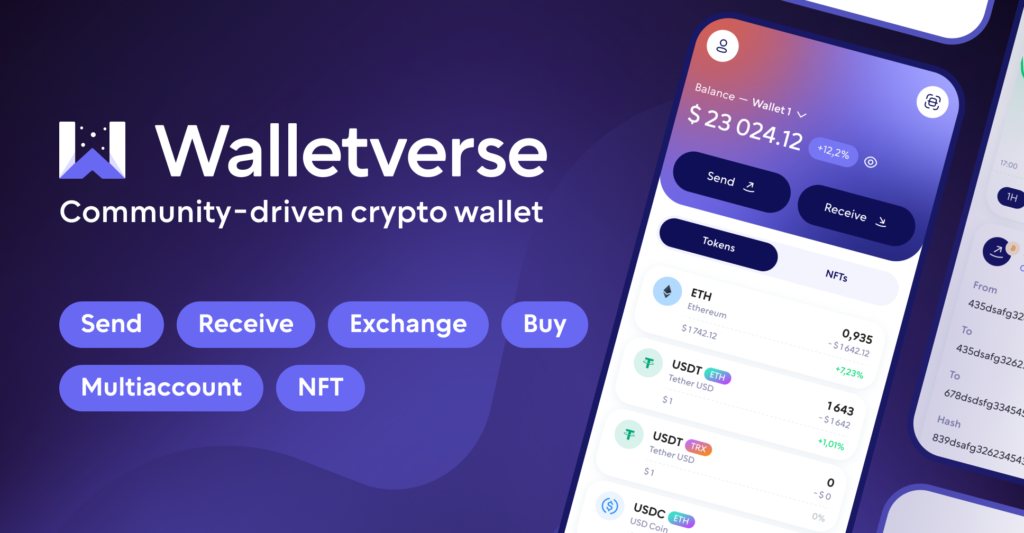
If you already hold other crypto, you don’t need fiat at all: swap it for BTC inside your wallet. Walletverse’s built-in aggregator connects 100+ DEX and CEX venues with more than 10,000 trading pairs. Open the coin you hold, tap Swap, choose BTC and check the quote. Step-by-step guides: XRP to BTC · LTC to BTC · BNB to BTC · DOGE to BTC.


What Is Fiat Currency?
Fiat money is government-issued currency that isn’t backed by a physical commodity like gold — for example, the US dollar, the euro or the British pound (Investopedia). “Buying crypto with fiat” simply means paying for crypto with regular money.
Stablecoins such as USDC aren’t fiat: USDC is a token issued by Circle and backed by cash and cash-equivalent assets (Circle), not a currency issued by a government.
Tips for Your First Bitcoin Purchase
- Start with an amount you can afford to lose. Bitcoin is volatile.
- Secure your wallet first — set a passcode and biometrics and store your recovery details offline before you buy.
- Compare the final BTC amount, not just the advertised fee.
- Check the address whenever you send BTC — payments can’t be reversed (bitcoin.org).
- Keep records of your purchases for taxes; in the US, the IRS treats digital assets as property (IRS).
Risks You Should Know Before Buying
- Bitcoin is volatile. Its price can move sharply within a single day.
- Self-custody means self-responsibility. If you lose both your device and your recovery details, no one — including Walletverse — can restore your funds.
- Transactions are irreversible. Always check the receiving address before you send BTC.
- Crypto isn’t a bank deposit and isn’t covered by deposit-insurance schemes such as FDIC or FSCS.
- The fiat payment is handled by a third-party provider. MoonPay, Simplex, Banxa, Transak and Wert each have their own terms, fees and country restrictions.
- This page is information, not financial advice.
FAQ
Most frequent questions and answers
Install Walletverse, tap Buy, select BTC, enter the amount in USD, EUR or another supported currency, choose a payment provider and pay by card or a local payment method. The BTC arrives in your own wallet, not in a platform account.
Yes, where your chosen provider supports them. Both are the quickest checkout on mobile because you confirm with Face ID or a fingerprint instead of typing card details.
USD, EUR, GBP, CAD, AUD, AED, ARS, KZT and INR are supported, along with additional currencies depending on the provider you choose. If yours is not supported directly, your bank converts it at checkout and the app still shows the exact BTC amount before you confirm.
In your own Walletverse wallet on your device. The private keys are generated and encrypted locally and never leave your phone, so Walletverse cannot access, freeze or move your funds.
Reinstall Walletverse on a new device and restore the wallet with your recovery phrase, or from the encrypted backup you saved to iCloud or Google Drive. Without one of those, the funds cannot be recovered by anyone — that is the trade-off of self-custody.
Yes. You can buy BTC with a card in a wallet app such as Walletverse, or swap other crypto you hold for BTC inside the wallet.


