
How to Buy Bitcoin (BTC) – Best Ways 2026
Bitcoin (BTC) remains the most recognized and valuable cryptocurrency in the world, continuing to attract both new and seasoned investors. The global Bitcoin market continues to experience significant growth, driven by its advantages, such as cheaper and faster payments, its role as a store of value, and secure transactions. Entering 2026, Bitcoin’s market capitalization stands at approximately USD 1.80 trillion, with a dominance of about 55% of the total crypto market . The global Bitcoin market itself was valued at USD 37.84 billion in 2025 and is projected to expand at a compound annual growth rate (CAGR) of 19.5% from 2026 to 2033, reaching an impressive USD 157.37 billion by the end of the forecast period . This growth is attributed to Bitcoin’s dual role as both a store of value and a medium of exchange, with long-term price forecasts suggesting it could reach USD 1.42 million by 2035 as institutional adoption deepens . With Bitcoin, financial transactions no longer require central authorization and are settled immediately, making it an attractive option for global users. In this guide, we will explore how to buy Bitcoin in 2026 and the best strategies for investing in this digital asset.
What is Bitcoin (BTC)?
Bitcoin (BTC) is a decentralized digital currency that was invented in 2008 by an unknown person or group of people using the name Satoshi Nakamoto. It was launched as open-source software in 2009, marking the beginning of the cryptocurrency era. Bitcoin operates on a peer-to-peer network, meaning transactions occur directly between users without the need for intermediaries such as banks or governments. This decentralized nature is one of Bitcoin’s essential features, ensuring that no single entity controls the currency.
Bitcoin is often referred to as “digital gold” because of its limited supply, only 21 million Bitcoins will ever exist. This scarcity, combined with increasing demand, has made Bitcoin a popular investment. It is used both as a medium of exchange for products and services and as a store of value, protecting against inflation and currency devaluation.
How to Buy Bitcoin (BTC) with Credit/Debit Cards
Purchasing Bitcoin with a credit or debit card is one of the most convenient ways to get started with cryptocurrency. Here’s how you can do it:
- Choose a reliable platform. To start, select one of the best platforms to buy Bitcoin, such as Walletverse, Coinbase, or Binance. These platforms are trusted for their security and user-friendly interfaces.
- Sign up and verify your account. Create an account on your chosen platform and complete any necessary identity verification steps. This process typically involves uploading a government-issued ID and possibly a selfie for verification purposes.
- Link your credit or debit card. After setting up your account, link your credit or debit card. Most platforms support major credit card providers like Visa and MasterCard, making it easy to fund your account.
- Make your purchase. Decide how much Bitcoin you want to buy, enter the amount, and confirm the transaction. The secure Bitcoin transactions will be processed instantly, and your BTC will be deposited into your wallet on the platform.
- Transfer to a secure wallet. For added security, consider transferring your Bitcoin from the exchange to a BTC wallet where you control the private keys. This step helps protect your investment from potential exchange vulnerabilities.
Buying Bitcoin (BTC) with Google Pay and Apple Pay
For those who prefer using mobile payment options, buying Bitcoin with Google Pay and Apple Pay offers a quick and secure method:
- Select a compatible platform. Platforms like Walletverse support buying Bitcoin with Google Pay and Apple Pay. Ensure that the platform you choose integrates with these payment methods.
- Link your Google Pay or Apple Pay account. After setting up your account, link your Google Pay or Apple Pay account to the platform.
- Purchase Bitcoin. Choose Bitcoin from the list of available cryptocurrencies, select Google Pay or Apple Pay as your payment method, and confirm the transaction. The purchase is processed instantly, and the BTC is added to your wallet.
- Secure your BTC. As with other payment methods, it’s advisable to transfer your Bitcoin to a secure Bitcoin wallet to ensure its safety.
What Are Other Ways to Buy Bitcoin (BTC)?
While buying Bitcoin with credit/debit cards and mobile payments like Google Pay and Apple Pay are popular methods, there are several other ways to acquire Bitcoin that offer different benefits, depending on your needs and preferences:
- Bank Transfers.
- Direct bank transfers: Many cryptocurrency exchanges allow users to purchase Bitcoin via direct bank transfers. This method is often favored by those who prefer to deal with more significant amounts of money, as it typically involves lower fees compared to card payments. The downside is that bank transfers can take longer to process—usually a few hours to a few days, depending on your bank and the exchange.
- SEPA transfers. In Europe, SEPA (Single Euro Payments Area) transfers are commonly used to buy Bitcoin. SEPA transfers are fast, usually processed within one business day, and come with lower fees, making them a cost-effective option for European users.
- Cryptocurrency exchanges.
- Centralized exchanges. Platforms like Binance, Kraken, and Coinbase are some of the largest and most reputable centralized exchanges where you can buy Bitcoin. These platforms offer a wide range of payment methods, including credit/debit cards, bank transfers, and e-wallets like PayPal. Centralized exchanges are user-friendly and provide advanced trading features, making them suitable for both beginners and experienced traders.
- Decentralized exchanges (DEXs). For those who value privacy and control over their funds, decentralized exchanges (DEXs) like Uniswap and PancakeSwap allow you to buy Wrapped Bitcoin without the need for a central authority. DEXs typically require you to connect your wallet and trade directly with other users. While they offer greater privacy, they may have higher fees and can be more complex to use for beginners.
- Peer-to-peer (P2P) platforms.
- P2P marketplaces. Platforms like LocalBitcoins and Paxful connect buyers and sellers directly, allowing them to negotiate the terms of the trade. P2P platforms offer a wide range of payment options, including cash deposits, bank transfers, gift cards, and even PayPal. This method is beneficial for those who want more flexibility in how they pay for Bitcoin. However, P2P transactions require trust between parties, so it’s essential to choose a platform with a strong reputation and robust security measures.
- Escrow services. Many P2P platforms offer escrow services to protect both buyers and sellers. The platform holds the Bitcoin in escrow until the payment is confirmed, reducing the risk of fraud. Always ensure that the platform you use has a reliable escrow system.
- Crypto ATMs.
- Bitcoin ATMs: In many cities around the world, you can find Bitcoin ATMs that allow you to buy Bitcoin with cash or a debit card. These machines are convenient for quick purchases and are often located in easily accessible places like shopping malls and airports. To use a Bitcoin ATM, you typically scan your wallet’s QR code, insert cash or your card, and send the equivalent amount of Bitcoin to your wallet. While Bitcoin ATMs are convenient, they usually come with higher fees—sometimes up to 10% of the transaction amount.
- Location and accessibility. Bitcoin ATMs are most prevalent in major cities and regions with high cryptocurrency adoption. Websites and apps like CoinATMRadar can help you locate the nearest Bitcoin ATM.
- Bitcoin futures and options.
- Futures trading. For more advanced investors, trading Bitcoin futures contracts on platforms like Binance Futures, CME Group, or BitMEX can be a way to gain exposure to Bitcoin. Futures allow you to speculate on the future price of Bitcoin, either long (betting the price will rise) or short (betting the price will fall). Futures trading is highly speculative and requires a good understanding of the market, as well as a higher risk tolerance.
- Options trading. Similarly, Bitcoin options allow you to buy or sell Bitcoin at a predetermined price before a specific date. Platforms like Deribit and LedgerX offer Bitcoin options trading. This method is also more suitable for experienced traders due to the complexity and risk involved.
- Buy Bitcoin with PayPal.
- Using PayPal. Some platforms, including Coinbase and eToro, allow you to buy Bitcoin using PayPal. This method is particularly appealing to users who already have a PayPal account and want a quick and familiar payment method. While convenient, PayPal transactions might come with higher fees, and not all exchanges support this option.
- Over-the-counter (OTC) trading.
- OTC desks. For those looking to buy large amounts of Bitcoin, over-the-counter (OTC) trading desks provide a private, more personalized service. OTC trades are typically conducted directly between buyers and sellers, often facilitated by a broker, and are ideal for high-volume transactions that might move the market if executed on a public exchange. OTC trading is popular among institutional investors and high-net-worth individuals due to its discretion and the better pricing that it can offer.
Each of these methods offers different advantages and suits different needs, from privacy and control to convenience and speed. When choosing a method to buy Bitcoin, consider your experience level, the amount you wish to invest, and your preferred payment method.
10 Best Place to Buy Bitcoin in 2026?
1. Walletverse
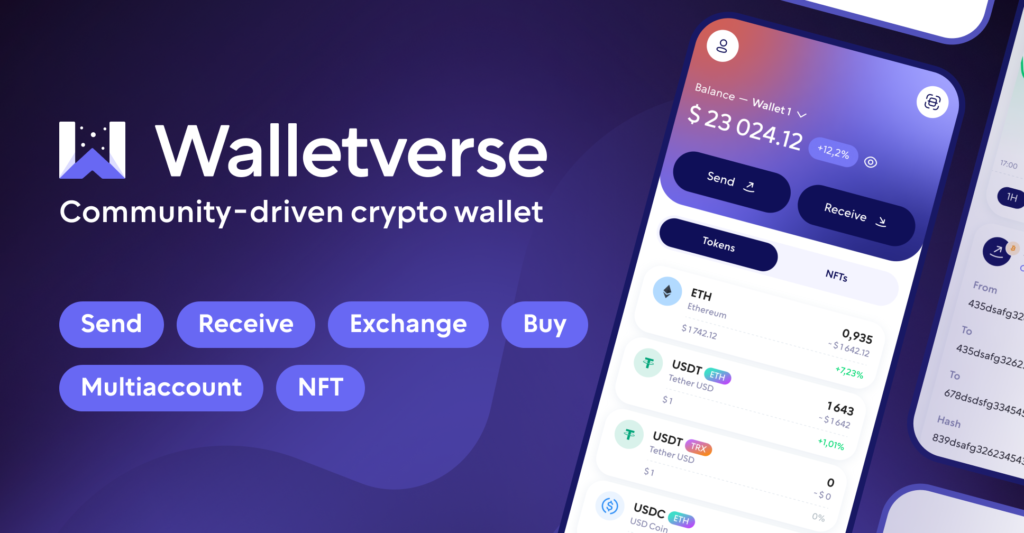
Walletverse is an excellent choice for both beginners and experienced users, offering a seamless and secure experience for buying Bitcoin. It supports multiple payment methods, including Google Pay, Apple Pay, and credit/debit cards, making it accessible and easy to use. As a self-custody wallet, it gives you full control over your private keys.
- Pros: User-friendly interface, multiple payment options, self-custody, supports over 600 cryptocurrencies, strong security with biometric authentication.
- Cons: Only mobile app.
2. Coinbase Wallet
Coinbase is known for its user-friendly interface and robust security features. It’s an excellent option for beginners and supports a wide range of payment methods, including PayPal and bank transfers. The platform also offers educational resources through Coinbase Learn, where users can earn crypto while learning about blockchain.
Pros: Very beginner-friendly, strong regulatory compliance (NASDAQ-listed), FDIC-insured USD balances, extensive educational resources, supports 250+ cryptocurrencies .
Cons: Higher fees compared to competitors (0.40%–0.60% on standard trades, 1.49% for instant buys) .
3. Binance Wallet
Binance is one of the largest cryptocurrency exchanges globally, providing a wide range of cryptocurrencies and advanced trading features. It’s ideal for those who want more control over their trading and investment strategies. The platform offers spot trading, futures, margin trading, staking, and an integrated Web3 wallet.
Pros: Deep liquidity, low trading fees (0.10% maker/taker), 350+ cryptocurrencies supported, SAFU fund ($1B+) for user protection .
Cons: Complex interface may overwhelm beginners, regulatory uncertainty in some regions, 2019 hack ($40M, users reimbursed) .
4. Kraken Wallet
Kraken is well-regarded for its security and regulatory compliance, making it a reliable platform for buying and storing Bitcoin. It offers both a simple interface for beginners and Kraken Pro for advanced traders with lower fees. The platform has never been hacked since its founding in 2011 and publishes regular proof-of-reserves audits.
Pros: Excellent security track record (no major breaches since 2011), proof-of-reserves transparency, Kraken Pro offers low fees (0.16%–0.40%), supports 240+ cryptocurrencies .
Cons: Instant Buy fees are higher (1% + spread), verification can be slow, interface has a moderate learning curve .
5. Bitget
Bitget has emerged as a leading “Universal Exchange” in 2026, offering an all-in-one platform for spot trading, futures, and innovative features like copy trading. It supports over 1,300 cryptocurrencies — the widest selection among major exchanges — and offers the lowest spot trading fees in the industry. The platform maintains a $300M+ Protection Fund and holds ISO 27001:2022 certification.
Pros: Lowest spot fees (0.01% maker/taker), 1,300+ cryptocurrencies supported, $300M+ Protection Fund with on-chain tracking, copy trading with 190,000+ elite traders, demo trading for beginners .
Cons: Newer platform (launched 2018) with shorter track record than Coinbase or Kraken .
6. Gemini
Gemini is a regulated cryptocurrency exchange founded by the Winklevoss twins, offering access to over 150 digital assets. It holds fiduciary status in New York and maintains licenses across multiple jurisdictions, making it ideal for users who prioritize regulatory compliance and institutional-grade security. The platform also features an integrated NFT marketplace through a partnership with Nifty Gateway.
Pros: Strong regulatory compliance (NYDFS-regulated), SOC 2 Type 2 certified, insurance coverage for hot wallet assets, ActiveTrader platform for advanced users .
Cons: Higher fees (0.20%–0.40%) compared to global competitors, limited customer support options (primarily help center) .
7. Bitpanda
Bitpanda is a European-based broker founded in Vienna in 2014, offering a fully regulated platform with BaFin licensing. It supports over 650 cryptocurrencies and enables easy fiat-to-crypto purchases via SEPA, SOFORT, credit cards, PayPal, and more. Bitpanda stores the majority of assets in cold storage and offers the Bitpanda Fusion interface with ultra-low fees (0.02%) for advanced users.
Pros: Fully regulated (BaFin license), 650+ cryptocurrencies supported, multiple payment options, cold storage for security, no deposit/withdrawal fees, 0.02% fees with Bitpanda Fusion .
Cons: Standard broker fees (0.99%) for simple purchases, primarily focused on European market .
8. OKX Wallet
OKX is a major global exchange offering a comprehensive suite of services including spot trading, futures, options, and an integrated Web3 wallet. It supports over 300 cryptocurrencies and maintains a $2.7B+ insurance fund. The platform has expanded its regulatory footprint with licenses in Malta (MFSA), Dubai (VARA), and France (DASP).
Pros: $2.7B+ insurance fund, 300+ cryptocurrencies supported, integrated Web3 wallet, competitive fees, advanced trading tools .
Cons: Paid $505M DOJ settlement in 2025 for operating as unlicensed money transmitter, complex interface may overwhelm beginners .
9. Crypto.com wallet
Crypto.com is a comprehensive cryptocurrency platform that combines a powerful exchange, a non-custodial DeFi wallet, and a crypto Visa card – all within a single app. It allows users to buy Bitcoin with fiat via bank transfer, credit card, Apple Pay, Google Pay, and more. The platform offers competitive fees, recurring buy orders, price alerts, and a user-friendly interface suitable for beginners. Strong security measures include ISO 27001 certification, SOC 2 Type II compliance, and insurance coverage for assets in cold storage.
Pros: All-in-one ecosystem (exchange, wallet, card), multiple fiat purchase methods, attractive staking and cashback rewards, high security with insurance, excellent mobile experience.
Cons: Some advanced features require the native CRO token, withdrawal fees can be higher for certain networks, customer support response times vary.
10. Gate.io Wallet
Gate.io has gained significant market share in 2025–2026, becoming a popular choice for traders seeking access to a wide variety of altcoins. The platform supports over 1,500 cryptocurrencies and offers comprehensive features including spot trading, margin trading, futures, and an integrated Web3 wallet. Recent data shows Gate.io gained nearly 3 percentage points in BTC spot market share over the past year .
Pros: 1,500+ cryptocurrencies supported, gaining market share rapidly, comprehensive trading features, integrated Web3 wallet .
Cons: Not available in all jurisdictions, less beginner-friendly than Coinbase or eToro, smaller user base than Binance .
How to Invest Bitcoin for Beginners?
Investing in Bitcoin as a beginner can be an exciting yet daunting experience. Here’s a step-by-step guide to get you started:
- Start small. Begin with a small investment that you can afford to lose. Bitcoin’s price can be volatile, so it’s wise to start with an amount that won’t significantly impact your finances.
- Educate yourself. Learn about Bitcoin investment strategies and how the cryptocurrency market works. Understanding the basics will help you make informed decisions.
- Choose a secure wallet. Set up a BTC wallet to store your Bitcoin securely. Consider using hardware wallets for long-term storage and software wallets for everyday use.
- Diversify your investments. Don’t put all your funds into Bitcoin. Consider diversifying across other cryptocurrencies or assets to spread your risk.
- Stay updated on market trends. Keep an eye on Bitcoin price predictions for 2025 and market developments. Staying informed will help you adjust your strategy as needed.
- Be patient. Cryptocurrency investments can take time to pay off. Avoid making impulsive decisions based on short-term price movements.
FAQ
Most frequent questions and answers
You can purchase BTC on platforms like Walletverse, Coinbase, or Binance using credit/debit cards, Google Pay, or Apple Pay. Simply sign up, link your payment method, and complete the transaction.
The easiest way to buy Bitcoin is by using a credit or debit card on a reputable platform like Walletverse. You can also use Google Pay or Apple Pay to make quick and convenient purchases.
Bitcoin can be used as a medium of exchange for products and services, as a store of value, or for making secure Bitcoin transactions across the globe. It’s also widely used for investments and as collateral in decentralized finance (DeFi) applications.
As of 2024, Bitcoin has millions of active users worldwide, with a growing number of wallets holding BTC. Its popularity continues to rise as more individuals and institutions recognize its value as both a currency and an investment.
Yes, crypto, particularly Bitcoin, is considered a good investment in 2025-2026 due to its growth potential, secure transactions, and the increasing adoption of cryptocurrencies globally. However, as with any investment, it’s essential to do thorough research and consider your risk tolerance.